Content Menu
● Why Robot Bearings Matter In Real Applications
● Main Types Of Robot Bearings
>> Thin Section Bearings For Compact Designs
>> Roller, Needle, And Cross Roller Bearings
>> High-Precision Angular Contact Ball Bearings
● How To Select Robot Bearings For Real Projects
>> Load And Speed Considerations
>> Space, Environment, And Materials
● Advances In Robot Bearing Technology
>> Miniaturization And Lightweight Designs
● Practical Maintenance Insights From The Field
>> Sealing And Lubrication Best Practices
>> Condition Monitoring And Preventive Care
● Real-World Applications Where Specialized Bearings Excel
● How A Specialized Bearing Partner Supports Your Robotics Project
● Get Expert Support For Your Robot Bearing Design
● FAQs
Modern robots rely on high-precision bearings to move smoothly, position accurately, and operate safely under demanding conditions. From humanoid robots and collaborative arms to radar systems and medical devices, the right bearing design is often the difference between reliable performance and costly downtime. Drawing on years of collaboration with universities, research institutes, and advanced manufacturers, this guide explains how robot bearings work, how to choose them, and where specialized solutions such as precision cross roller bearings and high-precision angular contact ball bearings deliver the most value.

Why Robot Bearings Matter In Real Applications
Robot bearings are not just rotating components—they are motion control elements that directly influence accuracy, stiffness, and service life.
When a six-axis industrial arm places a tiny component on a circuit board, or a surgical robot adjusts an instrument inside the human body, the bearing system must:
– Keep joints moving smoothly under varying loads
– Maintain precise position with minimal backlash
– Resist vibration and tipping moments during rapid starts and stops
In many real-world projects with four-legged robots, humanoid platforms, and collaborative arms, engineers find that upgrading to cross roller bearings or high-grade angular contact ball bearings immediately reduces positioning errors and trajectory deviation. Preloaded designs eliminate internal clearances, improving repeatability and ensuring that robot joints stop exactly where commanded, even after millions of cycles.
Main Types Of Robot Bearings
Thin Section Bearings For Compact Designs
Thin section bearings are designed with a very small cross section while still carrying considerable loads. They are ideal in robotic systems where space and weight are tightly constrained:
– Slim robotic arms with integrated cables and sensors
– Compact rotary tables inside inspection or measurement equipment
– Lightweight exoskeletons and wearable devices
A typical comparison looks like this:
| Bearing Type | Dynamic Load Rating | Static Load Rating | Key Feature | Typical Use Case |
|---|---|---|---|---|
| Thin section bearing | Application-dependent | Application-dependent | Very compact, reduced weight | Slim robot arms, exoskeleton joints |
| Crossed roller bearing XSU080168 (example) | 71 kN | 114 kN | Multi-directional load support, high rigidity | Robot rotary joints, precision rotary tables |
By reducing mass at the joints, thin section bearings help robots accelerate faster, consume less energy, and integrate more sensors or actuators into the same envelope.
Roller, Needle, And Cross Roller Bearings
Roller bearings and needle bearings use cylindrical elements instead of balls, spreading loads over a larger contact area. Needle bearings are particularly useful when the design envelope is narrow but load demands are high.
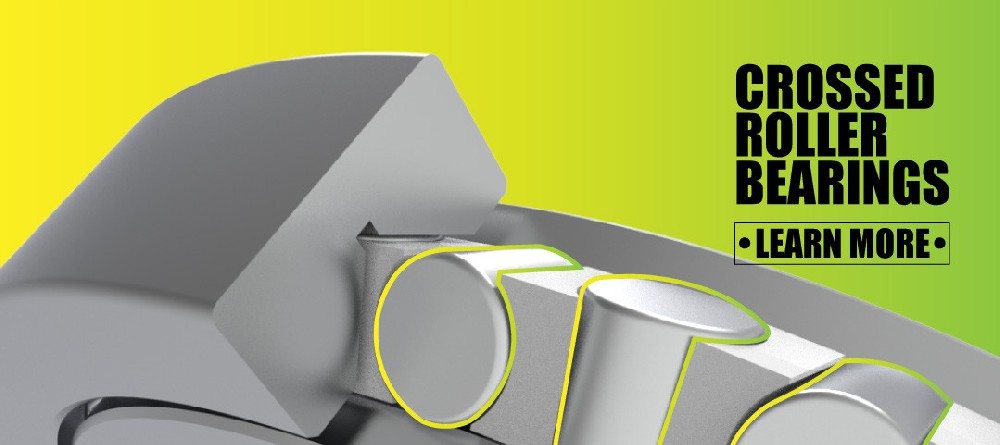
A special configuration, cross roller bearings, arranges rollers at 90 degrees to each other. This structure allows a single bearing to handle:
– Radial loads
– Axial loads in both directions
– Moment loads (tilting and overturning)
Because of their unique geometry, cross roller bearings can be 3–4 times stiffer than standard angular contact ball bearings. In robotic joints, higher stiffness translates directly into:
– More stable end-effector positioning
– Lower deflection during dynamic motions
– Fewer bearings needed per joint, simplifying the design
Cross roller bearings are widely used in:
– Waist and wrist axes of industrial robots
– Precision NC rotary tables
– Medical imaging equipment
– Semiconductor wafer handling systems

High-Precision Angular Contact Ball Bearings
High-precision angular contact ball bearings are the backbone of many high-speed robotic joints, motor spindles, and reducers. By designing the raceways to carry combined radial and axial loads, these bearings:
– Support high rotational speeds
– Maintain accurate axial positioning
– Reduce friction and heat generation
In demanding robot applications—such as DD motors, harmonic and planetary reducers, or high-speed servo axes—engineers often specify precision grades such as P5, P4, and P2, combining:
– Tight dimensional tolerances
– Carefully controlled contact angles
– Advanced materials and heat treatments
These bearings are essential wherever robots must run at high speeds with repeatable positioning over long service life.
How To Select Robot Bearings For Real Projects
Load And Speed Considerations
A common source of failures in robot bearings is mismatched load and speed ratings. Each joint experiences different load conditions:
– Radial loads act perpendicular to the shaft
– Axial loads act along the shaft
– Combined loads occur in complex motions, such as simultaneous rotation and tilting
Before finalizing a design, engineers should calculate or simulate:
– Maximum radial, axial, and moment loads in normal operation
– Peak loads during emergency stops or collisions
– Required speed ranges for rotary and linear motions
For example, rotary joints may run at more than 5,000 rpm, while linear axes can exceed 100 mm/s. Selecting bearings with appropriate precision classes and preload ensures that joints remain stable and accurate at these speeds, without excessive heat or wear.
Practical tip: Always match bearing ratings to actual operating conditions, not just catalog values. Use safety factors for unexpected load spikes and emergency conditions.
Space, Environment, And Materials
Robot bearings rarely operate in ideal conditions. Space constraints, temperature, contaminants, and cleaning requirements all affect the choice of design.
Key factors and typical solutions include:
| Factor | Example Solution | Benefit |
|---|---|---|
| Tight installation space | Thin section bearing | Saves room, reduces overall weight |
| High temperature | Ceramic or heat-resistant steel bearing | Stable performance under extreme heat |
| Dust or liquid exposure | Sealed bearing | Protects rolling elements from contaminants |
| Corrosive chemicals | Corrosion-resistant coating | Extends life in harsh environments |
Depending on the application—such as textile machinery, radar systems, or food-grade packing robots—engineers may combine sealed designs, stainless materials, and special surface treatments to maintain reliability and cleanliness.
Advances In Robot Bearing Technology
Miniaturization And Lightweight Designs
Recent development efforts have focused on miniaturizing bearings to meet the needs of compact robots, wearable systems, and agile collaborative arms. Engineers have achieved:
– Bearing rings up to 50% thinner than conventional designs
– Outside diameters reduced to roughly 90% of earlier generations
– Increased number of rolling elements (often around 50% more)
The result is a bearing that is smaller and lighter, yet can carry higher dynamic and static loads. These advances enable:
– Slim humanoid robot joints with integrated sensors
– Lightweight four-legged robots capable of longer operation on battery power
– Compact medical robots that fit in constrained operating rooms
Industry analyses suggest that miniaturized bearing solutions for robots are growing rapidly, driven by strong demand in electronics manufacturing, medical devices, and advanced automation systems.
Longevity And Reliability
Modern robot bearings are designed to last significantly longer than earlier generations. By optimizing ring geometry, rolling element count, and lubrication systems, manufacturers achieve:
– Dynamic load rating increases of around 10%
– Static load rating improvements of about 30%
– Bearing life extended by approximately 1.3 times in many test cycles
These gains are particularly important in:
– 24/7 industrial robots in automotive and electronics plants
– High-cycle collaborative arms that frequently interact with workers
– AGV platforms and mobile robots with continuous operation schedules
Smart Bearing Solutions
In advanced factories and research labs, smart bearings are increasingly used in robot joints. Integrated sensors monitor:
– Temperature
– Vibration
– Rotational speed
– Lubricant condition
Data from these sensors is fed into monitoring platforms and analytical tools, enabling:
– Real-time condition tracking
– Predictive maintenance planning
– Early detection of misalignment, overload, or lubrication issues
This approach reduces unplanned downtime and helps operators schedule service before failures occur. In high-value applications—such as medical robots, precision measurement systems, or semiconductor processes—smart bearing solutions significantly improve overall equipment effectiveness.
Practical Maintenance Insights From The Field
Sealing And Lubrication Best Practices
As many maintenance teams have learned, even perfectly selected bearings will fail early if sealing and lubrication are neglected. Good practices include:
– Choosing seals suited to dust, moisture, or chemical exposure
– Using the correct grease or oil viscosity for the operating speed and temperature
– Monitoring lubrication film thickness during inspections
Self-lubricating materials and sealed-for-life designs can reduce routine maintenance, but they still benefit from periodic checks—especially in high-duty or high-temperature environments.
Key insight: In industries such as aerospace and food processing, improving lubrication strategies has visibly reduced bearing-related failures and contamination issues.
Condition Monitoring And Preventive Care
Effective preventive maintenance combines visual checks with quantitative monitoring, such as:
– Vibration analysis to spot early damage
– Temperature trend monitoring for overloaded joints
– Noise and clearance checks during scheduled shutdowns
Training technicians to recognize early warning signs—such as unusual noise, heat, or increased backlash—helps avoid catastrophic failures. In demanding environments like mining, marine systems, and heavy handling equipment, careful alignment and monitoring have significantly extended bearing life and reduced replacement costs.
Real-World Applications Where Specialized Bearings Excel
Based on extensive industry experience and project collaboration, specialized robot bearings—especially precision cross roller bearings and high-precision angular contact ball bearings—have proven their value in:
– Four-legged robots and humanoid platforms where joint compactness, high rigidity, and long-term reliability are critical
– Service robots and collaborative arms in logistics, inspection, and assembly tasks operating alongside humans
– Medical robots and imaging systems requiring ultra-smooth, quiet motion with minimal vibration
– Radar systems and communication equipment that demand steady rotation and precise pointing
– High-precision rotary tables, hollow rotary platforms, DD motors, harmonic and planetary reducers where bearing accuracy directly determines motion quality
In these projects, partnering with a bearing manufacturer experienced in custom design, heat treatment, coating technologies, and high-precision grades has been essential to achieving both performance and cost-efficiency.

How A Specialized Bearing Partner Supports Your Robotics Project
Choosing and applying robot bearings is a multi-dimensional engineering task. A capable bearing partner typically provides:
– Application engineering support to match bearing type, preload, and accuracy grade to robot kinematics and duty cycles
– Custom design services for non-standard sizes, special mounting structures, and integrated seals or flanges
– Comprehensive testing and quality control, including hardness checks, dimensional inspection, and load testing
– Long-term collaboration with robot manufacturers, universities, and research institutes to develop solutions for emerging platforms such as exoskeletons, quadruped robots, and humanoid systems
With extensive experience in precision cross roller bearings, thin section bearings, high-precision angular contact ball bearings, and dedicated robot reducer bearings, Henan Yuwei Industrial Technology Co., Ltd. is well positioned to support complex robotics projects in industrial automation, medical devices, intelligent logistics, and defense-related applications.
Get Expert Support For Your Robot Bearing Design
If you are currently designing or upgrading robotic equipment—whether a compact collaborative arm, a four-legged robot, a precision rotary table, or a special-purpose reducer—consider working with a bearing specialist that understands both robot dynamics and precision manufacturing.
Provide your target application, load and speed data, installation space, and environment requirements, and request:
– A tailored bearing selection proposal
– Recommendations on preload, accuracy grade, and sealing
– Guidance on mounting, lubrication, and maintenance plans
Professional support at the design stage helps your robot systems operate more safely, accurately, and economically over their entire lifecycle.
FAQs
Q1. What role do bearings play in robot accuracy?
Bearings directly influence joint stiffness and backlash. High-stiffness designs such as cross roller bearings and precision angular contact ball bearings keep joints stable under dynamic loads, reducing positioning errors and improving repeatability.
Q2. Can the same bearing type be used across all robot joints?
Not usually. Different joints see different combinations of speed, load, and space constraints. Heavy-load axes may require cross roller bearings, while high-speed spindle-like joints are better served by angular contact ball bearings or specialized thin section designs.
Q3. How often should robotic bearings be inspected?
Inspection intervals depend on duty cycle and environment, but many industrial users schedule checks every few months. Condition monitoring tools and smart bearing solutions allow these intervals to be optimized based on real operating data.
Q4. What are the main signs of impending bearing failure in robots?
Common warning signs include rising vibration levels, abnormal temperature, unusual noise, increased backlash, and changes in torque requirements. Early detection allows for planned replacement before major damage occurs.
Q5. Why are miniaturized bearings important for new-generation robots?
Miniaturized bearings support compact, lightweight robot designs, which improve agility, efficiency, and integration of sensors and electronics. They are especially important for humanoid robots, exoskeletons, and collaborative arms where space is limited but performance demands are high.
References
1. Luoyang LIKE Precision Machinery Co., Ltd. “The Ultimate Guide To Understanding Robot Bearings.” [https://lkpbearing.com/the-ultimate-guide-to-understanding-robot-bearings/]
2. Stratview Research. “Robotics Bearings Market Trends, Size, Growth, Forecast, 2026.” [https://www.stratviewresearch.com/market-reports/robotics-bearings-market]
3. CCTY Group. “How Cross Roller Bearings Maximize Precision & Performance.” [https://cctygroup.com/how-cross-roller-bearings-maximize-precision-performance/]
4. Slew Bearing Tec. “Cross Roller Bearing Applications.” [https://www.slewbearingtec.com/cross-roller-bearing-applications.html]
5. HGT Bearing. “Crossed Roller Bearings: The Optimal Solution for Robotic.” [https://hgtbearing.com/Crossed-Roller-Bearings-for-Robotic]
6. Henan Yuwei Industrial Technology Co., Ltd. “What Does Yuwei Bearing Offer? Products & Selling Points.” [https://yuwei-bearing.com/zh/yuwei-bearing-offer-products-selling-points/]
7. Research and Markets. “Bearings Market Report 2026.” [https://www.researchandmarkets.com/reports/5752108/bearings-market-report]
Hot Tags: Robot Bearings, Cross Roller Bearings, Angular Contact Ball Bearings, Precision Robot Components, Industrial Robot Bearings, Humanoid Robot Bearings, Collaborative Robot Bearings, Thin Section Bearings, Robotics Rotary Table Bearings, High Rigidity Bearings