Content Menu
● Understanding Bearing Requirements in Industrial Robots
● What Is a Cross Roller Bearing?
● What Is an Angular Contact Bearing?
● Cross Roller Bearing vs Angular Contact Bearing: Core Comparison
● Stiffness and Load Capacity: Data‑Driven View
● Speed, Efficiency, and Thermal Behavior
● Real‑World Robotics Applications: Where Each Bearing Excels
● Expert Design Insights for Industrial Robot Engineers
● How Henan Yuwei Supports Robotics Bearing Selection
● Practical Selection Steps for Robot Designers
● Case Insight: Robot Wrist Joint
● When to Prioritize Cross Roller Bearings
● When to Prioritize Angular Contact Bearings
● Choosing the Right Bearing Partner
● FAQs
Cross roller bearings and angular contact bearings are two of the most important precision bearing solutions for industrial robots, but they are optimized for different priorities: cross rollers for maximum rigidity and multi‑directional load capacity, angular contact bearings for high speed, flexible configurations, and cost efficiency. Choosing the right solution for an industrial robot joint, rotary table, or actuator comes down to how you balance stiffness, speed, space, and lifecycle cost in your application.

Understanding Bearing Requirements in Industrial Robots
Modern industrial robots and collaborative robots rely on high precision bearings in every joint and rotary axis to achieve repeatable positioning, smooth motion, and long service life.
Typical robotic bearing requirements include:
– High rigidity to minimize elastic deformation under load for accurate positioning.
– Multi‑axis load capacity (radial, axial, and moment loads combined).
– Compact design to fit into narrow robot wrists, hollow shafts, and reducers.
– Stable performance over millions of cycles in demanding environments.
In heavy‑duty robots, precision manipulators, and high‑accuracy rotary stages, engineers commonly choose between cross roller bearings and angular contact bearings to meet these requirements.
What Is a Cross Roller Bearing?
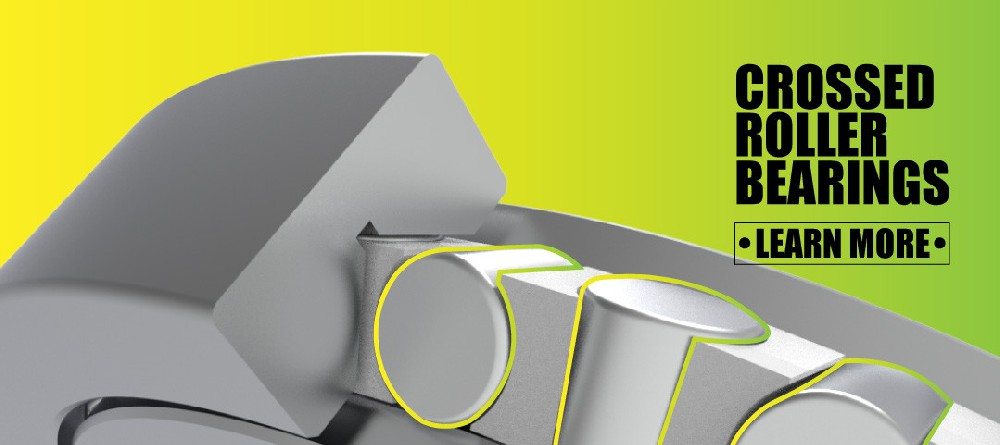
A cross roller bearing uses cylindrical rollers arranged alternately at 90 degrees between the inner and outer rings. This distinctive structure allows a single bearing to handle complex loads.
Key structural features:
– Cylindrical rollers with line contact, not point contact.
– Rollers crossed at right angles, each oriented to support loads in one direction.
– Optimized races for minimal clearance and high stiffness.
Performance characteristics:
– Very high rigidity with minimal elastic deformation under multi‑directional loads.
– Handles radial, axial, and moment loads simultaneously.
– Compact structure, ideal for robot wrists, rotary actuators, and hollow rotary platforms.
– Typically operates at moderate rotational speeds compared with high‑speed ball bearings.
In robotics, cross roller bearings are widely used in industrial robot joints, precision rotary tables, and medical robots where even micron‑level deflection is unacceptable.
What Is an Angular Contact Bearing?
An angular contact bearing is a ball bearing whose inner and outer raceways are offset along the bearing axis, creating a defined contact angle.
Key structural features:
– Ball elements with point contact between ball and raceway.
– Raceways offset to create a contact angle (e.g., 15°, 25°, 40°).
– Often used in pairs or sets (back‑to‑back, face‑to‑face, tandem) to support axial loads in both directions.
Performance characteristics:
– Excellent for combined radial and axial loads in one main direction.
– High‑speed capability, especially in super precision designs and spindle applications.
– Flexible arrangements allow customized stiffness, axial capacity, and pre‑load.
In robotic applications, angular contact bearings are common in high‑speed joints, servo motor supports, and precision spindles where speed and smooth rotation are critical.

Cross Roller Bearing vs Angular Contact Bearing: Core Comparison
Below is a side‑by‑side view of cross roller bearings vs angular contact bearings in industrial robot applications.
| Aspect | Cross roller bearing | Angular contact bearing |
|---|---|---|
| Rolling element | Cylindrical rollers (line contact) | Balls (point contact) |
| Load capacity | Handles radial, axial, and moment loads in a single bearing | Handles combined radial and axial loads; moment loads via pairs/arrangements |
| Rigidity | Very high rigidity, minimal deformation under multi‑directional loads | Medium to high rigidity, improved when used in matched pairs |
| Speed capability | Moderate speed, optimized for stiffness | High speed, suitable for spindles and fast rotating robot joints |
| Space & integration | Compact, often used as single bearing for large robot joints and rotary tables | More flexible arrangements, but may need pairs or sets, increasing space |
| Assembly complexity | Typically simpler — one integrated bearing, no pairing needed | Requires careful pairing and pre‑load setting for optimal performance |
| Cost profile | Higher unit cost, but may replace multiple bearings in one joint | Often more economical per piece, widely available in many sizes |
| Typical robotics use | Robot wrists, industrial rotary stages, precision measurement axes, hollow rotary platforms | Servo motor supports, high‑speed joints, spindles, reducers with elevated speed requirements |
Stiffness and Load Capacity: Data‑Driven View
From a joint‑design perspective, stiffness determines how much the axis deflects under load. Recent comparison data between cross roller bearings and angular contact bearings shows:
– Axial stiffness
– Cross roller bearings: ≈ 200–800 N/μm
– Angular contact bearings: ≈ 150–500 N/μm
– Radial stiffness
– Cross roller bearings: ≈ 300–1200 N/μm
– Angular contact bearings: ≈ 200–700 N/μm
The reason behind this difference is the line contact in roller bearings versus point contact in ball bearings.
– Line contact distributes load over a larger area, reducing stress and deformation.
– Point contact concentrates stress, which suits high speed but limits maximum stiffness.
For heavy‑load robot joints, precision rotary tables, and measurement axes, engineers consistently prefer cross roller bearings when rigidity is the top priority.
Speed, Efficiency, and Thermal Behavior
For high‑speed industrial robots and automation systems, especially those with fast pick‑and‑place cycles or high‑speed spindles, the choice often shifts toward angular contact bearings.
Angular contact bearing advantages at speed:
– Lower friction due to ball point contact.
– Better thermal behavior at high rotational speeds.
– Easier to design for high‑speed motor shafts and spindles with standard sizes and lubrication practices.
Cross roller bearings can handle moderate speeds with excellent accuracy, but in very high‑speed environments, thermal management and lubrication become more challenging. This makes them more suitable for slow‑to‑medium speed precision axes rather than ultra‑fast rotations.
Real‑World Robotics Applications: Where Each Bearing Excels
In modern robotic systems, engineers typically allocate cross roller bearings and angular contact bearings to different roles.
Cross roller bearings are widely used in:
– Industrial robot wrists and rotary joints carrying high loads and requiring tight positioning.
– SCARA robot swiveling units and precision rotary tables.
– Hollow rotary platforms and DD motor outputs where stiffness and accuracy dominate.
– Medical robots and vision systems needing low deflection under multi‑axis loads.
Angular contact bearings are widely used in:
– Servo motor shafts, reducers, and drive units needing high speed and smooth torque.
– High‑speed spindles in machining centers and robotic machining cells.
– General robot joints with moderate loads but high cycle counts and speed demands.
– Thin‑section angular contact designs providing space‑saving solutions in compact joints.
This division allows system designers to build hybrid solutions, for example:
– A robot wrist using a cross roller bearing for the main output axis, combined with angular contact bearings in upstream gearboxes and motors.
– A collaborative robot joint using thin‑section angular contact bearings where speed and compactness outrank extreme stiffness.
Expert Design Insights for Industrial Robot Engineers
From a practical engineering perspective, the decision between cross roller bearings vs angular contact bearings in industrial robots often comes down to a few critical questions:
1. What is the main performance priority—rigidity or speed?
– If maximum rigidity and positioning accuracy are essential, cross roller bearings are typically favored.
– If high rotational speed and dynamic response are key, angular contact bearings are the natural choice.
2. What load combinations will the joint see?
– For significant radial, axial, and moment loads all at once, cross roller bearings handle these in a single unit.
– For mainly radial loads with defined axial components, angular contact bearings in pairs offer robust and flexible solutions.
3. How much space is available in the joint?
– Cross roller bearings can reduce component count by replacing multiple bearings with one compact unit.
– Angular contact bearings may require paired configurations, but thin‑section variants help save space.
4. What is the assembly and maintenance strategy?
– Cross roller bearings simplify assembly because they often come as pre‑adjusted units.
– Angular contact bearings require careful pre‑load control, alignment, and sometimes more frequent inspection in high‑speed use.
How Henan Yuwei Supports Robotics Bearing Selection
Henan Yuwei Industrial Technology Co., Ltd. focuses on precision cross roller bearings and high precision angular contact ball bearings for advanced robotic and automation applications. Leveraging long‑term cooperation with universities and research institutes, the company has developed specialized bearings for:
– Four‑leg robots, service robots, industrial and collaborative robots
– SCARA robots, medical robots, exoskeleton robots, humanoid robots, special‑purpose robots
– AGV vehicles, medical equipment, communication radars, precision measurement instruments
– CNC machine tools, industrial rotary tables, hollow rotary platforms, DD motors, harmonic and planetary reducers
By offering dedicated series such as:
– Precision cross cylindrical roller bearings, high‑rigidity cross roller bearings, thin‑wall cross roller bearings, double‑row cross roller bearings.
– High precision, high speed, and long‑life angular contact ball bearings.
Henan Yuwei helps robotics engineers tailor bearing solutions to each axis according to load, speed, duty cycle, and environmental conditions.
Practical Selection Steps for Robot Designers
To choose between cross roller bearings vs angular contact bearings for a specific industrial robot project, engineers can follow a structured approach grounded in field experience and current bearing technology.
Step 1: Define axis function and priorities
– Identify whether the axis is a precision positioning stage, a high‑speed rotating joint, or a structural support.
– Rank priorities: rigidity, speed, space, noise, and cost.
Step 2: Quantify loads and motion profile
– Calculate radial, axial, and moment loads, including worst‑case scenarios.
– Define speed ranges, duty cycle, and required accuracy (e.g., repeatability in microns).
Step 3: Map requirements to bearing type
– If the axis demands exceptional stiffness and multi‑directional load capacity, select a cross roller bearing.
– If the axis is dominated by high speed and combined radial/axial loads, select angular contact bearings, potentially in paired configurations.
Step 4: Consider integration with reducers and motors
– Align bearing choice with harmonic reducers, planetary reducers, and DD motors used in the system.
– Ensure bearing stiffness and preload support the overall transmission accuracy.
Step 5: Validate with prototypes and testing
– Run dynamic tests for vibration, thermal behavior, and positioning accuracy.
– Adjust bearing pre‑load, lubrication, and mounting to optimize performance.

Case Insight: Robot Wrist Joint
In a typical industrial robot wrist joint, the balance between stiffness and speed is particularly sensitive. Experience from both robotics designers and bearing specialists suggests the following pattern:
– Use a cross roller bearing as the main output bearing of the wrist rotary actuator. This achieves:
– High stiffness against tilting moments from payloads and sudden motion changes.
– Excellent position accuracy for end‑effector orientation.
– Reduced component count and compact integration.
– Use angular contact bearings in upstream servo motors and reducers where higher rotational speeds and lighter loads predominate. This provides:
– Smooth, efficient rotation at higher speeds.
– Flexible configurations for axial load management and pre‑load tuning.
This layered approach combines the strengths of both bearing types in a single robotic axis to achieve stable, precise, and efficient motion.
When to Prioritize Cross Roller Bearings
As an industry practitioner, there are clear scenarios where cross roller bearings are the preferred choice in industrial robots:
– The axis must hold heavy payloads with minimal deflection (e.g., large industrial robot shoulders and wrists).
– The system requires micron‑level accuracy in rotary stages or measurement equipment.
– There is exposure to complex combined loads, including constant radial forces plus changing axial and moment loads.
– Space is limited and a single integrated bearing is more practical than multiple paired bearings.
In these situations, the investment in cross roller bearings yields higher stability, better repeatability, and longer life under demanding conditions.
When to Prioritize Angular Contact Bearings
Conversely, angular contact bearings remain the better solution where:
– The main requirement is high rotational speed with controlled combined radial and axial loads.
– The axis design benefits from standardized bearing sizes and arrangements.
– Cost efficiency and availability across many sizes are important.
– The joint will operate with moderate loads but high cycle frequency, such as in fast pick‑and‑place robots.
In these cases, precision angular contact bearings provide the balance of speed, cost, and sufficient stiffness required by many industrial and collaborative robot applications.
Choosing the Right Bearing Partner
For robot manufacturers, selecting between cross roller bearings vs angular contact bearings is only part of the challenge. Equally important is working with a bearing partner that can:
– Provide application‑specific design guidance, not only catalog data.
– Offer both standard and customized bearing solutions for unique robot joints.
– Support long‑term reliability testing, quality assurance, and traceability.
Henan Yuwei Industrial Technology Co., Ltd. combines production capabilities with joint research projects and long‑term cooperation with academic institutions to deliver bearings that match real‑world robotic requirements, from light collaborative robots to specialized radar and measurement platforms. With stable quality and competitive performance, these bearings have been widely adopted across multiple provinces and exported to markets in North America, Europe, Asia, and South America.
Conclusion
If you are designing or upgrading industrial robots, rotary tables, or precision automation systems and need to decide between cross roller bearings vs angular contact bearings, consider engaging directly with a specialist bearing manufacturer. By sharing your load data, speed profiles, and accuracy requirements, you can receive tailored recommendations, sample configurations, and prototype support to ensure each robotic axis uses the most suitable bearing solution.
Henan Yuwei Industrial Technology Co., Ltd. welcomes engineering teams and purchasing managers to discuss upcoming projects and explore how precision cross roller bearings and high precision angular contact bearings can help your robots move more safely, accurately, and efficiently.
FAQs
1. Are cross roller bearings always better than angular contact bearings for robotics?
No. Cross roller bearings provide superior rigidity and multi‑directional load capacity, but angular contact bearings are better for high‑speed applications and can be more cost‑effective in moderate‑load robot joints.
2. Can angular contact bearings replace cross roller bearings in robot wrists?
In many high‑load wrist joints, replacing cross roller bearings with angular contact bearings would reduce stiffness and increase deflection. However, in lighter‑duty or high‑speed wrists, well‑paired angular contact bearings can be a viable alternative.
3. Why are cross roller bearings common in hollow rotary platforms?
Hollow rotary platforms often carry significant axial and moment loads while needing precise positioning. Cross roller bearings support these loads in a single compact bearing, making integration easier and improving accuracy.
4. When should thin‑section angular contact bearings be used in robots?
Thin‑section angular contact bearings are ideal when space is very limited but the axis needs high speed and moderate rigidity, such as in compact collaborative robot joints and small manipulators.
5. How do I decide the contact angle for angular contact bearings in a robot joint?
The contact angle should be chosen based on the ratio of radial to axial loads and the required stiffness. Larger contact angles support higher axial loads and stiffness but may slightly reduce speed capability.
References
1. Machine Design – *Introduction to Bearings in Humanoid Robots*
[https://www.machinedesign.com/mechanical-motion-systems/article/55250781/ccty-introduction-to-bearings-in-humanoid-robots-what-roboticists-need-to-know] [machinedesign]
2. Patsnap Eureka – *Cross‑Roller vs Angular Contact Bearing Stiffness Comparison*
[https://eureka.patsnap.com/report-cross-roller-bearings-vs-angular-contact-bearings-stiffness-comparison] [eureka.patsnap]
3. Bearings Direct – *Bearings for Robotics, Automation Systems, and Industrial Robots*
[https://bearingsdirect.com/blog/bearings-for-robotics-automation-systems-and-industrial-robots] [bearingsdirect]
4. PIB Sales – *Precision Bearings for Robotic Applications*
[https://pibsales.com/bearings/precision-bearings-for-robotic-applications/] [pibsales]
5. PRS Bearings – *Difference Between Crossed Roller Bearings and Angular Contact Ball Bearings*
[https://www.prsbearings.com/a/news/difference-between-crossed-roller-bearings-and-angular-contact-ball-bearings.html] [prsbearings]
6. RigBRS Bearing – *Bearings for Industrial Robots*
[https://www.rigbrsbearing.com/bearings-for-industrial-robots/] [rigbrsbearing]
7. SMB Bearings – *Automation and Robotic Bearings Guide*
[https://www.smbbearings.com/automation-and-robotic-bearings-guide] [smbbearings]
8. Emerson Bearing – *Precision Bearings for Robotic Automation*
[https://blog.emersonbearing.com/blog/precision-bearings-robotic-applications] [blog.emersonbearing]
9. Norck Robotics – *High‑Precision Bearings*
[https://www.norckrobotics.com/collections/high-precision-bearings] [norckrobotics]
10. USHGT – *Application: Robot Industry*
[https://www.ushgt.com/robot-industry/] [ushgt]
Hot Tags: Cross Roller Bearing, Angular Contact Bearing, Industrial Robot Joint, Precision Robot Bearings, Robotics Rotary Table, Hollow Rotary Platform, DD Motor Bearing, Harmonic Reducer Bearing, Planetary Reducer Bearing, Collaborative Robot Bearing