Content Menu
● Understanding Robotic Joint Requirements
● What Is an Angular Contact Ball Bearing?
● What Is a Four‑Point Contact Ball Bearing?
● Load Handling: Axial, Radial and Moment
● Stiffness, Accuracy and Backlash
● Speed, Friction and Thermal Behavior
● Space, Weight and Integration with Robot Structures
● Typical Robotic Joint Use Cases
● Expert Insights on Design Trade‑Offs
● How Henan Yuwei Supports Robotic Joint Design
● Practical Selection Steps for Robotic Engineers
● When to Choose Each Bearing Type
● Robotic OEMs and Integrators
● FAQs
Angular contact ball bearings and four-point contact ball bearings each play a critical role in robotic joints, but they excel in different conditions. Choosing the right bearing for a robot arm, humanoid or collaborative robot joint depends on load direction, stiffness, speed, space constraints and lifecycle costs.
Understanding Robotic Joint Requirements
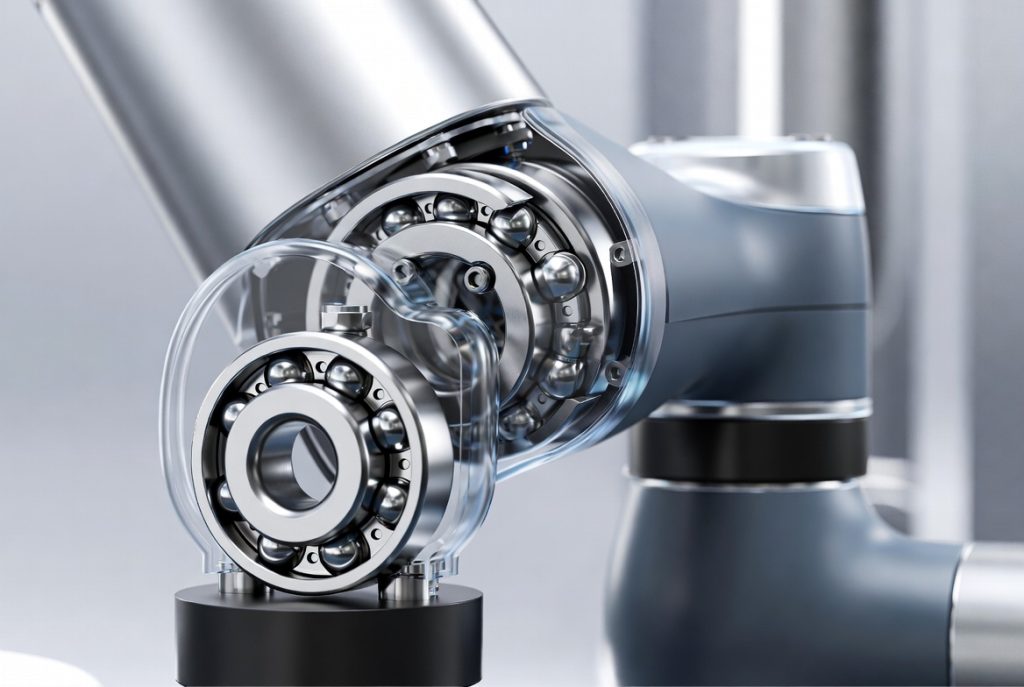
Robotic joints – from four‑legged robots and humanoids to industrial arms and AGV steering modules – demand joints that are:
– Highly precise, with repeatable positioning over millions of cycles.
– Capable of handling combined loads: radial, axial and moment loads from acceleration, deceleration and payload changes.
– Compact and lightweight, especially in elbow, wrist and ankle joints where every gram and millimeter matter.
– Stable under dynamic motion, with minimal deflection and backlash to keep trajectories accurate.
In my work with robotic OEMs and integrators, I see two recurring questions: how to balance stiffness versus speed, and how to minimize joint size without sacrificing reliability. Angular contact and four‑point contact ball bearings address these questions differently and are often evaluated side by side in design reviews.
What Is an Angular Contact Ball Bearing?
An angular contact ball bearing uses a single row of balls and raceways oriented at an angle to the radial plane. This geometry allows the bearing to support radial loads and high axial loads in one direction, and, when used in pairs, axial loads in both directions.
Key characteristics:
– Single‑direction axial capacity for one bearing; bidirectional axial capacity when used in matched pairs (face‑to‑face or back‑to‑back).
– High speed capability thanks to point contact and optimized cage designs.
– Good running accuracy suitable for precision machinery, robotic joints and machine tool spindles.
In robotic joints, angular contact ball bearings are often paired and preloaded to remove internal clearance and provide a more rigid, backlash‑free arrangement.
What Is a Four‑Point Contact Ball Bearing?
A four‑point contact ball bearing is a specialized single‑row angular contact bearing with split inner or outer rings. Each ball can touch the raceway at four discrete points, enabling a single bearing to carry axial loads in both directions and radial loads in a compact form factor.
Key characteristics:
– Bidirectional axial load support with one bearing, replacing two conventional angular contact bearings in many cases.
– Compact axial width, important when space envelope is limited (robot wrists, compact gearboxes).
– Moderate radial capacity, with axial load ratio typically dominant.
Four‑point contact designs are widely used in robotic joints, precision gearboxes and rotary tables where space and weight savings are critical, and bidirectional axial loads are significant.
Load Handling: Axial, Radial and Moment
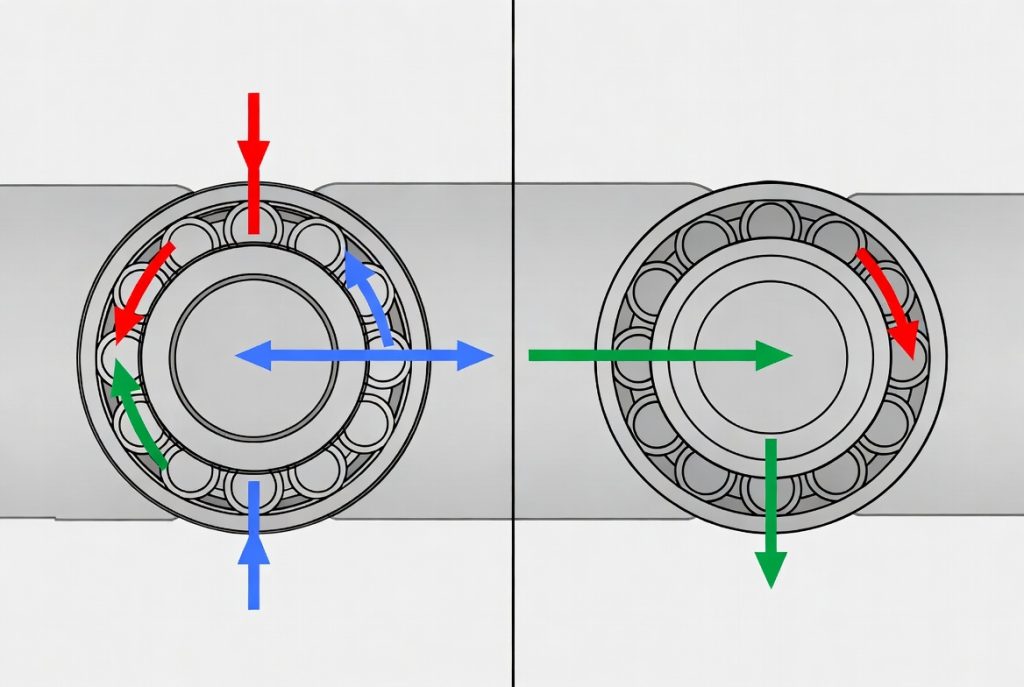
From a design engineer’s perspective, understanding load paths is essential.
Angular contact ball bearings:
– Handle radial loads and high axial loads in one direction per bearing.
– Typically arranged in pairs to support axial loads both ways and improve stiffness.
– When properly preloaded, paired angular contact bearings provide reliable support for combined radial and axial loads but rely on surrounding structure and layout to resist moment loads.
Four‑point contact ball bearings:
– Support axial loads in both directions and moderate radial loads with a single row.
– Particularly suitable when axial load dominates and space is tight.
– Often combined with a separate radial bearing when heavy radial loads or high moment loads are present.
In robotic joint applications, four‑point contact bearings are attractive for:
– Robot wrists that need bidirectional axial load capacity and compactness.
– Lightweight articulated arms where replacing two angular contact bearings with one four‑point contact bearing reduces size and mass.
However, for joints that see heavy radial loads and significant overturning moments – for example, base or shoulder joints in industrial robots – designers frequently pair angular contact ball bearings or select crossed roller bearings for higher stiffness and moment capacity.
Stiffness, Accuracy and Backlash
Robotic joints must maintain positional accuracy under dynamic loads. The difference between angular contact and four‑point contact ball bearings becomes clear here.
Angular contact ball bearings:
– Offer good stiffness when properly preloaded, especially in paired arrangements.
– Provide acceptable running accuracy for many industrial robots and collaborative systems.
– Because contact is at points and deformations are elastic, deflection under high loads is higher than line‑contact roller designs.
Four‑point contact ball bearings:
– Offer compact stiffness in axial directions thanks to four contact points.
– When correctly loaded, they maintain close axial clearance and can be tuned to limit backlash in precision gearboxes and robot joints.
– Their single‑row construction, however, limits ultimate stiffness compared with paired angular contacts or crossed roller bearings.
From industry experience and published performance metrics, crossed roller bearings provide 3–4× higher rigidity than angular contact ball bearings in comparable envelopes and achieve rotational accuracy in the 2–5 arcsecond range for premium applications. This is why high‑precision robots, DD motor rotary tables and hollow‑shaft platforms often favor cross roller designs, while angular and four‑point contact ball bearings are chosen when speed, cost or geometry constraints dominate.
Speed, Friction and Thermal Behavior
In fast‑moving robotic joints – particularly high‑speed pick‑and‑place arms or lightweight service robots – bearing friction and thermal behavior directly influence performance.
Angular contact ball bearings:
– Designed for high rotational speeds with low friction torque.
– Suitable for spindles, high‑speed actuators and robot axes that must accelerate rapidly without excessive heat build‑up.
– In high‑speed robotic wrists, paired angular contacts with optimized lubrication often deliver superior performance.
Four‑point contact ball bearings:
– Also capable of significant speeds, but load distribution over four contact points and split ring geometry require careful load management to avoid excessive contact stress or slip.
– Under mixed radial–axial loading, ensuring the correct load ratio is crucial so that balls make stable contact on intended raceway surfaces.
Designers typically choose angular contact ball bearings for joints where speed and smoothness are paramount, and the space is sufficient for paired arrangements. Four‑point contact bearings are preferred when axial load flexibility and compactness are more important than ultimate speed.
Space, Weight and Integration with Robot Structures
Modern robots – especially humanoids, exoskeletons and collaborative arms – face tight constraints on diameter, thickness and weight.
Angular contact ball bearings:
– When used in pairs, require additional axial space and careful arrangement (face‑to‑face or back‑to‑back) to achieve desired stiffness and load sharing.
– Increase joint thickness and assembly complexity but allow fine‑tuning via preload and selection of contact angle.
Four‑point contact ball bearings:
– Combine bidirectional axial support into a single, narrow bearing, improving space utilization.
– Can directly interface with gearboxes, harmonic drives or hollow rotary platforms, simplifying joint architecture.
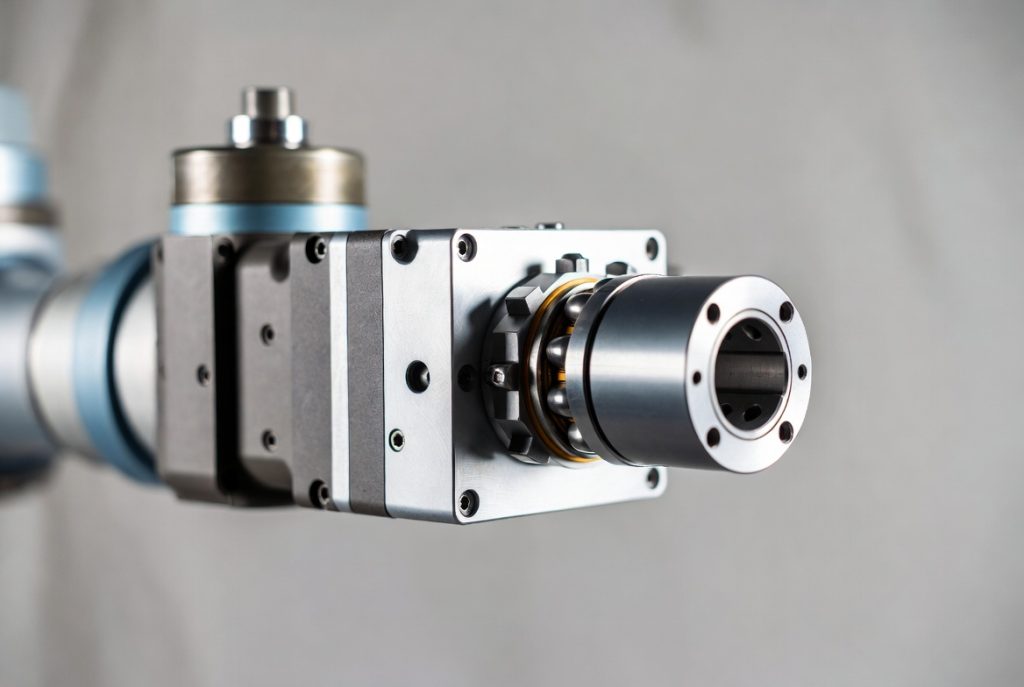
In practice, robot designers often specify four‑point contact bearings for compact actuators, elbow and wrist joints where every millimeter of axial width matters, while angular contact bearings dominate in larger joints where structural robustness is the priority.
Typical Robotic Joint Use Cases
Drawing on current applications in industrial, service and medical robotics, the following patterns are common:
– Robot base and shoulder joints
Prefer paired angular contact ball bearings or crossed roller bearings due to higher required stiffness, larger radial loads and significant overturning moments.
– Wrist and end‑effector joints
Frequently use four‑point contact ball bearings to support bidirectional axial loads in a compact envelope, especially in integrated gearhead designs.
– Compact actuators and small robot arms
Alternate between four‑point contact bearings and paired angular contacts depending on the balance between space savings, stiffness requirements and budget.
– High‑precision rotary platforms, DD motor joints, measurement systems
Often employ crossed roller bearings to achieve ultra‑high rigidity and sub‑micron repeatability.
Expert Insights on Design Trade‑Offs
From discussions with bearing engineers and robotics teams, several practical insights stand out:
– Stiffness vs. compactness:
When stiffness and moment capacity are paramount (heavy payloads, long arms), paired angular contacts or crossed rollers are preferred. When compactness and axial width dominate, four‑point contact bearings become compelling.
– Cost vs. performance:
A single four‑point contact bearing can replace two angular contact bearings, reducing part count and potentially lowering cost, but only if the load ratings and stiffness meet the application’s needs.
– Load direction uncertainty:
In joints where axial loads can reverse frequently and unpredictably – such as humanoid ankle joints during dynamic walking – four‑point contact bearings offer flexibility, while angular contact designs require careful pairing and preload planning.
These insights align with the trend towards integrated, compact joints where actuators, bearings and sensors are combined within a single module.
How Henan Yuwei Supports Robotic Joint Design
Henan Yuwei Industrial Technology Co., Ltd. develops and manufactures high‑precision angular contact ball bearings and customized special bearings for robotic and automation applications. With long‑term cooperation with universities and research institutes, the company has completed multiple research and test projects, including bearings for four‑legged robots, service robots, industrial robots, collaborative robots, SCARA robots, medical robots, exoskeletons and humanoid robots.
For robotic joint applications, Henan Yuwei can:
– Provide high‑speed and long‑life angular contact ball bearings specifically optimized for robot axes.
– Design and engineer special bearings for radar vehicles, AGV platforms, precision measuring instruments and hollow rotary tables.
– Work in co‑development programs with robot manufacturers to select the optimal bearing type – angular contact, four‑point contact or crossed roller – based on joint load cases, stiffness requirements and integration constraints.
This combination of in‑house manufacturing and collaborative engineering helps robotic OEMs shorten design cycles and improve joint reliability.
Practical Selection Steps for Robotic Engineers
For engineers evaluating angular contact ball bearing vs four‑point contact bearing for a specific robotic joint, a structured selection approach is essential:
1. Define load cases precisely
Quantify radial, axial and moment loads across operating conditions, including worst‑case scenarios such as emergency stops and maximum payload.
2. Determine priority: stiffness or compactness
Decide whether rigidity and positional accuracy or space and weight savings drive the design. For high‑precision joints, consider cross roller solutions; for compact actuators, four‑point contact bearings may be attractive.
3. Evaluate bearing arrangements
Compare a paired angular contact solution against a single four‑point contact bearing, checking static and dynamic load ratings, stiffness, backlash behavior and anticipated service life.
4. Assess integration with gearboxes and motors
Review how the bearing interfaces with harmonic drives, planetary reducers, hollow shafts and DD motors. Confirm lubrication, sealing and mounting provisions.
5. Validate through testing
Prototype the joint with the shortlisted bearing type, instrument it for deflection, temperature and noise, and verify performance against positional accuracy and repeatability targets.
Henan Yuwei’s engineering team can support each step with application‑specific simulations, test data and customized bearing designs, ensuring the chosen solution matches both mechanical and operational requirements.
Summary Comparison Table
| Criterion | Angular Contact Ball Bearing | Four‑Point Contact Ball Bearing |
|---|---|---|
| Axial load capacity | High, in one direction per bearing, bidirectional in pairs | High, bidirectional axial load with a single bearing |
| Radial load capacity | Good radial load support in single or paired arrangements | Moderate radial load support, often with separate radial bearing for heavy loads |
| Stiffness and backlash | Good stiffness when preloaded in pairs; moderate compared with cross rollers | Compact axial stiffness; lower overall stiffness than paired angular or crossed rollers |
| Speed capability | Excellent high‑speed performance with low friction torque | Good speed capability; requires careful load management at four contact points |
| Space and weight | Requires more axial space when used in pairs | Saves axial space and weight by replacing two bearings with one |
| Typical robotic joint use | Base, shoulder and heavy‑load joints; general robot axes | Compact wrist joints, integrated gearheads, lightweight arms |
| Integration complexity | More components and preload management in paired setups | Simpler, single‑bearing solution; careful matching of load ratios needed |
When to Choose Each Bearing Type
For robotic joint applications, a practical guideline is:
– Choose angular contact ball bearings when:
– The joint carries significant radial and axial loads, especially in one main direction.
– High speed and smooth running are essential.
– There is enough axial space for paired bearings and the design requires fine‑tuned stiffness.
– Choose four‑point contact ball bearings when:
– Axial loads occur in both directions and must be handled by a single, compact unit.
– Space and weight are constrained and component count should be minimized.
– Combined loads are moderate and a separate radial bearing handles heavier radial forces.
Working with a bearing specialist such as Henan Yuwei allows robotic manufacturers to combine standard high‑precision angular contact bearings with customized four‑point or crossed roller solutions, creating optimized joint architectures for humanoids, service robots, industrial arms and special equipment.
Robotic OEMs and Integrators
If you are designing or upgrading robotic joints and need to decide between angular contact ball bearings and four‑point contact ball bearings, consider partnering with a manufacturer that can supply high‑precision bearings and application engineering support. Henan Yuwei Industrial Technology Co., Ltd. offers precision angular contact ball bearings, specialized cross roller bearings and custom solutions for robotic joints, hollow rotary platforms, DD motors and precision reducers.
You can engage with Henan Yuwei’s technical team to:
– Review your joint load cases and performance targets.
– Select or customize the most suitable bearing type and structure.
– Co‑develop and validate bearings in prototype and mass production phases.
This collaborative approach helps ensure that each robotic joint delivers stable, precise and reliable motion over its entire lifecycle.
FAQs
Q1: Can a four‑point contact ball bearing always replace a pair of angular contact ball bearings in a robot joint?
A: Not always. A four‑point contact bearing can replace two angular contacts when the axial and radial load ratings, stiffness and life requirements are met. In high‑load or high‑precision joints, a paired angular contact or crossed roller solution may still be necessary.
Q2: Which bearing type is better for high‑speed robot wrist joints?
A: For very high speed with smooth motion and controlled heat generation, angular contact ball bearings – especially in optimized paired arrangements – are often preferred. Four‑point contact bearings can work at significant speeds but require careful load control and may not match the highest speed performance of angular contacts.
Q3: How do I decide between angular contact and four‑point contact bearings when space is limited?
A: When axial space is tight and bidirectional axial loads are present, four‑point contact bearings provide clear advantages. However, you must verify that their stiffness and load capacity are adequate; if extreme rigidity or high overturning moments are required, a more robust solution such as paired angular contacts or crossed roller bearings may be justified.
Q4: Are crossed roller bearings a replacement for angular contact and four‑point contact ball bearings in robotics?
A: Crossed roller bearings are not a direct replacement but an alternative for joints that demand maximum stiffness, minimal backlash and very high positional accuracy, such as precision rotary tables and high‑end industrial robots. They typically offer higher rigidity and accuracy but may involve different cost and integration considerations.
Q5: What support can a bearing manufacturer provide during robotic joint development?
A: A capable bearing manufacturer can assist with load analysis, bearing selection, custom bearing design, prototype testing and long‑term reliability assessment, ensuring that each joint uses the most suitable bearing type and geometry for its specific application. Henan Yuwei’s experience with robot bearings, radar vehicles, measuring instruments and precision platforms enables such collaborative development.
References
1. NSK. “Angular Contact Ball Bearings – Product Overview.” [https://www.nsk.com/am-en/products/bearings/ball-bearings/angular-contact-ball-bearings/]
2. LKPBearing. “Deep Groove Ball Bearing Vs. Angular Contact Ball Bearing.” [https://lkpbearing.com/deep-groove-ball-bearing-vs-angular-contact-ball-bearing/]
3. Lily Bearing. “Understanding Axial and Radial Load Capacity in Angular Contact Ball Bearings.” [https://www.lily-bearing.com/resources/blog/understanding-axial-and-radial-load-capacity-in-angular-contact-ball-bearings]
4. LQYS Bearings. “Four-Point Contact Ball Bearing vs Angular Contact Bearing: Which One to Choose?” [https://www.lqysbearings.com/news/four-point-contact-ball-bearing-vs-angular-contact-bearing-which-one-to-choose/]
5. Neuweg Tech. “Four Point Bearings: Solutions for Load Handling.” [https://neuweg-tech.com/four-point-ball-bearings-machinery-design-experts/]
6. Schaeffler. “Four Point Contact Bearings – Rolling Bearings.” [https://medias.schaeffler.us/en/knowledge-center/rolling-bearings/four-point-contact-bearings]
7. SKF USA via Machine Design. “Why Crossed Roller Bearings Dominate Precision Robotics and Automation.” [https://www.machinedesign.com/mechanical-motion-systems/video/55376218/skf-usa-why-crossed-roller-bearings-dominate-precision-robotics-and-automation]
8. HGT Bearing. “Crossed Roller Bearings for Robotic Arms: Achieving Positional Accuracy.” [https://hgtbearing.com/Crossed-Roller-Bearings-for-Robotic]
9. IKON. “Industrial Robots Demand Versatile Crossed Roller Bearings.” [https://ikont.com/technical-resources/technology-blog/industrial-robots-demand-versatile-crossed-roller-bearings/]
10. CCTY Group. “How Cross Roller Bearings Maximize Precision & Performance.” [https://cctygroup.com/how-cross-roller-bearings-maximize-precision-performance/]
Hot Tags: Angular Contact Ball Bearing, Four Point Contact Bearing, Robotic Joint Design, Industrial Robot Joint Bearing, Humanoid Robot Bearings, Collaborative Robot Joint Solutions, Crossed Roller Bearings, High Precision Angular Contact Bearings, Robotic Gearbox Bearing Solutions, Henan Yuwei Industrial Bearings