In the world of precision automation, a single speck of rust can bring an entire production line to a halt. For industries operating in “Wet Labs” environments involving high humidity, liquid chemicals, or frequent wash-downs—standard hardware simply isn’t enough.
To maintain accuracy and speed, engineers and procurement managers are turning to Tough Corrosion Resistant Robot Joint Bearings. These specialized components are the “elbows” and “shoulders” of robotic arms, designed to survive where water and chemicals usually cause destruction.
Why Standard Bearings Fail in Wet Labs
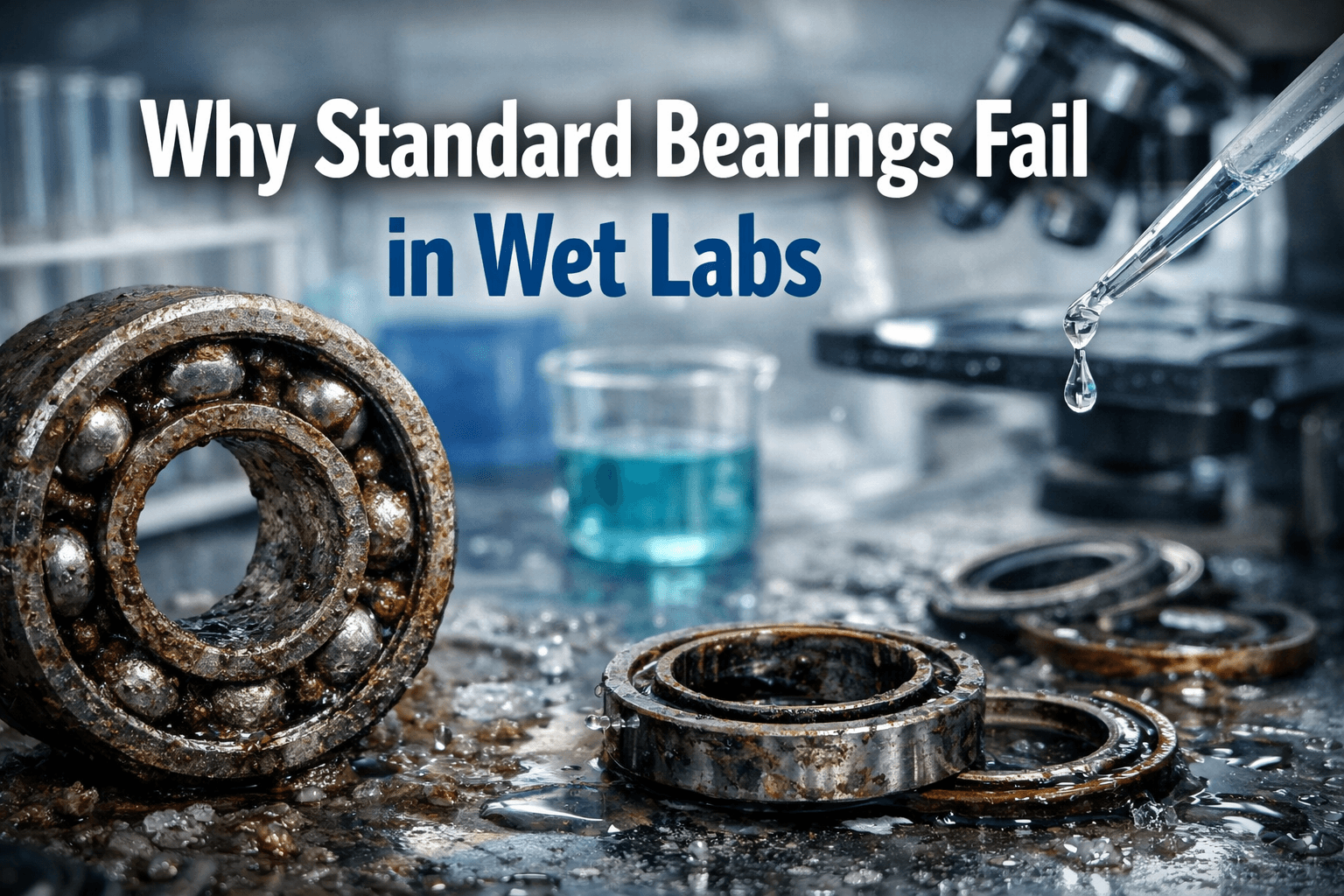
Most industrial bearings are made of chrome steel. While strong, chrome steel reacts quickly with moisture to form iron oxide (rust). In a robotic joint, rust leads to:
-
Pitting: (Small holes or craters forming on the metal surface).
-
Seizure: (When the bearing gets stuck and stops rotating).
-
Contamination: (Rust flakes falling into sensitive lab samples).
To solve this, corrosion resistant robot arm joint bearings use advanced materials that chemically “ignore” water and harsh cleaning agents.
The Anatomy of a Tough Joint Bearing
What makes these bearings “tough”? It comes down to three main engineering choices:
1. Premium Materials
Instead of standard steel, these bearings often use AISI 440C Stainless Steel (a high-grade metal that resists rusting while remaining very hard) or Nitride Ceramics (non-metal balls that can never rust). In extreme cases, they may feature passivation (a chemical treatment that adds a protective “skin” to the metal).
2. Specialized Seals
A bearing is only as good as its shield. For wet labs, manufacturers use IP69K-rated seals (the highest level of protection against high-pressure water and dust). These seals act like a waterproof jacket, keeping the internal balls dry and the lubricant inside.
3. Water-Repellent Lubrication
Standard oil washes away in water. “Tough” bearings use Synthetic Polyurea Greases (thick lubricants that stay sticky even when sprayed with water). This ensures the robot joint moves smoothly without needing constant maintenance.
Strategic Benefits for Suppliers and Manufacturers
For those in the bearing industry, offering corrosion-resistant solutions is a high-value business move.
-
Lower Total Cost of Ownership (TCO): (The total money spent on a part over its entire life, including repairs). While these bearings cost more upfront, they last 5x longer than standard parts, saving the customer money in the long run.
-
Reduced Downtime: (The time a machine is broken and not making money). In B2B sales, “reliability” is the biggest selling point.
-
遵守: Many wet labs work in the medical or food sectors. Using RoHS-compliant (materials free from hazardous substances) bearings ensures the final robot meets international safety laws.
Common Applications in Modern Labs
Where exactly do these corrosion resistant robot joint bearings work?
-
Chemical Sampling: Robots moving test tubes through acidic vapors.
-
Cold Storage: Automated arms in freezers where condensation (water droplets forming from temperature changes) is a constant threat.
-
Cleanroom Washdowns: Equipment that must be sprayed with bleach or alcohol to stay sterile.
结论
Choosing the right bearing is an investment in the “health” of your robot. By prioritizing corrosion resistant robot joint bearings, manufacturers can guarantee their machines will perform with high 重复性 (the ability of a robot to return to the exact same spot every time) without the fear of rust-related failure.
If you are building or maintaining robots for harsh, wet environments, the shift to corrosion-resistant technology isn’t just an upgrade—it’s a necessity for survival.
Stop rust and downtime with 宇威轴承. Your trusted partner for tough, corrosion-resistant robot joints. Order your high-precision samples today!