Content Menu
● Quick Answer: Which Bearing Is Better?
● Small Angular Contact Bearing vs Cross Roller Bearing: Core Comparison
● What Is a Small Angular Contact Bearing?
>> Where Small Angular Contact Bearings Perform Best
● What Is a Cross Roller Bearing?
● Why Rigidity Matters in Miniature Automation Devices
● Load Capacity: Understand the Real Load Case
>> Practical Load Review Checklist
● Speed and Friction: The Angular Contact Bearing Advantage
● Moment Capacity: The Cross Roller Bearing Advantage
● Installation Space and System Simplification
● Expert Selection Guide for Miniature Automation Devices
>> Choose a Small Angular Contact Bearing When
>> Choose a Cross Roller Bearing When
>> Consider a Hybrid System When
● Precision, Preload, and Repeatability
● Mounting Practices That Protect Bearing Accuracy
● Application Example: Compact Robot Wrist Axis
● Work With a Bearing Manufacturer Early
● FAQ
>> 1. Can a cross roller bearing replace two angular contact bearings?
>> 2. Are small angular contact bearings better for high speed?
>> 3. Why are cross roller bearings used in robot joints?
>> 4. What is the biggest installation risk for cross roller bearings?
>> 5. Do angular contact bearings require preload?
>> 6. Can cross roller bearings be used in high-speed applications?
>> 7. Which bearing is better for a hollow rotary platform?
>> 8. What information should I provide for a custom bearing recommendation?
Choosing between a small angular contact bearing and a cross roller bearing can determine whether a miniature automation device achieves smooth, repeatable motion or develops vibration, positioning error, heat, and premature wear. For compact robots, precision rotary modules, small radar platforms, medical instruments, AGV steering systems, and miniature machine-tool assemblies, the best bearing is not necessarily the smallest or lowest-cost option—it is the one that matches the real load path, required stiffness, rotational speed, mounting space, and accuracy target.
As a manufacturer focused on precision cross roller bearings and high-precision angular contact ball bearings, Henan Yuwei Industrial Technology Co., Ltd. regularly evaluates applications where designers must balance compact dimensions, high rigidity, rotational accuracy, and long operating life. In practice, small angular contact bearings are often preferred for high-speed shaft systems, while cross roller bearings are often selected for compact rotary joints that must support radial load, axial load, and overturning moment in one bearing arrangement.
This guide explains the engineering differences, selection risks, and practical use cases of small angular contact bearing vs cross roller bearing for miniature automation devices.

Quick Answer: Which Bearing Is Better?
A small angular contact bearing is usually the better choice when the device operates at relatively high speed and the primary design requirement is efficient, low-friction rotation around a shaft.
A cross roller bearing is usually the better choice when a miniature automation device needs high rotational stiffness, high moment-load capacity, compact installation, and stable positioning under combined loading.
The deciding factor is simple:
– Choose an angular contact ball bearing when speed, low torque, and spindle-style support are the priority.
– Choose a cross roller bearing when rigidity, compactness, moment capacity, and precision rotary positioning are the priority.
– Use a properly matched bearing arrangement when the application requires both high speed and high structural stiffness.
Neither design is universally superior. The correct choice depends on the motion system.
Small Angular Contact Bearing vs Cross Roller Bearing: Core Comparison
| Comparison Factor | Small Angular Contact Bearing | Cross Roller Bearing |
|---|---|---|
| Rolling elements | Balls | Cylindrical rollers arranged alternately at 90 degrees |
| Primary strength | High-speed rotation and low friction | High rigidity and combined-load support |
| Radial load capacity | Good | High |
| Axial load capacity | Strong in one direction per bearing; paired arrangements support both directions | Supports axial load in both directions |
| Moment-load capacity | Usually requires paired bearings and adequate spacing | High moment capacity in one compact bearing |
| Rotational stiffness | Moderate to high, depending on preload and arrangement | Typically very high |
| Speed capability | Generally better for high-speed applications | Usually lower than ball bearings at comparable size |
| Installation space | Often needs a duplex pair or multiple bearings | Can replace a multi-bearing arrangement |
| Typical miniature use | Small spindles, motors, pumps, high-speed shafts | Robot joints, rotary tables, hollow platforms, indexing modules |
| Mounting sensitivity | Preload, orientation, and paired arrangement are important | Housing flatness, mounting accuracy, bolt tightening, and preload are important |
| Cost structure | Often economical for standard sizes | Often higher per bearing but may reduce system-level parts |
The main design distinction is that an angular contact ball bearing is usually part of a bearing system, while a cross roller bearing can often function as a compact, integrated rotary support.
What Is a Small Angular Contact Bearing?
A small angular contact bearing uses balls running between raceways designed with a contact angle. This geometry allows the bearing to carry a combination of radial load and axial load.
Because the load travels through the balls at an angle, an individual angular contact ball bearing usually carries axial load mainly in one direction. For bidirectional thrust loads, designers commonly use a matched pair or a multi-bearing arrangement.
Common arrangements include:
– Back-to-back arrangement, often used to increase moment stiffness.
– Face-to-face arrangement, which can better tolerate some alignment variation.
– Tandem arrangement, used where axial load capacity in one direction must be increased.
– Universal matching, allowing bearings to be combined in predetermined configurations.
For miniature automation equipment, small angular contact bearings are valuable because they offer low friction, good speed capability, and accurate shaft guidance. They are frequently used in compact servo motors, miniature spindles, small pumps, precision drives, encoder shafts, gearboxes, and high-speed rotating instruments.
Where Small Angular Contact Bearings Perform Best
Small angular contact bearings are often the right choice when the design includes a rotating shaft and the bearing set can be spaced apart to create structural support.
Typical examples include:
– High-speed miniature motor shafts.
– Compact CNC spindle assemblies.
– Dental and medical handpiece mechanisms.
– Optical scanning devices.
– Miniature compressor shafts.
– Precision gearbox input shafts.
– Small centrifugal pump assemblies.
– High-speed rotary encoders.
Their key advantage is efficient high-speed motion. Ball-to-raceway contact produces lower rolling resistance than line-contact roller designs, helping reduce heat generation at elevated rotational speeds.
However, this does not mean an angular contact bearing is automatically the best option for every compact rotary axis. If the device must resist a large overturning moment in a very short axial length, a standard bearing pair may require more space than the designer can afford.
What Is a Cross Roller Bearing?
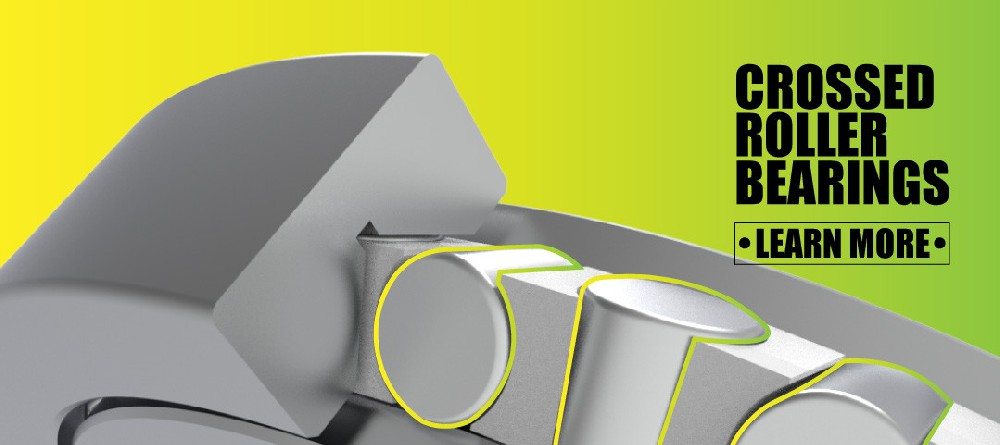
A cross roller bearing uses cylindrical rollers positioned alternately at right angles. One roller is oriented to carry radial loading, while the next roller is oriented to support axial loading. This crossed arrangement enables the bearing to handle radial loads, axial loads in both directions, and overturning moments within one compact structure.
In miniature automation devices, this feature is particularly valuable. A robot joint, rotary actuator, or hollow rotation platform often experiences complex forces rather than a simple radial load. The bearing may need to support the weight of an end effector, acceleration forces, cable drag, off-center payloads, and repeated start-stop motion.
A properly selected precision cross roller bearing can provide:
– High rotational rigidity.
– Excellent resistance to tilting moment.
– Compact axial installation length.
– Stable accuracy under combined loading.
– Support for axial load in both directions.
– Potential to simplify the mechanical structure.
Cross roller bearings are widely used in industrial robots, collaborative robots, SCARA robots, service robots, quadruped robots, humanoid robots, medical robots, radar systems, CNC rotary tables, direct-drive motors, harmonic reducers, planetary reducers, and precision measurement equipment.
Why Rigidity Matters in Miniature Automation Devices
Miniature equipment does not always mean light-duty equipment. In fact, compact systems can experience very high localized loads because the structure has limited lever-arm length and limited space for reinforcement.
Consider a small robotic wrist. The payload may be modest, but the gripper is mounted at a distance from the joint center. During rapid acceleration, the wrist creates an overturning moment that can cause angular deflection. Even a small amount of deflection can affect vision alignment, pick-and-place repeatability, dispensing accuracy, screwdriving quality, or sensor positioning.
This is where the difference between bearing types becomes clear.
A small angular contact bearing pair can provide good support, but its final stiffness depends on several system-level factors:
– Distance between the two bearings.
– Bearing contact angle.
– Preload level.
– Shaft stiffness.
– Housing stiffness.
– Machining accuracy.
– Assembly quality.
A cross roller bearing can provide high moment rigidity in a shorter structure because it is designed to support multiple load directions within one bearing. For compact robotic joints and rotary positioning stages, this can reduce the need for a long bearing span.
The bearing is not the entire structure. Housing rigidity, mounting surface quality, fastener torque, shaft geometry, and preload selection all influence final motion accuracy.

Load Capacity: Understand the Real Load Case
The most common bearing-selection mistake is choosing based only on the weight of the moving component. Static payload weight is only one part of the load case.
A miniature automation device may experience:
– Radial load from belts, gears, pulleys, or external tooling.
– Axial load from thrust, clamping, lead screws, or vertical motion.
– Moment load from off-center payloads.
– Shock load from emergency stops or collisions.
– Dynamic load from acceleration and deceleration.
– Vibration from servo motion, gear meshing, or process equipment.
– Reversing load from repeated direction changes.
For an angular contact bearing arrangement, the designer must determine how the load distributes across the bearing pair. The position of the load relative to the bearing span matters greatly.
For a cross roller bearing, the designer must still verify radial, axial, and moment ratings separately. A high moment rating does not mean the bearing can tolerate unlimited speed, shock load, or poor mounting conditions.
Practical Load Review Checklist
Before selecting a small angular contact bearing or cross roller bearing, gather the following information:
1. Maximum radial load and normal operating radial load.
2. Axial load in both directions.
3. Maximum overturning moment.
4. Continuous rotational speed and peak speed.
5. Acceleration, deceleration, and reversing frequency.
6. Required positioning repeatability.
7. Acceptable axial runout and radial runout.
8. Available shaft diameter, housing diameter, and axial space.
9. Ambient temperature and heat sources.
10. Lubrication method and maintenance interval.
11. Expected operating hours and duty cycle.
12. Shock, vibration, dust, moisture, or corrosive exposure.
This information helps the bearing supplier recommend the correct internal clearance, preload class, accuracy grade, lubrication, sealing approach, and mounting configuration.
Speed and Friction: The Angular Contact Bearing Advantage
For high-speed miniature automation systems, angular contact ball bearings often offer a clear advantage. Balls create point contact with raceways, which generally produces lower rolling friction than the line contact between cylindrical rollers and raceways.
This helps angular contact bearings operate efficiently in applications where speed is the major requirement.
Examples include:
– Compact motorized spindles.
– High-speed inspection stations.
– Small engraving and drilling units.
– Precision grinding heads.
– Miniature pumps.
– High-speed rotor assemblies.
– Medical rotary instruments.
However, speed capability is affected by more than bearing type. The final allowable speed depends on:
– Bearing size.
– Cage design.
– Contact angle.
– Preload.
– Lubricant type and quantity.
– Heat dissipation.
– Balance quality.
– Shaft and housing fit.
– External load.
– Seal friction.
A heavily preloaded angular contact bearing can gain stiffness but generate more heat. A lightly preloaded arrangement may run cooler but offer lower positional stability. The optimal configuration requires a practical balance between stiffness, speed, temperature, and life.

Moment Capacity: The Cross Roller Bearing Advantage
Cross roller bearings are particularly effective when the rotating component faces a significant tilting moment. This is common in robotic arms, camera platforms, radar mechanisms, rotating sensors, end-effectors, and compact rotary tables.
For example, a robot wrist may hold a lightweight gripper, but the gripper’s center of gravity may sit far from the rotational axis. When the robot accelerates, the resulting moment can create angular displacement at the joint.
If angular displacement is excessive, the robot may experience:
– Reduced placement repeatability.
– Tool misalignment.
– Poor visual inspection accuracy.
– Inconsistent force-control performance.
– Increased vibration during direction changes.
– Uneven wear in gears or reducers.
A high-rigidity cross roller bearing can improve system stability because it supports moment loads directly within the bearing structure. This is one reason cross roller bearings are widely adopted in compact precision rotary axes.
For many miniature automation devices, the important question is not “How much weight can the bearing carry?” It is “How much angular deflection will the system produce under the actual operating moment?”
Installation Space and System Simplification
Space is one of the most important constraints in miniature automation design. Designers may need to route electrical cables, pneumatic tubing, optical fibers, sensors, motor components, reducers, and fasteners through a limited envelope.
A small angular contact bearing solution may require:
– Two bearings.
– A shaft with accurate bearing seats.
– Spacers or preload adjustment components.
– Retaining nuts.
– A longer housing.
– Additional structural support.
A cross roller bearing may reduce the number of parts because it can support combined loads in one unit. In some designs, it can also support a hollow center structure that allows cables or shafts to pass through the axis.
This can be beneficial for:
– Hollow rotary platforms.
– Robot joints with internal cable routing.
– Direct-drive motor axes.
– Compact radar positioning systems.
– Medical imaging equipment.
– Lightweight collaborative robot modules.
Still, cross roller bearings demand accurate mounting surfaces. Uneven housing faces, poor flatness, uneven bolt tightening, or distorted mounting rings can reduce rotational smoothness and service life.
Expert Selection Guide for Miniature Automation Devices
Use the following decision path when comparing a small angular contact bearing and a cross roller bearing.
Choose a Small Angular Contact Bearing When
– The rotating shaft runs at high speed.
– Friction and temperature control are critical.
– The main loads are radial and axial rather than high overturning moment.
– The design can accommodate a matched bearing pair.
– A longer bearing span is acceptable.
– The application requires a conventional spindle-style arrangement.
– The system uses a precision shaft with well-controlled fits.
Choose a Cross Roller Bearing When
– The device has limited axial space.
– The rotary axis must resist moment load.
– High stiffness is more important than maximum speed.
– Radial, axial, and moment loads act together.
– The mechanism requires precise indexing or positioning.
– The design benefits from a hollow center.
– The bearing can be installed on sufficiently rigid, accurate mounting surfaces.
Consider a Hybrid System When
Some advanced automation systems use both bearing concepts in different locations.
For example:
– A high-speed motor shaft may use small angular contact bearings.
– A robot wrist output axis may use a cross roller bearing.
– A compact reducer input shaft may use angular contact bearings.
– The reducer output flange may use a cross roller bearing.
This approach places each bearing type where its strengths matter most.
Precision, Preload, and Repeatability
Preload is a critical topic for both bearing types. It removes internal clearance and increases rigidity, but excessive preload can raise friction, temperature, and wear.
For small angular contact bearings, preload is commonly achieved through matched bearing arrangements, spacers, springs, or axial adjustment.
For cross roller bearings, preload may be built into the bearing design or controlled through selection of the appropriate clearance or preload classification.
A good preload strategy should consider:
– Required positioning accuracy.
– Rotational torque limit.
– Operating speed.
– Heat generation.
– Thermal expansion.
– Expected external load.
– Lubrication conditions.
– Service-life target.
In miniature automation, excessive preload can be as harmful as insufficient preload. A bearing that feels “tight” during manual assembly may produce unacceptable torque, heat, or servo load during continuous operation.
Measure the operating result, not just the assembly feel. Evaluate torque, temperature rise, vibration, runout, and repeatability after installation.
Mounting Practices That Protect Bearing Accuracy
Even the best precision bearing can underperform if the surrounding components are inaccurate. This is especially important for thin-section cross roller bearings and small high-precision angular contact bearings.
Follow these practical guidelines:
1. Machine shaft and housing seats to the recommended tolerance.
2. Keep mounting shoulders clean, square, and free from burrs.
3. Check housing face flatness and perpendicularity.
4. Avoid hammering directly on bearing rings.
5. Apply force only to the ring being press-fitted.
6. Use a cross-pattern sequence when tightening mounting bolts.
7. Apply specified tightening torque consistently.
8. Verify rotational torque after mounting.
9. Confirm axial and radial runout before final assembly.
10. Use the correct grease or oil quantity for the operating speed.
11. Protect the bearing from abrasive contamination.
12. Record installation conditions for repeat production.
For robotic and medical automation projects, it is also wise to test the complete mechanism under realistic acceleration, payload, and reversal cycles. A bearing can perform well in a static inspection but behave differently during rapid motion.
Application Example: Compact Robot Wrist Axis
Imagine a compact six-axis industrial robot designed for electronics assembly. The wrist must rotate a gripper and camera module at moderate speed while maintaining precise orientation during pick-and-place motion.
The engineering team initially considers a pair of small angular contact bearings. This approach may work if the bearing span is adequate and the wrist housing is long enough. However, the design also requires a hollow center for cable routing and has a short axial envelope.
In this situation, a precision cross roller bearing may be the more efficient solution because it can:
– Support radial, axial, and moment load in one compact structure.
– Improve angular rigidity at the wrist output.
– Reduce the number of bearing-related components.
– Create a more compact rotary joint.
– Help maintain tool orientation during acceleration and deceleration.
By contrast, if the same robot includes a high-speed motor driving a small reducer, angular contact ball bearings may be the better choice for the motor shaft due to their lower friction and stronger high-speed characteristics.
This illustrates the central selection principle: choose the bearing according to the motion function, not only the outside diameter.
Work With a Bearing Manufacturer Early
Bearing selection should begin before the mechanical design is frozen. Early technical discussion can prevent expensive redesigns involving shaft diameters, housing geometry, lubrication paths, fastener patterns, or reducer interfaces.
For a useful technical evaluation, prepare:
– Bearing drawing or installation envelope.
– Shaft and housing dimensions.
– Maximum and normal load values.
– Rotational speed range.
– Required rigidity or allowable deflection.
– Accuracy and runout requirements.
– Duty cycle and target life.
– Lubrication preference.
– Operating environment.
– Annual purchasing quantity.
– Existing model number, if replacement is required.
Henan Yuwei Industrial Technology Co., Ltd. supplies precision cross roller bearings and angular contact ball bearing solutions for robotics, rotary platforms, CNC equipment, reducers, radar systems, medical equipment, and other advanced automation applications. A properly defined technical requirement helps identify whether a high-rigidity cross roller bearing, a high-speed angular contact bearing, or a custom bearing solution is the right route.
Conclusion
When comparing a small angular contact bearing vs cross roller bearing for miniature automation devices, the choice comes down to the type of motion and load the system must manage.
Small angular contact bearings are highly effective for compact, high-speed shafts where low friction, thermal control, and conventional duplex arrangements are practical. Cross roller bearings are especially valuable for compact rotary axes that demand high rigidity, bidirectional axial support, moment-load resistance, and precise positioning.
The right solution is not based on bearing size alone. It depends on the entire system: load direction, speed, acceleration, installation space, structural stiffness, lubrication, mounting accuracy, and required repeatability.
Send Henan Yuwei Industrial Technology Co., Ltd. your drawing, installation dimensions, load data, speed range, accuracy requirement, and annual volume estimate to receive a targeted bearing recommendation and quotation for your miniature automation project.
FAQ
1. Can a cross roller bearing replace two angular contact bearings?
In many rotary-axis applications, yes. A cross roller bearing can support radial load, axial load in both directions, and overturning moment in one compact unit. However, replacement should only be confirmed after reviewing speed, load, mounting geometry, rigidity, and lubrication requirements.
2. Are small angular contact bearings better for high speed?
Generally, yes. Angular contact ball bearings are often better suited to high-speed shaft applications because ball contact typically creates less rolling friction than cylindrical roller contact. Final speed capability still depends on preload, lubrication, cage design, bearing size, seal type, and heat control.
3. Why are cross roller bearings used in robot joints?
Robot joints often face combined radial, axial, and moment loads. A cross roller bearing provides high rigidity in a compact design, helping the joint maintain orientation and positioning stability during payload movement, acceleration, and direction reversal.
4. What is the biggest installation risk for cross roller bearings?
Poor mounting accuracy is a major risk. Uneven mounting faces, inadequate housing stiffness, improper bolt torque, contamination, or installation distortion can create uneven load distribution, increased torque, vibration, and shorter bearing life.
5. Do angular contact bearings require preload?
Many precision angular contact bearing systems use preload to increase stiffness and reduce axial or radial clearance. The preload level must be selected carefully because too much preload can increase friction, heat, and wear.
6. Can cross roller bearings be used in high-speed applications?
They can operate at moderate speed when correctly selected and lubricated, but they are generally not the first choice for very high-speed shaft systems. Designers should evaluate rotational speed, friction torque, heat generation, lubrication method, and duty cycle before selection.
7. Which bearing is better for a hollow rotary platform?
A cross roller bearing is often a strong option for a hollow rotary platform because it can provide high rigidity and combined-load capacity in a compact ring-shaped structure. The hollow center can accommodate cables, air lines, optical components, or a shaft.
8. What information should I provide for a custom bearing recommendation?
Provide the installation drawing, inner and outer dimensions, radial load, axial load, overturning moment, speed, acceleration, duty cycle, accuracy target, lubrication method, operating environment, and expected annual quantity. This allows the manufacturer to evaluate load rating, bearing structure, preload, accuracy grade, and mounting requirements.
References
1. [Henan Yuwei Industrial Technology Co., Ltd. — Precision Bearing Manufacturer]
2. [Henan Yuwei Industrial Technology Co., Ltd. — About the Super Precision Bearing Factory]
3. [Crossed Roller Bearings and Angular Contact Ball Bearings for Precision Motion Systems]
4. [Yuwei Bearing Industry News: Angular Contact Ball Bearings for Advanced Automation Equipment]
5. [NSK — Angular Contact Ball Bearings]
7. [Schaeffler — Rolling Bearing Technical Principles]
Hot Tags: Small Angular Contact Bearing, Cross Roller Bearing, Angular Contact Ball Bearing, Precision Cross Roller Bearing, Miniature Automation Bearings, Robot Joint Bearings, High Precision Bearings, High Rigidity Bearing, Rotary Table Bearing, Industrial Robot Bearings