Content Menu
>> Cylindrical Roller Bearings
>> Spherical Roller Thrust Bearings
>> Cam Followers and Track Roller Bearings
● Roller Bearing Selection Factors
● How to Select a Bearing Step by Step
>> 2. Define Accuracy and Rigidity Targets
>> 3. Evaluate Speed, Lubrication, and Heat
>> 4. Design for Cleanliness and Correct Mounting
● When Crossed Roller Bearings Are the Better Choice
● Partner With a Precision Bearing Manufacturer
● FAQs
>> What is the difference between a roller bearing and a ball bearing?
>> Which roller bearing handles combined radial and axial loads?
>> Why are crossed roller bearings used in robots?
>> Can spherical roller bearings handle misalignment?
>> What causes premature roller bearing failure?
>> How do I choose a bearing for a hollow rotary platform?
>> Can a customized bearing improve machine performance?
Roller bearings are essential components in machines that require controlled rotary or linear motion under load. From industrial gearboxes and conveyor systems to robot joints, radar platforms, machine-tool rotary tables, and medical equipment, the right roller bearing type directly affects accuracy, stiffness, service life, heat generation, and maintenance requirements.
For engineering teams, selecting a roller bearing is not simply a matter of matching bore diameter and load rating. The bearing must also suit the load direction, moment load, operating speed, mounting space, lubrication method, alignment condition, required positioning accuracy, and working environment. This guide explains the major roller bearing types and provides a practical framework for choosing the right solution for demanding equipment.

What Is a Roller Bearing?
A roller bearing is a rolling-element bearing that uses cylindrical, tapered, spherical, or needle-shaped rollers between raceways. Compared with plain bearings, roller bearings reduce sliding friction and can carry substantial loads while maintaining predictable movement.
The roller shape creates a larger contact area than a ball bearing in many designs. This makes roller bearings particularly suitable for high radial loads, high stiffness requirements, and applications exposed to shock, vibration, or overturning moments.
However, no roller bearing type is universally best. A bearing that performs well in a low-speed rotary table may be unsuitable for a high-speed spindle. Likewise, a compact bearing for a robot wrist may not tolerate the shaft misalignment found in mining machinery.
Main Roller Bearing Types
Cylindrical Roller Bearings
Cylindrical roller bearings use rollers with a straight cylindrical profile. Their design supports high radial load capacity and good rigidity, especially when the rollers and raceways are precisely manufactured.
They are commonly selected for:
– Electric motors
– Gearboxes
– Machine-tool spindles
– Pumps and compressors
– Industrial drive systems
– Railway and heavy machinery applications
Their main strength is radial load support. Depending on the flange arrangement, some versions can also accommodate limited axial movement or axial force in one or both directions.
A cylindrical roller bearing is often a strong choice when the shaft must rotate accurately under heavy radial load. However, it generally requires good shaft and housing alignment. Excessive misalignment can create edge stress on the rollers and reduce operating life.

Tapered Roller Bearings
Tapered roller bearings use conical rollers and raceways. Their geometry allows them to carry combined radial and axial loads at the same time.
They are widely used in:
– Automotive wheel hubs
– Truck and trailer axles
– Gear reducers
– Rolling mills
– Construction machinery
– Heavy-duty conveyor drives
The contact angle determines how much axial load the bearing can accommodate. A larger contact angle generally improves thrust-load capability, while the bearing arrangement affects stiffness and preload.
Tapered roller bearings are usually mounted in opposed pairs, such as face-to-face or back-to-back arrangements. This enables engineers to control axial positioning and preload. Proper adjustment is critical: too little preload can reduce rigidity, while excessive preload raises friction and operating temperature.
Spherical Roller Bearings
Spherical roller bearings are designed for heavy-duty applications where shaft deflection, housing deformation, or installation errors may cause misalignment. Their barrel-shaped rollers run on a spherical outer-ring raceway, allowing the bearing to self-align.
Typical applications include:
– Mining machinery
– Vibrating screens
– Crushers
– Pulp and paper equipment
– Wind-turbine drivetrains
– Large conveyor systems
Their key benefit is their ability to tolerate angular misalignment while carrying high radial loads and moderate axial loads. This makes them valuable in large fabricated structures where perfect alignment is difficult to maintain over time.
Self-alignment should not be treated as permission for poor installation. Correct shaft geometry, mounting surfaces, lubrication, and sealing still determine whether the bearing achieves its expected service life.
Needle Roller Bearings
Needle roller bearings use long, small-diameter rollers. They provide high radial load capacity within a very limited radial installation space.
They are often used in:
– Automotive transmissions
– Planetary gearboxes
– Compact reducers
– Power tools
– Textile machinery
– Small motors
– Robotic transmission mechanisms
A needle roller bearing is especially useful when designers need to minimize the outside diameter of a rotating assembly. For example, a compact planetary reducer may need to transmit high torque while preserving space for gears, seals, and housing features.
Because needle rollers are slender, raceway quality and mounting accuracy matter greatly. Some designs run directly on a hardened shaft or housing raceway, which can reduce component count but requires careful material selection and surface finishing.
Thrust Roller Bearings
Thrust roller bearings are designed primarily to carry axial loads. They may use cylindrical, tapered, or spherical rollers, depending on the load, speed, and alignment requirements.
Common applications include:
– Vertical pumps
– Rotary tables
– Extruders
– Marine propulsion systems
– Heavy machine tools
– Crane slewing structures
A thrust roller bearing should not be selected for substantial radial loading unless the bearing design specifically permits it. Engineers should evaluate the complete load spectrum, including transient loads during acceleration, deceleration, tool engagement, or impact.
Spherical Roller Thrust Bearings
Spherical roller thrust bearings combine high axial load capability with self-aligning performance. They are useful when equipment carries heavy thrust loads but may also experience shaft deflection or mounting misalignment.
They are commonly found in:
– Marine propulsion shafts
– Hydroelectric generators
– Large vertical motors
– Extruders
– Heavy-duty presses
– Industrial gear drives
This bearing type is often selected where a conventional thrust bearing would be vulnerable to misalignment. It can support high thrust loads and, depending on the design, moderate radial loading.
Cam Followers and Track Roller Bearings
Cam followers and track roller bearings are designed to run directly on tracks, cams, guide rails, or curved profiles. They are generally available as stud-type or yoke-type structures.
They are used in:
– Automated production lines
– Material-handling systems
– Indexing mechanisms
– Cam-driven equipment
– Packaging machines
– Linear guide assemblies
Their outer rings are often thick-walled to withstand repeated contact stress. Crowned outer-ring profiles can help reduce edge loading when the track is not perfectly aligned.
For these bearings, the running surface is as important as the bearing itself. A worn, contaminated, or poorly hardened track can rapidly damage the outer-ring raceway.
Crossed Roller Bearings
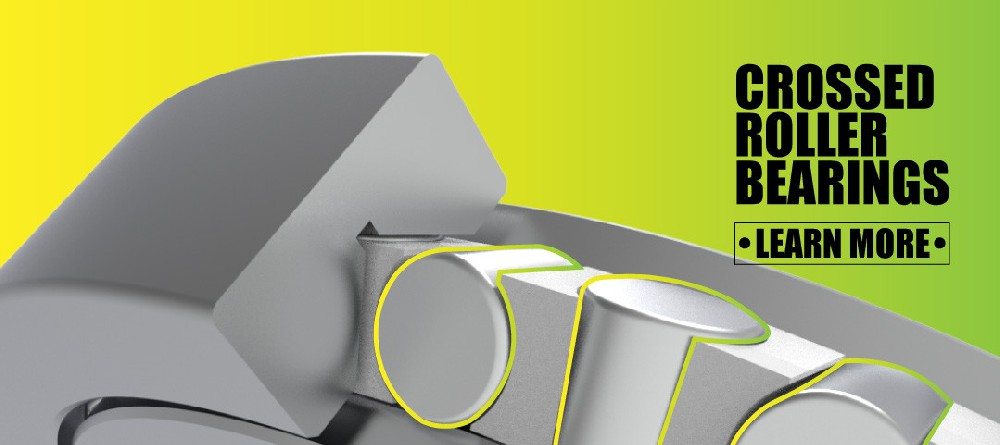
Crossed roller bearings use cylindrical or tapered rollers arranged alternately at 90 degrees. This structure allows one bearing to support radial load, axial load in both directions, and overturning moment load.
They are especially valuable in precision equipment because they provide high rigidity and accurate rotational guidance in a compact arrangement. Precision crossed roller designs are widely associated with machine-tool rotary tables, vertical boring machines, grinding machines, industrial robots, radar systems, and compact pivot structures.
Typical applications include:
– Industrial robots and collaborative robots
– Humanoid and quadruped robot joints
– Harmonic reducers and RV reducers
– Rotary tables and indexing tables
– CNC machine tools
– Hollow rotary platforms
– Precision measuring equipment
– Medical imaging devices
– Communication and radar equipment
For a robot shoulder, waist, wrist, or reducer output stage, a crossed roller bearing can replace a multi-bearing arrangement when the design needs compactness, high rigidity, and stable rotational accuracy.
Henan Yuwei Industrial Technology Co., Ltd. develops precision crossed cylindrical roller bearings, high-rigidity crossed roller bearings, thin-section crossed roller bearings, double-row crossed roller bearings, and high-precision angular contact ball bearings for such motion-critical applications. Its product focus is particularly relevant to robotics, precision machinery, radar platforms, medical equipment, DD motors, hollow rotary tables, harmonic reducers, and planetary reducers.
Roller Bearing Selection Factors
The best bearing choice begins with the application, not the catalog. Before selecting a model, define the actual operating conditions.
| Selection factor | Questions to answer | Typical bearing implication |
|---|---|---|
| Load direction | Is the load radial, axial, combined, or moment-based? | Tapered and crossed roller bearings handle combined loads; thrust bearings prioritize axial loads |
| Load magnitude | What are the normal, peak, shock, and emergency loads? | Higher loads may require larger rollers, more rows, or a different bearing structure |
| Required stiffness | How much deflection is acceptable at the working point? | Crossed roller and preloaded tapered roller arrangements can improve rigidity |
| Speed | Is the application low, moderate, or high speed? | Heat, lubrication, cage design, and preload become increasingly important at high speed |
| Accuracy | Does the machine require repeatable positioning or low runout? | Precision crossed roller or high-precision angular contact bearings may be appropriate |
| Space | Are bore, outside diameter, and section height restricted? | Needle, thin-section, and compact crossed roller designs can save space |
| Misalignment | Can the shaft bend or housing distort in service? | Spherical roller designs tolerate misalignment better |
| Environment | Is there dust, moisture, vibration, chemical exposure, or temperature variation? | Sealing, lubrication, coating, cage material, and clearance must be considered |
Bearing service life is affected not only by load but also by lubrication, contamination, installation quality, clearance, tilt, and internal load distribution. Current ISO guidance for rolling-bearing life calculations explicitly addresses factors such as lubrication, contamination, misalignment, operating clearance, and edge stress.
How to Select a Bearing Step by Step
1. Map the Real Load Case
Start by identifying all forces acting on the bearing:
– Radial load
– Axial load
– Moment or overturning load
– Shock load
– Vibration load
– Acceleration and braking forces
For a robot joint, static payload is only one part of the calculation. The dynamic torque generated during rapid movement, emergency stopping, and arm extension can create a much larger moment load than the nominal payload suggests.
2. Define Accuracy and Rigidity Targets
Precision equipment often fails performance requirements before the bearing reaches fatigue life. A bearing may remain intact but allow too much rotational runout, axial displacement, or elastic deformation.
For example, in a machine-tool rotary table, excessive deflection can affect part geometry. In a collaborative robot, insufficient joint rigidity can reduce repeat positioning accuracy and create vibration during trajectory changes.
Specify measurable targets such as:
– Radial runout
– Axial runout
– Rotational torque
– Tilting stiffness
– Positioning repeatability
– Permissible temperature rise
3. Evaluate Speed, Lubrication, and Heat
Higher speed increases frictional heat. Grease type, oil viscosity, preload, seal friction, cage design, and internal geometry all influence operating temperature.
During commissioning, a controlled test run helps identify abnormal noise, vibration, or heat. SKF notes that whistling or screeching can indicate insufficient lubrication, while uneven rumbling may be linked to contamination or mounting-related damage.
A practical rule is simple: do not judge bearing suitability by speed alone. Evaluate speed together with preload, load, lubrication method, duty cycle, and heat dissipation.
4. Design for Cleanliness and Correct Mounting
Contamination can severely shorten bearing life because solid particles indent rolling surfaces and raise local contact stress.
To reduce avoidable damage:
1. Keep bearings in sealed packaging until installation.
2. Clean shafts, housings, tools, and work areas before assembly.
3. Use proper mounting force on the ring being fitted.
4. Avoid transmitting installation force through rolling elements.
5. Apply the specified lubricant quantity and grade.
6. Verify preload, clearance, and tightening sequence.
7. Conduct a low-to-moderate-speed test run before full-load operation.
For precision crossed roller bearings, mounting surface flatness, bolt tightening sequence, and seat accuracy are especially important. A high-precision bearing cannot compensate for an inaccurate housing or distorted support structure.
When Crossed Roller Bearings Are the Better Choice
A crossed roller bearing is often the preferred option when one compact bearing must carry complex loading from several directions.
Choose this structure when the application needs:
– High rotational accuracy
– High tilting stiffness
– Radial and axial load capacity
– Moment-load resistance
– Compact installation dimensions
– Stable support for a rotating platform
– Low deflection under changing direction loads
For example, a hollow rotary platform in an automated production cell may support a fixture, workpiece, motor torque, cable routing, and intermittent indexing forces. A crossed roller bearing can provide a compact, rigid support structure while preserving a central through-hole for wiring or pneumatic lines.
For ultra-high-speed spindles, however, a high-precision angular contact ball bearing arrangement may be more suitable because ball bearings can offer lower friction at high speed. The final decision should be based on calculated loads, speed, stiffness, thermal conditions, and required accuracy rather than a general preference for one bearing type.

Partner With a Precision Bearing Manufacturer
Reliable bearing performance depends on more than the bearing model. It depends on application analysis, material quality, heat treatment, machining precision, cleanliness control, assembly method, inspection capability, and technical support.
Henan Yuwei Industrial Technology Co., Ltd. works with universities and research institutions on bearing research, testing, and specialized projects. The company develops bearing solutions for advanced equipment including industrial robots, service robots, quadruped robots, humanoid robots, medical robots, radar vehicles, precision instruments, CNC machine tools, DD motors, harmonic reducers, and planetary reducers.
If you are designing a robotic joint, rotary table, reducer output, radar platform, medical device, or custom motion system, share your operating conditions with the Yuwei technical team. Provide the drawing, installation space, load direction, moment load, speed, accuracy requirement, lubrication method, and working environment to receive a more targeted bearing recommendation.
Contact Yuwei Bearing today to discuss standard or customized precision crossed roller bearings and high-precision angular contact ball bearings for your application.
FAQs
What is the difference between a roller bearing and a ball bearing?
Roller bearings use rollers, while ball bearings use balls. Rollers generally provide a larger contact area and can support higher loads and stiffness in many applications. Ball bearings are often preferred for high-speed operation because they can generate lower friction.
Which roller bearing handles combined radial and axial loads?
Tapered roller bearings and crossed roller bearings are common choices for combined loads. Tapered roller bearings are widely used in axles and gearboxes, while crossed roller bearings are suitable for compact precision mechanisms that must also resist overturning moments.
Why are crossed roller bearings used in robots?
Robot joints often require compact dimensions, high stiffness, accurate rotation, and the ability to carry radial, axial, and moment loads. Crossed roller bearings meet these requirements in a single integrated structure.
Can spherical roller bearings handle misalignment?
Yes. Spherical roller bearings are designed to accommodate a degree of shaft or housing misalignment. They are widely used in heavy equipment where shaft deflection or structural deformation may occur.
What causes premature roller bearing failure?
Common causes include inadequate lubrication, contamination, incorrect mounting, poor alignment, excessive preload, improper clearance, overload, and unsuitable sealing. Particle contamination is particularly harmful because it can damage rolling surfaces and increase contact stress.
How do I choose a bearing for a hollow rotary platform?
Evaluate radial load, axial load, overturning moment, rotational speed, platform diameter, required accuracy, central-hole size, mounting method, and environmental conditions. A thin-section or crossed roller bearing is often suitable when compactness and stiffness are priorities.
Can a customized bearing improve machine performance?
Yes. A customized bearing can be designed around installation space, load distribution, preload, tolerance class, sealing, lubrication, cage material, and environmental demands. Customization is particularly useful for robotic joints, radar systems, medical devices, and non-standard rotary mechanisms.
References
– [ISO 16281:2025 — Rolling bearings: Methods for calculating modified reference rating life]
– [SKF — Bearing selection factors and operating life]
– [SKF — Test running of rolling bearings]
– [SKF — Contamination factor and bearing rating life]
– [Timken — Cross Roller XR Bearings]
– [Timken — Precision Machine Tool Bearings]
– [Original article reviewed: A Comprehensive Guide to Roller Bearing Type]
Hot Tags: Roller Bearing Types, Crossed Roller Bearings, Precision Crossed Roller Bearings, Cross Roller Bearing Manufacturer, Industrial Robot Bearings, High Precision Bearings, Angular Contact Ball Bearings, High Speed Angular Contact Ball Bearings, CNC Machine Tool Bearings, Rotary Table Bearings