Content Menu
● Why Bearing Selection Affects Robot Accuracy
● What Is a Robot Arm Bearing?
>> Common Robot Arm Bearing Types
● What Is an Angular Contact Ball Bearing?
>> Typical Angular Contact Ball Bearing Applications
● Crossed Roller Bearing vs Angular Contact Ball Bearing
● Which Bearing Improves Robot Accuracy?
>> Choose a Crossed Roller Bearing When
>> Choose Angular Contact Ball Bearings When
● The Most Important Factor: Moment Rigidity
● How Preload Changes Robot Bearing Performance
● A Practical Bearing Selection Process
>> Step 1: Define the Real Joint Loads
>> Step 2: Set Accuracy and Stiffness Targets
>> Step 3: Review Speed, Torque, and Heat
>> Step 4: Verify the Housing and Shaft
>> Step 5: Validate with Testing
● Expert Insight: Accuracy Is a System Outcome
● Why Work With Henan Yuwei Industrial Technology Co., Ltd.
>> 1. Is a crossed roller bearing better than an angular contact ball bearing for robot arms?
>> 2. Can angular contact ball bearings be used in industrial robots?
>> 3. Why does bearing stiffness affect robotic repeatability?
>> 4. What is the main advantage of a crossed roller bearing?
>> 5. Do angular contact ball bearings need to be installed in pairs?
>> 6. How do I choose preload for a robot bearing?
>> 7. Can Yuwei Bearing provide customized robot bearings?
Selecting the right robot arm bearing has a direct effect on robotic positioning accuracy, repeatability, payload stability, and service life. In most precision robot joints, the comparison is not simply between two generic bearing types—it is a choice between a compact, multi-directional crossed roller bearing solution and a speed-focused, configurable angular contact ball bearing arrangement.
For articulated robot shoulders, elbows, wrists, rotary tables, harmonic reducers, and precision positioning modules, a crossed roller bearing often provides the stronger foundation for accuracy because it can resist radial, axial, and overturning-moment loads in one compact unit. High-precision angular contact ball bearings, however, remain highly effective where high speed, low friction, adjustable preload, and paired bearing arrangements are the main design priorities.
At Henan Yuwei Industrial Technology Co., Ltd., we manufacture precision crossed cylindrical roller bearings, high-rigidity crossed roller bearings, thin-section crossed roller bearings, double-row crossed roller bearings, and high-precision angular contact ball bearings for demanding motion systems. Based on practical bearing-selection experience across robotics, machine tools, radar equipment, medical devices, rotary platforms, reducers, and precision measurement systems, the best choice depends on how the robot moves, where loads act, and how much deflection the application can tolerate.

Why Bearing Selection Affects Robot Accuracy
Robot accuracy is commonly discussed in terms of positioning accuracy and repeatability. However, the bearing inside a joint is one of the mechanical components that determines whether the robot can maintain that accuracy under real operating conditions.
A robot may achieve an acceptable position without a payload, then show greater deviation when the arm accelerates, carries an end effector, changes direction, or operates at an extended reach. This is because bearing deformation, internal clearance, preload variation, installation error, and moment loading can all influence the final position of the tool center point.
A bearing contributes to robot accuracy through several factors:
– Radial stiffness, which limits sideways displacement under load.
– Axial stiffness, which controls movement along the rotational axis.
– Moment rigidity, which resists tilting caused by an offset payload or long arm.
– Rotational runout, which affects smooth and repeatable rotation.
– Preload stability, which determines whether clearance remains controlled over time.
– Torque consistency, which influences motion smoothness and servo response.
– Thermal behavior, which affects internal clearance during long operating cycles.
– Mounting accuracy, which determines whether the bearing can perform as designed.
In a high-precision robot, the bearing should not be considered a passive component. It is part of the robot’s accuracy chain together with the reducer, motor, encoder, housing, shaft, fastening structure, lubrication system, and control algorithm.
What Is a Robot Arm Bearing?
A robot arm bearing is a broad application term rather than one single bearing design. It refers to a bearing selected to support rotating joints in industrial robots, collaborative robots, SCARA robots, humanoid robots, service robots, medical robots, AGVs, quadruped robots, exoskeleton robots, and special-purpose automation equipment.
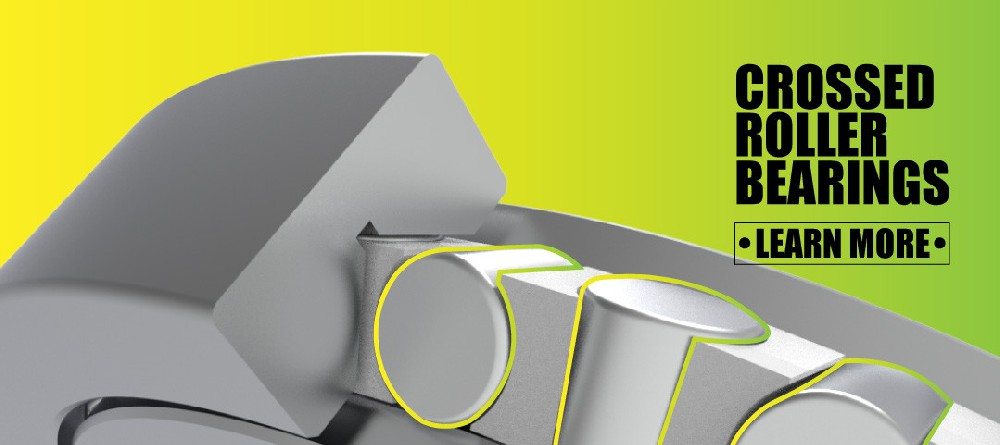
For high-load and high-accuracy robot joints, crossed roller bearings are often the preferred robot arm bearing design. Their structure uses cylindrical rollers arranged alternately at 90 degrees between inner and outer rings. This alternating roller orientation allows one bearing to carry radial loads, axial loads in both directions, and overturning moments simultaneously.
This is especially important in robot joints because loads rarely act in only one direction. A robot elbow, for example, may experience:
– Radial force from arm weight and acceleration.
– Axial load from assembly orientation or external process force.
– Tilting moment from a long arm or offset gripper.
– Reversing loads during rapid start-stop motion.
– Vibration from machining, handling, dispensing, welding, or inspection tasks.
A precision crossed roller bearing can simplify the joint architecture by handling these combined loads in one compact bearing position.
Common Robot Arm Bearing Types
| Bearing type | Main structural feature | Typical robotic use | Main advantage |
|---|---|---|---|
| Crossed roller bearing | Orthogonally arranged cylindrical rollers | Robot joints, harmonic reducers, rotary axes | High rigidity and multi-directional load capacity |
| Thin-section crossed roller bearing | Compact cross-roller design with reduced section height | Lightweight robots, compact wrists, medical robots | Space saving with strong moment resistance |
| Double-row crossed roller bearing | Two rows of crossed rollers | Heavy-duty industrial joints and turntables | Higher load capacity and rigidity |
| Angular contact ball bearing | Balls contact raceways at a defined angle | High-speed spindles, motors, compact rotary systems | High-speed capability and low friction |
| Thin-section angular contact ball bearing | Reduced cross section with angular contact geometry | Lightweight mechanisms and compact assemblies | Compact size and flexible paired arrangements |
The term robot arm bearing should therefore be linked to the robot’s real mechanical requirements—not only to the bearing’s outside diameter or load rating.

What Is an Angular Contact Ball Bearing?
An angular contact ball bearing uses balls that contact the inner and outer raceways at a defined contact angle. This geometry allows the bearing to support combined radial and axial loads. The contact angle determines how effectively the bearing carries axial force.
Angular contact ball bearings are frequently used in precision rotating equipment because they can operate at relatively high speeds, offer low friction, and can be supplied in matched sets for controlled preload. In many applications, two or more bearings are mounted together in back-to-back, face-to-face, or tandem arrangements to support loads from different directions.
A single-row angular contact ball bearing is usually designed to support axial load primarily in one direction. Therefore, a second bearing is commonly required to locate the shaft or rotating component in the opposite direction.
This makes angular contact ball bearing systems especially suitable when engineers need to customize a bearing arrangement around speed, axial load direction, preload level, shaft configuration, or installation space.

Typical Angular Contact Ball Bearing Applications
High-precision angular contact ball bearings are widely used in:
– CNC machine-tool spindles.
– Servo motors and high-speed motor shafts.
– Precision pumps and compressors.
– Machine-tool ball screws.
– Radar and communication equipment.
– Medical instruments.
– High-speed rotary modules.
– Precision measuring devices.
– Light-load robot axes with high rotational speed requirements.
For robotics, angular contact ball bearings can be a strong solution in compact high-speed axes, end effectors, motor supports, auxiliary rotating units, and applications where the moment load is controlled by the housing structure or another bearing arrangement.
Crossed Roller Bearing vs Angular Contact Ball Bearing
The central difference is simple: a crossed roller bearing is designed as a highly rigid, compact bearing system for combined loads and moments, while an angular contact ball bearing is designed for efficient high-speed rotation and flexible arrangement design.
| Comparison factor | Crossed roller bearing for robot arms | Angular contact ball bearing |
|---|---|---|
| Rolling element | Cylindrical rollers arranged at 90 degrees | Balls operating at a contact angle |
| Contact geometry | Line contact between roller and raceway | Point contact between ball and raceway |
| Radial load capacity | High | Good to high, depending on size and arrangement |
| Axial load capacity | Supports axial loads in both directions | Usually supports axial load mainly in one direction per bearing |
| Moment-load capacity | Excellent; suitable for overturning loads | Usually requires paired bearings and adequate spacing |
| Rigidity | Very high due to roller contact and structure | Lower than roller-based solutions at comparable size |
| Rotational accuracy | Very high when preload and mounting are controlled | High, especially in super-precision grades |
| Speed capability | Moderate to high depending on size, lubrication, preload, and cage design | Generally higher, especially for spindle-type use |
| Friction torque | Often higher than ball-bearing solutions | Usually lower, supporting high-speed rotation |
| Mounting design | Can reduce joint complexity with one compact unit | Often requires matched pairs or multi-bearing arrangements |
| Best fit | Robot joints, reducers, turntables, radar, precision indexing | High-speed shafts, spindles, motors, compact rotary assemblies |
Crossed roller rings are specifically recognized for high rigidity and rotational accuracy. Their spacer-retainer construction can reduce roller skewing and friction-related torque increase, helping maintain stable rotation even when preload is applied.
Which Bearing Improves Robot Accuracy?
For many robot arm joints, a precision crossed roller bearing is the stronger choice for improving mechanical accuracy. The reason is not that angular contact ball bearings are inaccurate. Instead, it is because robot joints frequently face complex, reversing, and offset loads that create a significant tilting moment.
A crossed roller bearing directly addresses this condition.
When a robot arm carries a payload at a distance from the joint center, the payload creates an overturning moment. The larger the arm length and payload offset, the greater the effect. If the bearing system allows even a small angular deflection, the end effector can move by a much larger amount at the tip of the arm.
A simplified relationship is:
Tool-point displacement≈Angular deflection×Arm length
For example, if a robot arm has a 1,000 mm reach, a small joint angular deflection of 0.001 radians can create approximately 1 mm of movement at the end effector. This illustrates why bearing rigidity is so important in long-reach handling, welding, dispensing, inspection, polishing, and precision assembly robots.
Choose a Crossed Roller Bearing When
A crossed roller bearing is normally the better option when the design requires:
– High moment rigidity in a compact joint.
– High resistance to arm deflection under payload.
– Accurate rotation under radial, axial, and moment loads.
– A single-bearing solution for multi-directional loading.
– Tight rotational runout control.
– Compact integration with harmonic reducers or planetary reducers.
– Stable positioning for robot shoulders, elbows, wrists, and rotary platforms.
– Strong performance in radar, medical equipment, machine tools, and precision measuring systems.
For example, a humanoid robot knee joint may need to withstand cyclic radial loads, axial impact, bending moments, and rapid changes in direction. A high-rigidity crossed roller bearing can help the joint remain stable while reducing the structural complexity of using multiple individual bearings.
Choose Angular Contact Ball Bearings When
High-precision angular contact ball bearings are often the better solution when the application prioritizes:
– High rotational speed.
– Lower friction torque.
– Controlled axial loading.
– Flexible preload selection.
– Matched bearing-pair configurations.
– Compact motor support arrangements.
– High-speed spindle or rotor operation.
– A design where moment loads are limited or handled by bearing spacing.
In a high-speed robotic spindle or precision motor assembly, angular contact ball bearings can provide excellent running accuracy and speed performance. Preload is especially important because it can increase system stiffness and improve shaft guidance, although excessive preload can raise friction, heat generation, and power loss.
The Most Important Factor: Moment Rigidity
Many bearing comparisons focus only on radial load rating or axial load rating. For robot designers, this can be incomplete. The most decisive issue is often moment rigidity.
Moment rigidity is the ability of a bearing system to resist tilting under an eccentric load. In a robot, eccentricity appears almost everywhere:
– A gripper extends forward from the wrist.
– A welding gun is mounted off-center.
– A camera or vision system is placed on one side.
– A payload changes shape or center of gravity.
– An arm reaches outward from the base.
– The robot accelerates or decelerates rapidly.
Crossed roller bearings are highly suitable for these conditions because the crossed roller arrangement supports loads and moments in every direction within a single bearing assembly.
By contrast, angular contact ball bearings can also resist moment loads when installed in a properly designed pair. A back-to-back arrangement, for instance, creates a wider effective support span and improves moment stiffness. However, the joint may require more axial space, more components, tighter assembly control, and more careful preload management.
How Preload Changes Robot Bearing Performance
Preload is the intentional internal load applied to a bearing system to remove clearance and increase rigidity. It is one of the most important variables in precision robot bearing design.
Proper preload can provide:
– Reduced internal clearance.
– Better rotational repeatability.
– Higher axial and radial stiffness.
– Improved resistance to vibration.
– More consistent motion reversal.
– Better encoder and servo-system response.
However, excessive preload can cause problems:
– Higher friction torque.
– Increased operating temperature.
– Lubricant degradation.
– Higher energy consumption.
– Reduced bearing life.
– Increased wear under contaminated conditions.
For angular contact ball bearings, preload is commonly created through matched bearing sets, spacers, springs, or controlled axial clamping. A single angular contact ball bearing generally requires another bearing to establish preload and locate the assembly from the opposite axial direction.
For crossed roller bearings, preload adjustment can also be important. Certain designs use separable rings, allowing preload to be set for accurate rotation. The correct preload must match the robot’s load condition, speed, mounting accuracy, temperature range, and target service life.
A Practical Bearing Selection Process
The best robot bearing choice should be made through a structured engineering review rather than a catalog-only comparison.
Step 1: Define the Real Joint Loads
Calculate or estimate:
– Radial load.
– Axial load in both directions.
– Maximum overturning moment.
– Static load during emergency stop.
– Dynamic load during acceleration.
– Payload mass and center-of-gravity offset.
– Reversing frequency and duty cycle.
Do not evaluate only the nominal payload. The acceleration profile can create much higher transient loads than the static payload alone.
Step 2: Set Accuracy and Stiffness Targets
Specify the required:
– Positioning accuracy.
– Repeatability.
– Allowable radial runout.
– Allowable axial runout.
– Maximum joint angular deflection.
– End-effector displacement limit.
– Vibration limit.
– Servo response requirement.
A bearing should be selected based on the allowable movement at the tool point, not only on the allowable movement at the bearing location.
Step 3: Review Speed, Torque, and Heat
Angular contact ball bearings are often advantageous when continuous high speed and low friction are critical. Crossed roller bearings should be evaluated carefully for rotational speed, preload, lubrication method, torque requirement, and thermal expansion.
The correct bearing is not always the bearing with the highest stiffness. It is the bearing that achieves the required stiffness while maintaining acceptable torque, temperature, life, and cost.
Step 4: Verify the Housing and Shaft
Even the highest-grade precision bearing cannot compensate for poor mating parts. Confirm:
– Shaft and housing tolerances.
– Shoulder squareness.
– Surface roughness.
– Mounting face flatness.
– Fastener tightening sequence.
– Bearing-seat roundness.
– Alignment between reducer, motor, and output flange.
A precision crossed roller bearing can lose much of its expected performance if it is installed in a distorted housing or clamped unevenly.
Step 5: Validate with Testing
For high-value robotics projects, validate the bearing system through:
– No-load torque testing.
– Loaded rotation testing.
– Temperature-rise testing.
– Runout inspection.
– Repeatability testing.
– Vibration monitoring.
– Life-cycle testing.
– Emergency-stop load testing.
This approach helps identify whether a robot accuracy issue comes from the bearing, reducer backlash, housing deformation, encoder error, mounting error, or control tuning.
Expert Insight: Accuracy Is a System Outcome
A common engineering mistake is expecting one premium bearing to solve every robot accuracy problem. In practice, robot accuracy is the result of the entire mechanical system.
A high-rigidity crossed roller bearing may reduce joint deflection, but the robot can still lose accuracy if the reducer has backlash, the housing flexes, the motor shaft is misaligned, or the encoder feedback is unstable.
Likewise, a high-precision angular contact ball bearing pair may provide excellent shaft guidance, but it may not be the ideal solution for a large robot wrist carrying a long, offset process tool.
The practical rule is:
> Select crossed roller bearings to control combined loads and moment-induced deflection. Select angular contact ball bearings to optimize high-speed rotation, preload flexibility, and efficient shaft support.
For many precision robot joints, a hybrid architecture is also possible. A crossed roller bearing may support the output side of a reducer or rotary joint, while angular contact ball bearings support a high-speed motor shaft. This allows each bearing type to perform where it is strongest.
Why Work With Henan Yuwei Industrial Technology Co., Ltd.
Henan Yuwei Industrial Technology Co., Ltd. focuses on the development, production, and supply of precision bearing solutions for advanced motion equipment. Our product portfolio includes:
– Precision crossed cylindrical roller bearings.
– High-rigidity crossed roller bearings.
– Thin-wall crossed roller bearings.
– Double-row crossed roller bearings.
– High-precision angular contact ball bearings.
– High-speed angular contact ball bearings.
– Long-life angular contact ball bearings.
– Customized bearings for specialized robotic, radar, and industrial equipment.
Our bearings are used in quadruped robots, service robots, industrial robots, collaborative robots, SCARA robots, medical robots, exoskeleton robots, humanoid robots, special robots, AGVs, medical equipment, communication radar systems, precision measuring instruments, textile and printing equipment, CNC machine tools, industrial rotary tables, hollow rotary platforms, DD motors, harmonic reducers, and planetary reducers.
Through long-term technical cooperation with universities and research institutions, Yuwei Bearing has participated in research, testing, and specialized bearing development for robotics, radar vehicles, and major scientific projects. Our focus is to provide stable quality, practical engineering support, and cost-effective precision bearing solutions for global customers.
If your project requires a robot arm bearing, crossed roller bearing, thin-section bearing, double-row crossed roller bearing, or high-precision angular contact ball bearing, contact Yuwei Bearing with your drawings, load data, installation space, rotational speed, accuracy target, and operating conditions. Our technical team can help you compare bearing structures and identify a solution that supports long-term robot accuracy.
Frequently Asked Questions
1. Is a crossed roller bearing better than an angular contact ball bearing for robot arms?
In many robot arm joints, yes. A crossed roller bearing is usually better when the joint must carry radial loads, axial loads, and overturning moments at the same time. Its high rigidity helps reduce joint deflection and improve positioning stability.
2. Can angular contact ball bearings be used in industrial robots?
Yes. Angular contact ball bearings are widely used in robot motors, high-speed shafts, end effectors, compact rotary systems, and spindle-related applications. They are especially suitable when high speed, low friction, and preload flexibility are more important than maximum moment rigidity.
3. Why does bearing stiffness affect robotic repeatability?
Bearing stiffness determines how much the bearing deflects when the robot moves under load. Lower deflection helps the joint return to a more consistent position during repeated motions, particularly when payload, speed, or arm orientation changes.
4. What is the main advantage of a crossed roller bearing?
Its key advantage is the ability to support radial, axial, and moment loads in all directions within one compact bearing structure. This makes it particularly valuable for precision robot joints, reducers, rotary tables, and radar equipment.
5. Do angular contact ball bearings need to be installed in pairs?
In many precision applications, yes. A single-row angular contact ball bearing generally supports axial load primarily in one direction, so a second bearing is commonly used to locate the shaft in the opposite direction and establish a preload arrangement.
6. How do I choose preload for a robot bearing?
Preload should be selected according to load, speed, required stiffness, installation accuracy, lubrication, temperature, and service-life targets. Too little preload can leave excessive clearance, while too much preload can increase torque, heat, and wear.
7. Can Yuwei Bearing provide customized robot bearings?
Yes. Yuwei Bearing can support bearing selection and customized solutions based on application drawings, size constraints, load conditions, rotational speed, target accuracy, mounting method, and operating environment.
References
1. [SKF — Preload, Clearance and Stiffness for Super-Precision Angular Contact Ball Bearings]
2. [SKF — Selecting Internal Clearance or Preload]
3. [SKF — Super-Precision Angular Contact Ball Bearings]
4. [THK — Cross-Roller Ring Product Information]
5. [THK — Full-Roller Type Cross-Roller Ring Introduction]
7. [THK — Model RF Cross Roller for Robots Catalog]
Hot Tags: Robot Arm Bearing, Crossed Roller Bearing, Angular Contact Ball Bearing, Industrial Robot Bearings, Precision Robot Bearings, Robot Joint Bearing, High Rigidity Bearing, Thin Section Bearing, Harmonic Reducer Bearing, Robotic Rotary Bearing