Content Menu
● What Is a Four-Point Contact Ball Bearing?
>> Basic Structure and Load Path
● How Four-Point Contact Ball Bearings Improve Load Distribution
>> Bidirectional Axial Support in One Bearing
>> Higher Ball Count Within a Short Axial Envelope
>> Controlled Axial Positioning
● Four-Point Contact Ball Bearings vs. Other Bearing Options
>> Four-Point Contact vs. Paired Angular Contact Bearings
>> Four-Point Contact vs. Cross Roller Bearings
● The Role of Contact Angle in Load Distribution
● Engineering Factors That Influence Real Load Distribution
>> Internal Clearance and Preload
● High-Speed Considerations for Compact Machinery
● Application Example: Compact Robot Rotary Module
● Selection Checklist for Four-Point Contact Ball Bearings
● Why Bearing Customization Matters
● FAQ
>> 1. Can a four-point contact ball bearing carry radial and axial loads at the same time?
>> 2. Why is a four-point contact ball bearing more compact than two angular contact bearings?
>> 3. Are four-point contact ball bearings suitable for high-speed applications?
>> 4. What is the difference between a four-point contact ball bearing and a cross roller bearing?
>> 5. Can four-point contact ball bearings compensate for shaft or housing misalignment?
>> 6. Should a four-point contact ball bearing be preloaded?
>> 7. Which compact machines commonly use four-point contact ball bearings?
Four-point contact ball bearings improve load distribution in compact machinery by allowing one bearing to manage bidirectional axial loads, limited radial loads, and certain overturning moments within a short axial envelope. For engineers designing robot joints, rotary platforms, compact gearboxes, precision instruments, and radar positioning systems, this can reduce component count while maintaining controlled axial positioning.
At Henan Yuwei Industrial Technology Co., Ltd., our engineering perspective is shaped by precision-bearing development for robotics, precision transmission systems, radar equipment, medical devices, industrial rotary tables, and high-accuracy automation. In compact machinery, the correct bearing arrangement is rarely selected only by catalogue load rating. It must also account for real load direction, installation stiffness, rotational speed, lubrication, heat, assembly tolerance, and service-life expectations.
A four-point contact ball bearing can be a highly efficient answer when axial loading reverses direction and installation space is constrained. However, it is not automatically the best answer for every combined-load application. Understanding its load path, strengths, and limitations is essential before choosing it instead of a paired angular contact ball bearing arrangement, a double-row bearing, or a cross roller bearing.

What Is a Four-Point Contact Ball Bearing?
A four-point contact ball bearing is a single-row angular contact ball bearing with specially shaped raceways. Its inner ring is commonly split into two halves, while the raceway geometry creates two contact paths on each side of the ball under certain loading conditions.
The term “four-point” describes the potential geometry of contact between the balls and the bearing raceways. Under a predominantly radial load condition, a ball may contact the raceways at four locations. Under a pure axial load in one direction, the ball normally transmits load through two primary contact points, similar to an angular contact bearing carrying thrust in its preferred direction.
This geometry gives the bearing its key advantage: one compact bearing can carry axial force in both directions.
Basic Structure and Load Path
A typical four-point contact ball bearing includes:
– A solid outer ring
– Two matched inner-ring halves
– A single row of precision balls
– A cage that maintains ball spacing
– Raceway geometry with a relatively large contact angle
– An open construction that requires an appropriate external sealing and lubrication strategy
The split inner ring allows the bearing to accommodate a relatively large number of balls. More rolling elements can increase axial load-carrying capability in a compact package. The design is also separable, which can simplify installation in some machinery layouts.
A four-point contact ball bearing is often compared with two single-row angular contact ball bearings mounted back-to-back. Functionally, both arrangements can support axial loads in two directions. The difference is that the four-point design achieves this within one bearing width, while the paired arrangement occupies more axial space.
How Four-Point Contact Ball Bearings Improve Load Distribution
Load distribution refers to how external forces are transferred from the shaft, rotating table, gearbox component, or housing into the rolling elements and raceways. Good distribution reduces localized stress, limits deformation, supports predictable running accuracy, and helps extend fatigue life.
In compact machinery, several loads may act at the same time:
– Radial load acting perpendicular to the shaft axis
– Axial load acting parallel to the shaft axis
– Reversing axial load that changes direction during operation
– Moment load caused by an offset force, overhung payload, or eccentric center of gravity
– Dynamic load generated by acceleration, deceleration, vibration, or impact
The four-point contact design improves load management mainly when the application is axial-load dominant and must support thrust in both directions.
Bidirectional Axial Support in One Bearing
A standard single-row angular contact ball bearing is designed to support axial load primarily in one direction. If axial force can reverse, engineers often install two bearings in a paired arrangement.
A four-point contact ball bearing uses its raceway geometry to support axial forces from either direction. This is valuable in equipment where a shaft, rotor, rotary table, or actuator repeatedly changes thrust direction.
Examples include:
– Robot wrist joints
– Rotary indexing platforms
– Compact servo reducers
– Radar and antenna positioning mechanisms
– Medical imaging mechanisms
– Precision rotary fixtures
– Reversing screw-drive systems
– Gearbox shafts with bidirectional thrust
When the axial force changes direction, the active contact path changes correspondingly. The bearing can therefore locate the shaft in both axial directions without requiring a second angular contact bearing solely for reverse thrust support.
Higher Ball Count Within a Short Axial Envelope
The split inner-ring structure makes it possible to use a larger ball complement than some conventional single-row arrangements. A larger number of balls can share the axial load, reducing the load carried by each individual ball when the bearing is properly selected and installed.
This does not mean every ball carries exactly the same force. Real load distribution is affected by:
– Raceway conformity
– Contact angle
– Internal clearance
– Ring stiffness
– Shaft and housing deformation
– Manufacturing accuracy
– Misalignment
– Temperature difference between rings
– Applied radial and axial load ratio
Still, the design can offer a favorable balance of axial capacity and compactness, particularly when compared with a double-row angular contact bearing that requires more axial installation space.
Controlled Axial Positioning
Compact machinery often depends on stable axial position. Excessive axial movement can affect gear mesh, encoder feedback, rotor clearance, belt alignment, seal performance, or tool positioning accuracy.
A four-point contact ball bearing can help maintain close axial clearance because it supports thrust from both directions. In applications such as robot joints, hollow rotary platforms, and high-precision positioning systems, this may support more consistent repeatability.
However, the bearing should not be treated as a universal high-rigidity solution. If the machine requires extremely high moment stiffness, very low runout, or high resistance to deformation under complex loads, a precision cross roller bearing or a carefully preloaded paired angular contact bearing arrangement may be more suitable.
Four-Point Contact Ball Bearings vs. Other Bearing Options
The right bearing is determined by the load spectrum, space envelope, operating speed, rigidity target, mounting accuracy, and cost structure. The table below compares common options for compact equipment.
| Bearing Type | Axial Load Direction | Radial Load Capability | Moment Resistance | Axial Space Requirement | Typical Strength |
|---|---|---|---|---|---|
| Four-point contact ball bearing | Both directions | Limited to moderate | Moderate, application-dependent | Low | Compact support for reversing axial load |
| Single-row angular contact ball bearing | One primary direction | Good for combined load | Moderate | Low per bearing | High-speed spindles and combined radial-axial loads |
| Matched angular contact bearing pair | Both directions | Good | Good, especially back-to-back arrangement | Medium to high | High-speed, preloaded, precision shaft support |
| Double-row angular contact ball bearing | Both directions | Good | Moderate to good | Higher | Simplified bidirectional support with a wider section |
| Cross roller bearing | Both directions | High | High | Compact radial profile | Robot joints, rotary tables, precision positioning |
| Deep-groove ball bearing | Limited axial capacity | Good | Low | Low | General radial applications |
Four-Point Contact vs. Paired Angular Contact Bearings
A pair of angular contact ball bearings can offer excellent rigidity, controlled preload, and high-speed performance. In a back-to-back arrangement, the effective support span is wider, improving resistance to overturning moments.
A four-point contact ball bearing offers a simpler and narrower alternative when:
– Axial loads reverse direction
– Radial load is relatively low
– Axial installation space is limited
– The design benefits from lower component count
– High-speed operation under large radial load is not the main requirement
The paired arrangement is often preferable when the shaft experiences substantial radial load, high speed, strong moment load, or stringent stiffness requirements.
Four-Point Contact vs. Cross Roller Bearings
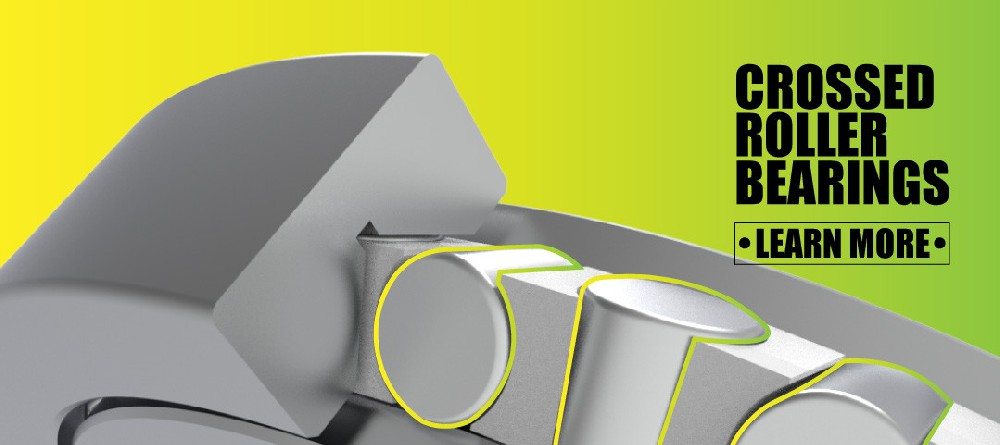
Cross roller bearings are frequently selected for high-precision robot joints, industrial turntables, medical equipment, and measurement systems because they can carry radial, axial, and moment loads with high rigidity.
Four-point contact ball bearings can be more attractive when the application is thrust-dominant and requires a narrower, lighter, or more economical structure. Cross roller bearings are often preferred when the load system is more complex and moment rigidity is a primary design target.
For example, a compact gearbox output shaft subjected mainly to alternating axial thrust may be a strong candidate for a four-point contact ball bearing. A humanoid robot hip joint carrying an offset payload and requiring high structural stiffness may require a cross roller bearing or a specially engineered bearing arrangement.
The Role of Contact Angle in Load Distribution
The contact angle is the angle between the load-transmission line through the ball-raceway contact and a line perpendicular to the bearing axis. It strongly affects the balance between radial and axial capacity.
A larger contact angle generally improves axial load capacity because the force is transmitted more directly along the axial direction. Four-point contact ball bearings commonly use a large nominal contact angle, often around 35 degrees in standard industrial designs.
This geometry explains why the bearing performs well under alternating thrust loads. It also explains why it should not be selected casually for radial-load-dominant applications.
When radial load becomes too high, four-point contact can increase friction and create less favorable rolling conditions. In many designs, a separate radial bearing may be used to carry radial force while the four-point contact bearing manages axial location.
Practical Load-Ratio Check
Before selecting a four-point contact ball bearing, engineers should examine the ratio:
Fa/Fr
Where:
– Fa is axial load
– Fr is radial load
If the application is strongly axial-load dominant, the four-point contact arrangement may be effective. If radial load is high relative to axial load, another bearing configuration may deliver lower friction, better heat control, and longer life.
A supplier’s technical data, dynamic equivalent-load equations, speed limits, and life calculations must always be used for final selection. General comparisons cannot replace a complete bearing calculation.
Engineering Factors That Influence Real Load Distribution
Bearing geometry matters, but surrounding machine structure matters just as much. In our experience with precision bearing applications, many premature failures are caused not by an incorrect bearing type alone, but by poor installation conditions.
Shaft and Housing Rigidity
A bearing cannot distribute load properly if its mounting surfaces deform excessively. Shaft bending, thin housing walls, uneven support shoulders, or localized clamping force can concentrate load on a limited group of balls.
For compact machinery, designers should ensure:
– Full and uniform support around the bearing rings
– Sufficient shoulder height and contact width
– Accurate shaft and housing seats
– Controlled roundness and runout
– Stable housing material and wall thickness
– Proper clamping without ring distortion
Precision components need precision mounting surfaces. A high-quality bearing installed in an inaccurate housing cannot achieve its intended performance.
Internal Clearance and Preload
Internal clearance has a direct impact on stiffness, friction, temperature, and load distribution.
Too much clearance may cause:
– Excessive axial movement
– Reduced positional accuracy
– Shock loading during reversal
– Uneven load sharing
– Higher vibration and noise
Too little clearance or excessive preload may cause:
– Higher friction torque
– Excessive heat generation
– Reduced lubrication film thickness
– Cage stress
– Shortened service life
For applications involving high speed, high precision, or changing temperature, clearance should be evaluated together with fit interference and thermal expansion. The correct setting is application-specific.
Misalignment Control
Four-point contact ball bearings have limited ability to compensate for angular misalignment. Even small misalignment can increase cage load, noise, friction, and contact stress.
This is especially important for:
– Long shafts
– Thin-walled housings
– Welded structures
– Overhung loads
– High-accuracy rotary stages
– Robotic arms with changing payloads
If structural deflection cannot be controlled, a bearing system with better tolerance for misalignment or a redesigned support structure may be necessary.
High-Speed Considerations for Compact Machinery
A four-point contact ball bearing can operate at useful speeds, but speed capability depends heavily on the actual load condition. Under significant radial load, four-point contact can produce higher friction because of the multi-contact condition.
High speed increases several effects:
– Centrifugal force on the balls
– Gyroscopic moment
– Heat generation
– Lubricant churning
– Cage stress
– Contact-angle variation
– Risk of sliding and smearing
Research on four-point contact ball bearings shows that rotational speed, contact geometry, external load, and contact-angle design can significantly affect contact load and stiffness. At higher rotational speeds, contact transitions may occur, changing the internal load distribution.
For high-speed applications, consider:
1. Use accurate operating load data, not only static design estimates.
2. Evaluate the full speed range, including acceleration and deceleration.
3. Choose grease or oil lubrication based on speed, temperature, and service interval.
4. Confirm cage material compatibility with lubricant and temperature.
5. Control radial load carefully.
6. Validate bearing temperature during prototype testing.
7. Use a paired angular contact bearing solution if high radial load and high speed are both critical.
Application Example: Compact Robot Rotary Module
Consider a compact rotary module for a service robot or collaborative robot joint. The module must support a rotating arm section with intermittent reversing motion.
The bearing system may experience:
– Axial force from arm orientation changes
– Reversing thrust during acceleration and braking
– Moderate radial force from the arm mass
– Moment load from an offset end effector
– Repeated low-speed oscillation
– High positioning accuracy requirements
A four-point contact ball bearing may work effectively when the axial loads are significant, the radial load remains controlled, and the housing is stiff enough to prevent misalignment. Its narrow axial section can create more room for a hollow shaft, encoder, cable routing, brake, harmonic reducer, or drive motor.
However, if the arm carries a heavy offset payload and moment stiffness becomes the primary design factor, a cross roller bearing may offer a more suitable solution. The key is not selecting the bearing with the highest published capacity. The key is selecting the bearing architecture that matches the real load path.

Selection Checklist for Four-Point Contact Ball Bearings
Use this practical checklist before specifying a four-point contact ball bearing for compact machinery.
1. Confirm whether axial load occurs in both directions.
2. Calculate the maximum axial, radial, and moment loads.
3. Identify the ratio of axial load to radial load throughout the duty cycle.
4. Check whether the machine requires low axial displacement or high moment rigidity.
5. Review rotational speed, acceleration, oscillation angle, and duty cycle.
6. Evaluate housing stiffness, shaft deflection, and alignment tolerance.
7. Determine the correct internal clearance or preload condition.
8. Select suitable material, heat treatment, cage, lubricant, and sealing design.
9. Verify fitting tolerances, shoulder dimensions, and assembly sequence.
10. Conduct life, static safety, temperature, and vibration validation before volume production.
For specialized machinery, prototype verification remains essential. Simulation is valuable, but actual testing under realistic loads, temperatures, contamination conditions, and motion profiles provides the strongest basis for final design decisions.

Why Bearing Customization Matters
Standard bearing sizes are useful, but advanced machinery often requires more than a catalogue product. Robotics, communication radar, medical systems, machine tools, and precision automation may require customized solutions based on:
– Non-standard dimensions
– Special raceway geometry
– Higher accuracy grades
– Optimized internal clearance
– Modified contact angle
– Customized cage design
– Low-torque grease selection
– Corrosion-resistant materials
– Integrated seals or shields
– Application-specific inspection standards
Henan Yuwei Industrial Technology Co., Ltd. develops and manufactures precision bearing solutions for demanding applications, including cross roller bearings, thin-section cross roller bearings, double-row cross roller bearings, high-rigidity cross roller bearings, and high-precision angular contact ball bearings.
For a compact machinery project, our technical team can help evaluate whether a four-point contact ball bearing, a high-precision angular contact bearing arrangement, or a cross roller bearing is the more effective solution for your load, space, precision, and cost requirements.
Conclusion
Four-point contact ball bearings improve load distribution in compact machinery by enabling bidirectional axial load support within a narrow axial installation space. Their raceway geometry, large contact angle, and ball complement allow a single bearing to perform a role that may otherwise require a wider paired-bearing arrangement.
They are particularly effective for compact systems with alternating axial thrust, limited radial load, and strict axial-space constraints. They are less suitable for radial-load-dominant, high-speed, or severe-misalignment applications unless the overall bearing arrangement is engineered carefully.
The best result comes from matching the bearing to the complete machine system: load direction, shaft stiffness, housing accuracy, lubrication, speed, temperature, clearance, and assembly method.
Contact Henan Yuwei Industrial Technology Co., Ltd. to discuss your compact machinery application. Share your bearing dimensions, load spectrum, rotational speed, accuracy target, and operating environment, and our engineering team can recommend a precision bearing solution designed around your real working conditions.
FAQ
1. Can a four-point contact ball bearing carry radial and axial loads at the same time?
Yes. It can carry axial loads in both directions and a limited radial load. It is generally most suitable when axial load is dominant. For applications with high radial load, a separate radial bearing or a different bearing arrangement may be more appropriate.
2. Why is a four-point contact ball bearing more compact than two angular contact bearings?
A four-point contact ball bearing supports bidirectional axial loads in one bearing body. Two single-row angular contact bearings must be mounted as a pair to support thrust in both directions, which usually requires more axial space.
3. Are four-point contact ball bearings suitable for high-speed applications?
They can operate at useful speeds, but high-speed suitability depends on radial load, lubrication, cage design, temperature, and internal geometry. Significant radial loading can increase friction, so high-speed applications should be evaluated carefully.
4. What is the difference between a four-point contact ball bearing and a cross roller bearing?
A four-point contact ball bearing uses balls and is especially effective for compact bidirectional axial support. A cross roller bearing uses crossed cylindrical rollers and is often selected for higher rigidity and stronger resistance to radial, axial, and moment loads.
5. Can four-point contact ball bearings compensate for shaft or housing misalignment?
Their ability to compensate for misalignment is limited. Angular misalignment can create uneven contact loads, increased friction, noise, cage stress, and reduced service life. Accurate shaft and housing geometry are important.
6. Should a four-point contact ball bearing be preloaded?
The appropriate clearance or preload depends on the application. Excessive preload can increase heat and friction, while too much clearance can reduce axial accuracy and create vibration. The setting should be determined through engineering analysis and testing.
7. Which compact machines commonly use four-point contact ball bearings?
Typical applications include compact gearboxes, rotary actuators, robot joints, radar systems, compressors, pumps, industrial rotary devices, positioning mechanisms, and machinery requiring bidirectional thrust support in a limited axial space.
References
1. [SKF — Four-Point Contact Ball Bearings]
2. [SKF — Angular Contact Ball Bearings]
3. [Schaeffler — Four Point Contact Bearings: Design, Load Capacity, Speed, Lubrication and Mounting]
5. [SKF Evolution — Four-Point Contact Ball Bearings: Two in One]
6. [Kaydon Bearings — Bearing Load Scenarios and Four-Point Contact Bearing Design]
7. [SLF Fraureuth — Four-Point Contact Bearings and Equivalent Dynamic Load]
Hot Tags: Four Point Contact Ball Bearings, Angular Contact Ball Bearings, Compact Machinery Bearings, Precision Ball Bearings, High Precision Bearings, Robot Joint Bearings, Industrial Rotary Bearings, Bidirectional Axial Load Bearings, High Speed Angular Contact Bearings, Bearing Load Distribution