Content Menu
● Why Robotic Rotation Systems Need High Rigidity
● How Cross Roller Bearings Create High Rigidity
>> Line Contact Improves Load Distribution
>> Orthogonal Rollers Support Multi-Directional Loads
● Cross Roller Bearings vs. Angular Contact Ball Bearings
>> When Cross Roller Bearings Are the Better Choice
>> When Angular Contact Ball Bearings Are the Better Choice
● The Real Meaning of Rigidity in Robot Joints
>> Expert Design Insight: Do Not Size Only by Load Rating
● Practical Bearing Selection for Robotic Rotation Systems
>> Step 1: Define the Joint Function
>> Step 2: Calculate Combined Loads
>> Step 3: Choose a Suitable Bearing Structure
>> Step 4: Specify Preload Carefully
>> Step 5: Control Installation Accuracy
● Bearing Selection for Different Robot Types
● Why High Rigidity Improves Robot Performance
>> Better Positioning Accuracy
>> Lower Vibration and Smoother Motion
● Work With a Precision Bearing Manufacturer
● FAQ
>> What is a cross roller bearing?
>> Why are cross roller bearings suitable for robot joints?
>> Can a cross roller bearing replace two angular contact ball bearings?
>> Are angular contact ball bearings better for high-speed rotation?
>> How does preload affect a cross roller bearing?
>> What causes poor performance in a cross roller bearing?
>> Which robot joints benefit most from high-rigidity cross roller bearings?
Robotic rotation systems must remain accurate while carrying changing radial loads, axial loads, and overturning moments. Cross roller bearings solve this challenge by using cylindrical rollers arranged alternately at 90 degrees, creating a compact bearing structure with high rigidity, strong moment resistance, and stable rotational accuracy for demanding robot joints.
For engineers developing industrial robots, collaborative robots, humanoid robots, SCARA robots, medical robots, AGVs, radar platforms, and precision rotary equipment, bearing selection is not simply a catalog decision. The bearing directly affects positioning repeatability, actuator torque, joint deflection, vibration, service life, assembly complexity, and the final user experience.
Henan Yuwei Industrial Technology Co., Ltd. develops and manufactures precision cross roller bearings and high-precision angular contact ball bearings for robotic and precision-motion applications. Based on practical requirements in robotic joint design, this article compares cross roller bearings with angular contact ball bearings and explains why cross roller bearing technology has become a preferred solution wherever high rigidity and compact rotary support are required.

Why Robotic Rotation Systems Need High Rigidity
A robot may look like a collection of motors, reducers, sensors, controllers, and links. However, every moving joint depends on a bearing system to keep rotating components aligned under real working loads.
When a robotic arm accelerates, stops, lifts a payload, reaches outward, or changes direction, its rotary joint is exposed to more than one load type. These loads often occur simultaneously.
Typical robotic joint loads include:
– Radial load caused by the weight of a link, payload, or transmission component
– Axial load created by thrust forces along the rotational axis
– Tilting moment load created when the payload acts at a distance from the bearing center
– Dynamic load caused by acceleration, deceleration, impact, vibration, or repetitive movement
– External disturbance load caused by collisions, cable forces, tooling forces, or uneven ground conditions
The most difficult load for many robotic joints is the tilting moment. For example, when a robot arm holds a gripper and payload far from the shoulder joint, the load acts like a lever. Even if the payload is moderate, the long arm length can create a large overturning moment.
If the bearing system lacks rigidity, the joint may deflect under load. That deflection can lead to:
– Lower end-effector positioning accuracy
– Reduced repeatability during repetitive motion
– Increased vibration during high-speed movement
– Uneven gear engagement in reducers
– Higher stress on motor shafts and housings
– More difficult calibration and control compensation
– Premature wear in the overall robotic transmission system
In high-precision automation, a very small angular deflection at the joint can become a meaningful positioning error at the end of a long robot arm. This is why bearing rigidity must be evaluated as a system-level requirement rather than an isolated component specification.
How Cross Roller Bearings Create High Rigidity
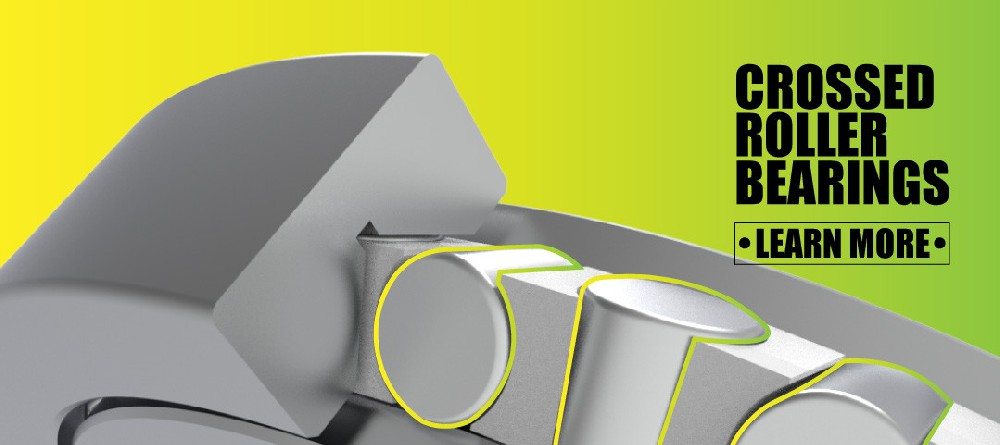
A cross roller bearing uses cylindrical rollers positioned alternately at right angles between inner and outer rings. One roller is oriented in one direction, while the next roller is oriented perpendicular to it.
This crossed arrangement allows a single bearing unit to support radial loads, axial loads from both directions, and moment loads. The roller arrangement also creates broad and stable support geometry within a compact envelope.
Crossed roller bearing designs use two sets of rollers at right angles, with alternating rollers facing opposite directions. This geometry produces a much larger effective support span than the physical bearing width might suggest, improving stability and resistance to tilting.
Line Contact Improves Load Distribution
The primary structural advantage of a cross roller bearing is line contact between cylindrical rollers and raceways.
Angular contact ball bearings use balls. A ball contacts the raceway over a relatively small area. By comparison, cylindrical rollers contact the raceway along a line. This increases the effective load-carrying area.
The benefits include:
– Higher contact stiffness
– Lower elastic deformation under equivalent loading
– Better distribution of radial and axial forces
– Stronger resistance to overturning moments
– Improved load capacity in compact robotic joints
– More stable rotational behavior under variable loads
For a robot joint, this means the bearing can resist deflection more effectively when the robot arm changes orientation or carries an eccentric payload.
Orthogonal Rollers Support Multi-Directional Loads
A conventional bearing arrangement may require two angular contact ball bearings mounted face-to-face, back-to-back, or in tandem. This can provide bidirectional axial support and higher moment stiffness, but it also increases assembly length, tolerance stack-up, mounting complexity, and potential alignment errors.
A cross roller bearing combines multi-directional support into one compact bearing unit.
| Load Requirement | Cross Roller Bearing Performance | Angular Contact Ball Bearing Performance |
|---|---|---|
| Radial load | Strong radial support in one compact unit | Good radial support, depending on arrangement |
| Axial load | Supports axial loads in both directions | Usually supports axial load mainly in one direction per bearing |
| Tilting moment | Excellent due to wide effective support span | Requires paired arrangement for improved moment resistance |
| Rotational rigidity | Very high | Moderate to high, depending on preload and pairing |
| Compactness | High load support in a narrow section | Often requires two bearings and additional spacing |
| Assembly complexity | Lower when using an integrated bearing solution | Higher due to matching, spacing, and preload control |
| High-speed suitability | Suitable for selected designs and controlled lubrication | Often preferred for very high rotational speeds |
| Cost focus | Higher initial unit cost but may reduce system complexity | Lower individual bearing cost, but pair design can raise system cost |
Angular contact ball bearings can carry axial load in one direction and are commonly used in pairs when bidirectional axial support is needed. Cross roller bearings, by contrast, can support radial loads, axial loads from both directions, tilting moments, and combined loading in a compact rotary actuator structure.

Cross Roller Bearings vs. Angular Contact Ball Bearings
Both cross roller bearings and angular contact ball bearings are valuable products. The correct choice depends on the actual performance target of the robotic rotation system.
The key question is not, “Which bearing is better?” The more useful question is, “Which bearing architecture best supports this joint’s load, rigidity, speed, accuracy, and packaging requirements?”
When Cross Roller Bearings Are the Better Choice
Cross roller bearings are usually the stronger solution when a robotic joint requires high rigidity in a limited installation space.
They are particularly suitable for:
– Robot shoulder joints
– Robot waist and torso rotation systems
– Robot elbow joints carrying eccentric loads
– Harmonic reducer output support
– Planetary reducer output stages
– Direct-drive rotary tables
– Hollow rotary platforms
– Medical imaging equipment
– Precision measuring instruments
– Radar and communication platforms
– CNC rotary tables
– Semiconductor and inspection equipment
– Compact positioning systems
Cross roller bearings are widely used in industrial robots and precision rotary equipment because their roller arrangement provides high stability, low runout potential, and strong tilting stiffness while saving installation space.
For robotic designers, the most important advantage is often the ability to reduce the number of components. Instead of designing a complex paired-bearing system, engineers can often use one precision cross roller bearing as the main output support.
This can simplify:
– Housing design
– Shaft design
– Assembly operations
– Preload adjustment
– Quality control
– Service procedures
– Joint length and overall robot weight
When Angular Contact Ball Bearings Are the Better Choice
High-precision angular contact ball bearings remain highly effective in many robotic and automation applications.
They are often preferred when the system prioritizes:
– Very high rotational speed
– Low friction torque at high RPM
– Spindle-type performance
– Lower initial bearing cost
– Standardized bearing arrangements
– Well-controlled axial loading
– Paired-bearing configurations with established mounting practices
For example, high-speed motor spindles, compact servo motors, pump shafts, and certain reducer input stages may use angular contact ball bearings effectively.
A high-speed angular contact ball bearing can deliver excellent rotational smoothness and speed capability. However, when the output joint must carry large combined loads and resist tilting with minimal deformation, a cross roller bearing is generally the more robust structural option.
The Real Meaning of Rigidity in Robot Joints
Rigidity is often discussed as if it were only a bearing property. In reality, robotic joint rigidity is a combined result of the bearing, preload, housing, shaft, reducer, fasteners, and assembly process.
A high-rigidity cross roller bearing can underperform if it is installed in a weak or distorted housing. Similarly, an excellent bearing may develop excessive torque or shortened life if preload is too high.
The total rotational deflection of a robot joint can be understood as:
θtotal=θbearing+θhousing+θshaft+θreducer+θfastening
Where:
-
θbearing is bearing deformation under load
-
θhousing is deformation of the bearing seat and surrounding structure
-
θshaft is bending or torsional deformation of the shaft
-
is compliance from the gearbox or transmission
- θfastening is deformation caused by bolts, interfaces, or joint clearances
This is why experienced bearing selection begins with the complete mechanical system.
Expert Design Insight: Do Not Size Only by Load Rating
A common mistake is choosing a bearing based only on static load rating or dynamic load rating. Load capacity is important, but it does not fully predict joint accuracy.
For robotic rotation systems, engineers should also evaluate:
– Rotational accuracy
– Radial runout
– Axial runout
– Tilting stiffness
– Starting torque
– Friction torque variation
– Preload class
– Bearing clearance
– Installation surface flatness
– Housing rigidity
– Lubrication method
– Seal design
– Operating temperature
– Duty cycle
– Expected service life
A bearing may carry the load safely but still fail to meet positioning requirements if its stiffness, preload, or installation quality is not appropriate.
Practical Bearing Selection for Robotic Rotation Systems
Selecting a cross roller bearing should follow a structured process. A good selection method protects the robot’s accuracy, life, and assembly efficiency.
Step 1: Define the Joint Function
First, identify where the bearing is used.
Is it supporting:
– A robot base rotation axis?
– A shoulder joint?
– An elbow joint?
– A wrist axis?
– A harmonic reducer output?
– A hollow rotary platform?
– A medical positioning mechanism?
– A radar scanning platform?
The joint position determines the likely load direction, moment load level, speed, contamination risk, and space limitation.
Step 2: Calculate Combined Loads
Do not evaluate radial, axial, and moment loads separately without considering the actual operating condition.
The bearing should be checked under:
– Maximum payload condition
– Maximum reach condition
– Emergency stop condition
– Maximum acceleration condition
– Shock or collision condition
– Vertical and horizontal mounting conditions
– Continuous-duty thermal condition
For a robot arm, the maximum moment load often occurs when the arm is fully extended and carries its maximum payload.
Step 3: Choose a Suitable Bearing Structure
Henan Yuwei Industrial Technology Co., Ltd. offers multiple cross roller bearing structures for different equipment requirements.
Common options include:
– Precision crossed cylindrical roller bearings for accurate rotary motion
– High-rigidity cross roller bearings for robot joints and high-moment systems
– Thin-section cross roller bearings for compact and lightweight equipment
– Double-row cross roller bearings for applications requiring enhanced load support
– High-precision angular contact ball bearings for high-speed and precision rotary systems
– High-speed angular contact ball bearings for motor and spindle-related applications
– Long-life angular contact ball bearings for demanding duty cycles
The correct structure should be selected according to the mounting method, ring design, required installation space, load direction, speed, and maintenance conditions.
Step 4: Specify Preload Carefully
Preload removes internal clearance and increases rigidity. However, preload is not always “more is better.”
Too little preload can cause:
– Joint play
– Lower positioning accuracy
– Increased vibration
– Reduced resistance to tilting
Too much preload can cause:
– Higher starting torque
– Increased heat generation
– Reduced speed capability
– Shortened lubrication life
– Premature fatigue
Crossed roller bearing designs can be configured for preload adjustment, allowing engineers to balance rigidity, torque, and service life for the actual robotic application.
Step 5: Control Installation Accuracy
Installation has a major impact on bearing performance. Precision bearings should be mounted on clean, rigid, accurately machined surfaces.
Key assembly practices include:
1. Check shaft and housing geometry before installation.
2. Remove burrs, particles, and surface damage.
3. Ensure mounting faces are flat and perpendicular.
4. Apply fastening bolts in a cross-pattern sequence.
5. Tighten bolts gradually to the specified torque.
6. Verify rotational torque after assembly.
7. Confirm there is no abnormal noise, vibration, or binding.
8. Use the recommended lubricant and relubrication interval.
Contamination, excessive clearance, and unsuitable torque can reduce accuracy and shorten bearing life. In robotic systems, excessive clearance can create delayed motion transfer, imprecise positioning, vibration, and accelerated wear.
Bearing Selection for Different Robot Types
Different robots create different bearing demands. A compact collaborative robot does not experience the same load profile as a radar platform or an industrial palletizing robot.
| Application | Main Bearing Requirement | Recommended Direction |
|---|---|---|
| Collaborative robot | Compact size, smooth motion, controlled torque, precision | Thin-section or precision cross roller bearing |
| Industrial robot | High moment load, strong rigidity, long service life | High-rigidity cross roller bearing |
| SCARA robot | Fast horizontal movement, radial load support, repeatability | Cross roller bearing or angular contact ball bearing arrangement |
| Humanoid robot | Compact actuator design, multi-directional loading, durability | Cross roller bearing for output joints |
| Medical robot | Precision, low vibration, stable positioning | High-precision cross roller bearing |
| AGV steering system | Reliability, shock resistance, compact design | Cross roller bearing or specialized rotary bearing |
| Radar platform | Tilting stiffness, smooth indexing, environmental protection | High-rigidity cross roller bearing |
| CNC rotary table | Accuracy, runout control, high moment support | Precision cross roller bearing |
| Harmonic reducer output | Compact output support, moment stiffness, positioning accuracy | Cross roller bearing |
| Motor or high-speed shaft | High RPM, low friction, thermal control | High-speed angular contact ball bearing |
Why High Rigidity Improves Robot Performance
High rigidity is not only about preventing mechanical deformation. It directly affects the robot’s ability to perform useful work.
Better Positioning Accuracy
When the bearing resists tilting and displacement, the robot’s end effector remains closer to the commanded position. This is critical for welding, dispensing, assembly, inspection, machining, medical procedures, and precision handling.
Better Repeatability
A robot must not only reach one position accurately. It must return to that position repeatedly throughout thousands or millions of cycles.
Bearing clearance and wear can reduce repeatability over time. Cross roller bearings help reduce unwanted movement because they can support combined loads with controlled internal geometry.
Lower Vibration and Smoother Motion
A rigid support structure reduces unwanted joint movement. This can improve motion smoothness, reduce vibration, and help control systems operate more consistently.
Longer System Life
When the bearing maintains alignment, other components also benefit.
This may reduce:
– Gear tooth misalignment
– Reducer wear
– Motor shaft stress
– Seal damage
– Sensor error caused by mechanical instability
– Fastener loosening caused by vibration
The bearing is therefore not just a support component. It is a key contributor to robotic reliability.

Work With a Precision Bearing Manufacturer
A high-performance robot requires more than a standard catalog bearing. It requires a bearing partner that understands mechanical design, load analysis, precision manufacturing, and application-specific customization.
Henan Yuwei Industrial Technology Co., Ltd. focuses on the research, production, and supply of precision cross roller bearings and high-precision angular contact ball bearings. The company supports customers in demanding applications including quadruped robots, service robots, industrial robots, collaborative robots, SCARA robots, medical robots, exoskeleton robots, humanoid robots, special-purpose robots, AGVs, radar systems, precision instruments, printing and dyeing equipment, CNC machine tools, industrial turntables, hollow rotary platforms, DD motors, harmonic reducers, and planetary reducers.
For a robotic rotation system that requires compact installation dimensions, high rigidity, stable accuracy, and reliable support under combined loads, a properly selected cross roller bearing can provide a major structural advantage.
Contact Henan Yuwei Industrial Technology Co., Ltd. with your bearing dimensions, load conditions, speed, installation drawings, accuracy requirements, and operating environment. Our engineering team can help identify the most suitable cross roller bearing or angular contact ball bearing solution for your application.
FAQ
What is a cross roller bearing?
A cross roller bearing is a precision rotary bearing that uses cylindrical rollers arranged alternately at 90 degrees between the inner and outer rings. The structure allows the bearing to support radial, axial, and tilting moment loads in a compact assembly.
Why are cross roller bearings suitable for robot joints?
Robot joints often carry combined radial, axial, and moment loads. Cross roller bearings provide high rigidity and strong resistance to tilting, helping the joint maintain accuracy under changing payload and motion conditions.
Can a cross roller bearing replace two angular contact ball bearings?
In many rotary applications, yes. A single cross roller bearing can provide bidirectional axial support, radial support, and moment-load resistance that might otherwise require a paired angular contact ball bearing arrangement. The final decision should still be based on load, speed, accuracy, and installation requirements.
Are angular contact ball bearings better for high-speed rotation?
Angular contact ball bearings are often preferred for very high-speed applications because they can provide low friction and strong high-RPM performance. For high moment loads and compact high-rigidity robot joints, cross roller bearings are usually more suitable.
How does preload affect a cross roller bearing?
Preload reduces internal clearance and improves rigidity. However, excessive preload can increase friction, torque, and heat. The preload level should be selected according to the load, speed, required accuracy, and expected service life.
What causes poor performance in a cross roller bearing?
Common causes include incorrect preload, contaminated raceways, poor housing rigidity, mounting surface distortion, uneven bolt tightening, insufficient lubrication, excessive speed, and inaccurate load estimation.
Which robot joints benefit most from high-rigidity cross roller bearings?
Robot base axes, waist joints, shoulder joints, elbow joints, harmonic reducer outputs, direct-drive rotary actuators, and precision positioning axes often benefit most because they experience significant moment loads and require stable rotational accuracy.
References
1. [Timken — Crossed Roller Precision Bearings]
2. [Tech Briefs — The Crucial Role of Bearings in the Humanoid Robotics Revolution]
3. [Machine Design — Why Crossed Roller Bearings Dominate Precision Robotics]
5. [Schaeffler Medias — Cross Roller Bearings]
6. [Henan Yuwei Industrial Technology Co., Ltd. — Angular Contact Ball Bearing vs. Cross Roller Bearing]
Hot Tags: Cross Roller Bearings, Crossed Roller Bearings, Robot Joint Bearings, Robotic Rotation Systems, High Rigidity Bearings, Precision Robot Bearings, Industrial Robot Bearings, Angular Contact Ball Bearings, Harmonic Reducer Bearings, Rotary Table Bearings