Content Menu
● Understanding the Two Bearing Designs
>> What Is a Four-Point Contact Ball Bearing?
>> What Is a Cross Roller Bearing?
● Four-Point Contact Ball Bearing vs Cross Roller Bearing: Core Differences
● Load Capacity and Moment Resistance
>> Why Moment Load Matters in Hollow Shaft Systems
>> Four-Point Contact Ball Bearing Under Combined Loads
>> Cross Roller Bearing Under Combined Loads
● Rigidity, Accuracy, and Deflection Control
>> Cross Roller Bearings Deliver Higher Structural Rigidity
>> Preload Is Powerful but Must Be Controlled
● Speed, Torque, and Thermal Performance
>> Four-Point Contact Ball Bearings Can Favor Higher-Speed Motion
>> Cross Roller Bearings Favor Precision over Maximum Speed
● Installation Accuracy: The Often-Overlooked Selection Factor
>> Practical Installation Checklist
>> Choose a Four-Point Contact Ball Bearing When
>> Choose a Cross Roller Bearing When
● Expert Insight: Select the System, Not Only the Bearing
● FAQ
>> 1. Can a four-point contact ball bearing carry radial, axial, and moment loads?
>> 2. Why is a cross roller bearing better for robot joints?
>> 3. Is a cross roller bearing suitable for a large hollow shaft?
>> 4. Which bearing has lower friction torque?
>> 5. Does more preload always improve cross roller bearing accuracy?
>> 6. What should be checked before installing a cross roller bearing?
>> 7. How should bearing life be evaluated?
When engineering a large hollow shaft mechanism, the bearing is not simply a supporting component. It directly affects rotary accuracy, tilting stiffness, torque stability, service life, installation complexity, and the usable diameter of the central opening. For applications such as robot joints, hollow rotary platforms, radar antennas, medical imaging equipment, DD motors, harmonic reducers, precision machine tools, and automated handling systems, the choice between a four-point contact ball bearing and a cross roller bearing can determine the long-term performance of the complete assembly.
At Henan Yuwei Industrial Technology Co., Ltd., we work with precision cross roller bearings and high-precision angular contact ball bearings used in demanding rotating systems. From an engineering perspective, the correct selection should not begin with the question, “Which bearing is better?” Instead, it should begin with: What loads, accuracy targets, speed requirements, shaft-opening dimensions, and installation conditions must the mechanism satisfy?
For a large hollow shaft structure, a four-point contact ball bearing can offer a compact and economical solution where smooth rotation, bidirectional axial load capacity, and moderate combined loads are required. A cross roller bearing is usually the stronger candidate when the mechanism must withstand high overturning moments, maintain exceptional rigidity, and achieve stable rotational accuracy under complex loading.

Understanding the Two Bearing Designs
What Is a Four-Point Contact Ball Bearing?
A four-point contact ball bearing is a single-row angular contact ball bearing with a specialized raceway geometry. Its inner ring is commonly split into two pieces, allowing each ball to contact the raceways at four points under axial loading conditions.
This structure enables the bearing to support:
– Axial loads in both directions
– Limited radial loads
– Certain combined radial, axial, and moment loads
– Compact axial installation dimensions
– Smooth rotational motion at relatively higher speeds
The bearing is often selected when designers want to replace a pair of single-row angular contact ball bearings with one compact bearing arrangement. SKF describes four-point contact ball bearings as single-row angular contact bearings designed mainly to support axial loads in both directions, while allowing a limited radial load depending on the applied axial load ratio.
For large hollow shaft mechanisms, the bearing may be integrated around the outside of a large-diameter central bore. This creates space for cables, pneumatic tubing, optical fibers, drive shafts, encoder wiring, vacuum lines, or robotic utility routing.
What Is a Cross Roller Bearing?
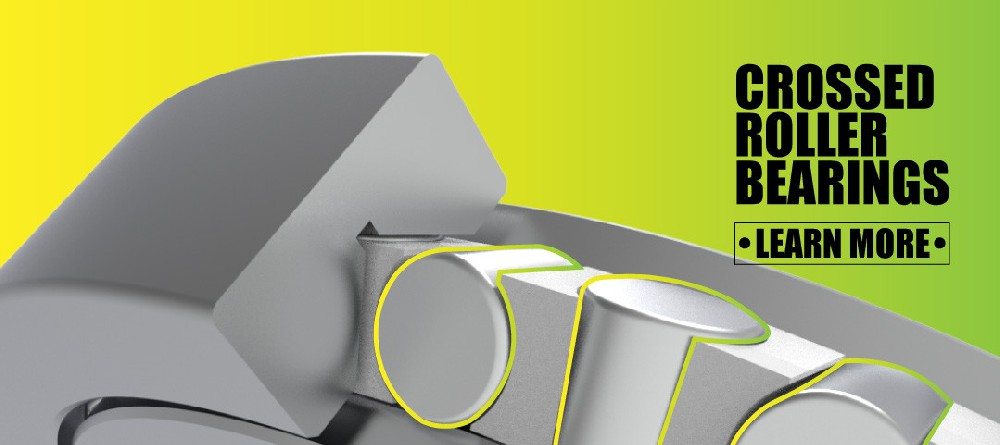
A cross roller bearing uses cylindrical rollers arranged alternately at 90 degrees. One roller faces one direction, while the adjacent roller faces the opposite direction. This crossed arrangement enables the bearing to carry radial loads, axial loads, and overturning moments simultaneously within one compact bearing structure.
Unlike ball bearings, which generally operate through point contact, cylindrical rollers create a broader contact zone with the raceway. This allows the load to be distributed across a larger surface area.
A precision cross roller bearing is particularly valuable for mechanisms requiring:
– High radial stiffness
– High axial stiffness
– High moment-load capacity
– Low rotational runout
– Accurate positioning
– Stable motion under changing load directions
– Compact integration in robot joints and rotary tables
IKO notes that crossed roller bearings can carry radial, thrust, and moment loads at the same time, while their structural design supports high rigidity and high rotational accuracy.
For large hollow shaft mechanisms, the cross roller bearing is often placed concentrically around the hollow section. This configuration supports the rotating structure without sacrificing the central passage required for cables, shafts, fluid lines, or other functional components.
Four-Point Contact Ball Bearing vs Cross Roller Bearing: Core Differences
The following comparison highlights the most important differences for engineers designing large hollow shaft mechanisms.
| Comparison Factor | Four-Point Contact Ball Bearing | Cross Roller Bearing |
|---|---|---|
| Rolling element | Steel balls | Cylindrical rollers |
| Contact geometry | Multi-point ball contact | Line-like roller contact |
| Main load advantage | Bidirectional axial loads with limited radial load | Combined radial, axial, and moment loads |
| Tilting stiffness | Moderate | Very high |
| Moment-load capacity | Suitable for moderate moments | Excellent for high overturning moments |
| Rotational accuracy | Good when correctly mounted | Excellent in precision applications |
| Speed capability | Often more suitable for higher-speed rotation | Usually better for moderate-speed precision rotation |
| Friction torque | Generally lower | Can be higher, especially with preload |
| Installation sensitivity | Relatively tolerant in standard applications | More sensitive to mounting surface accuracy |
| Hollow shaft suitability | Good for compact axial layouts | Excellent for rigid, large-bore precision platforms |
| Typical applications | Pumps, gearboxes, compact rotary units, indexing systems | Robot joints, radar systems, rotary tables, medical devices, reducers |
The fundamental distinction is simple: four-point contact ball bearings prioritize compact bidirectional thrust support and smooth motion, while cross roller bearings prioritize rigidity, moment resistance, and high-precision rotation.
Load Capacity and Moment Resistance
Why Moment Load Matters in Hollow Shaft Systems
A large hollow shaft mechanism often carries an offset load. For example, a robot arm may be mounted to one side of a rotating joint. A radar antenna may extend away from the rotation axis. A machine tool fixture may hold a workpiece with a center of gravity outside the bearing centerline.
This creates an overturning moment.
The basic relationship is:
M=F×L
Where:
– M is overturning moment
– F is the applied force
– L is the distance from the bearing centerline
Even a moderate external force can create a substantial moment when the load is positioned far from the rotational center. This is why bearing selection for a large hollow shaft cannot rely only on radial load or axial load values.
Four-Point Contact Ball Bearing Under Combined Loads
Four-point contact ball bearings can manage combined loading, but their strongest function remains bidirectional axial support. Their raceway geometry allows one bearing to handle thrust from both directions, which can reduce axial space compared with a paired angular contact arrangement.
However, when radial loads and overturning moments increase, the ball contact pattern becomes more heavily concentrated. This may result in higher contact stress, reduced stiffness, and more noticeable elastic deflection compared with a cross roller design.
A four-point contact ball bearing may be the right choice when:
– Axial load is the dominant force
– Radial load remains limited
– The moment load is moderate
– Smooth rotation and lower torque are important
– The mechanism operates at relatively high speed
– Cost control is a major design objective
Schaeffler identifies four-point contact bearings as particularly suitable for applications dominated by axial load, especially where the available axial space is insufficient for a double-row angular contact bearing arrangement.
Cross Roller Bearing Under Combined Loads
Cross roller bearings are designed for applications where loading direction may change continuously. The alternating roller orientation allows the bearing to resist forces from multiple directions while maintaining strong support against tilting.
This is especially beneficial for a large hollow shaft mechanism used in:
– Industrial robot waist joints
– Collaborative robot shoulder or elbow joints
– Four-legged robot leg modules
– Radar and communication antenna platforms
– Medical diagnostic equipment
– CNC rotary tables
– Hollow rotary actuators
– Harmonic drive and planetary reducer output stages
Because rollers provide a wider contact region than balls, a cross roller bearing generally offers higher rigidity and better resistance to deformation under load. Crossed roller bearing systems are specifically known for handling radial force, thrust, and moment loads simultaneously.

Rigidity, Accuracy, and Deflection Control
Cross Roller Bearings Deliver Higher Structural Rigidity
For precision machinery, stiffness is often more important than the nominal load rating. A bearing can technically carry a load but still allow too much angular deflection for the application to perform accurately.
In a robot joint, even small angular deformation can produce visible positional error at the end effector. In a radar platform, bearing deflection can affect tracking direction. In a medical system, vibration or rotational instability can reduce measurement reliability.
A cross roller bearing is usually preferred when the application requires:
– Low angular deflection
– Stable rotational accuracy
– High resistance to external moments
– Consistent repeatability
– High positioning precision
– Improved machine rigidity
Schaeffler states that cross roller bearings are highly rigid, offer high running accuracy, and can be supplied with normal clearance, low clearance, or preload.
In practical terms, preload helps reduce internal clearance and improve stiffness. However, engineers should not assume that more preload is always better.
Preload Is Powerful but Must Be Controlled
Preload can improve rotational accuracy and reduce vibration. It can also increase starting torque, operating temperature, and contact stress. Excessive preload can shorten bearing life or cause surface damage.
THK warns that excessive preload may create indentation, shorten service life, or cause operational problems.
For this reason, the preload selection should be based on:
– Actual radial, axial, and moment loads
– Required rotational accuracy
– Target torque range
– Operating temperature
– Lubrication type
– Mounting accuracy
– Duty cycle
– Shock-load conditions
For high-precision hollow rotary platforms, a light or moderate preload is often a practical balance between rigidity and service life. For extreme moment loads, a carefully selected higher preload may be appropriate, but only after detailed engineering verification.
Speed, Torque, and Thermal Performance
Four-Point Contact Ball Bearings Can Favor Higher-Speed Motion
Ball bearings generally produce less rolling friction than roller bearings under comparable conditions. This makes a four-point contact ball bearing attractive for applications requiring faster rotation, lower running torque, or lower heat generation.
Typical examples include:
– High-speed rotary heads
– Compact motor-supported mechanisms
– Pump and gearbox assemblies
– Fast indexing systems
– Lightweight rotating modules
– Certain high-speed hollow shaft drives
However, speed capability should never be evaluated by bearing type alone. Cage design, lubrication, preload, seal arrangement, fit, thermal expansion, and operating load all influence the final permissible speed.
SKF explains that bearing catalogues commonly distinguish between reference speed, which is linked to thermal conditions, and limiting speed, which is related to mechanical limits.
Cross Roller Bearings Favor Precision over Maximum Speed
Cross roller bearings can operate at practical rotational speeds, but their primary strength is not maximum speed. They are typically selected for precision, stiffness, and load stability rather than ultra-high-speed performance.
When a large hollow shaft mechanism requires both high speed and high rigidity, the engineering team should evaluate:
1. Bearing size and roller arrangement.
2. Preload level.
3. Lubricant viscosity and supply method.
4. Cage or separator design.
5. Heat dissipation through the housing.
6. Duty cycle and acceleration profile.
7. External load variation during rotation.
In many robotic and industrial rotary systems, the goal is not continuous high-speed operation. It is rapid acceleration, accurate stopping, repeated positioning, and stable motion under changing loads. In these cases, a cross roller bearing may deliver superior overall system performance even if its maximum speed is lower than a comparable ball-bearing solution.
Installation Accuracy: The Often-Overlooked Selection Factor
A high-performance bearing cannot compensate for an inaccurate housing, poor mounting surface flatness, or uneven bolt tightening. This is particularly important for cross roller bearings.
Because they are highly rigid, cross roller bearings transfer mounting errors directly into the rotating system. Uneven support surfaces may create local stress concentration, torque fluctuation, reduced accuracy, and shortened life.
THK recommends specific shaft and housing fit ranges for several cross-roller ring designs, including h7/H7 fits in positioning applications and more precise recommended fits for certain series.
Practical Installation Checklist
Before installing either bearing type in a large hollow shaft mechanism, verify the following:
– Housing shoulder flatness and perpendicularity
– Shaft and housing dimensional tolerances
– Surface roughness of mounting seats
– Bolt-hole alignment
– Even tightening sequence for flange bolts
– Correct lubrication quantity and type
– Absence of burrs, dents, or contamination
– Proper control of preload or internal clearance
– Thermal expansion between shaft, bearing, and housing
– Compatibility between the bearing and seal design
For a cross roller bearing, the mounting process should be treated as a precision assembly operation rather than a conventional bearing installation.
Application Selection Guide
Choose a Four-Point Contact Ball Bearing When
A four-point contact ball bearing is often the better solution when the design requires compact bidirectional axial support with moderate overall loads.
Consider this bearing type when:
– The mechanism experiences mainly axial loading.
– Radial loads are limited.
– Moment loads are moderate.
– Low friction torque is important.
– The operating speed is relatively high.
– Axial installation space is restricted.
– The project requires a cost-effective compact arrangement.
– The application can tolerate moderate deformation under moment load.
A large hollow shaft gearbox, compact rotary actuator, or moderate-duty indexing system may benefit from this approach.
Choose a Cross Roller Bearing When
A cross roller bearing is generally the better solution when the hollow shaft mechanism must remain stiff and accurate under complex loading.
Consider this bearing type when:
– High overturning moments are present.
– The rotating platform carries offset loads.
– Radial, axial, and moment loads act simultaneously.
– The mechanism needs high rotational accuracy.
– Low runout is essential.
– Position repeatability is critical.
– The application includes shock loads or changing load directions.
– The center bore must remain large without sacrificing rigidity.
For robot joints, hollow rotary tables, radar antenna supports, medical robots, precision measurement systems, and reducer output mechanisms, a cross roller bearing is frequently the more reliable engineering choice.
Expert Insight: Select the System, Not Only the Bearing
The most common mistake in bearing selection is comparing only catalog load ratings. In real engineering projects, a bearing works as part of a system that includes the shaft, housing, drive motor, reducer, flange, bolts, seals, lubrication, and external load structure.
A cross roller bearing may have excellent stiffness, but its advantage can be reduced by a thin housing wall or flexible mounting flange. A four-point contact ball bearing may be economical, but it can become unsuitable if the actual moment load is underestimated.
For a large hollow shaft mechanism, evaluate the full assembly:
– Bearing internal geometry
– Hollow bore diameter
– Load position relative to the rotation axis
– Housing wall thickness
– Flange rigidity
– Bolt pattern and preload
– Motor torque and acceleration
– Reducer output load
– Required positioning accuracy
– Environmental contamination level
– Lubrication access and maintenance interval
The correct bearing selection is therefore a balance between load capacity, stiffness, speed, torque, service life, manufacturing cost, and installation capability.

Final Recommendation
For most large hollow shaft mechanisms requiring high precision, high moment-load capacity, and reliable structural stiffness, a cross roller bearing is the stronger long-term solution. Its crossed roller arrangement provides excellent support for radial, axial, and overturning loads while maintaining stable rotation in demanding applications.
A four-point contact ball bearing remains a highly practical option when the system is dominated by bidirectional axial loads, moderate radial loads, moderate moments, compact axial space, and faster rotational requirements.
Henan Yuwei Industrial Technology Co., Ltd. develops precision cross cylindrical roller bearings, high-rigidity cross roller bearings, thin-section cross roller bearings, double-row cross roller bearings, and high-precision angular contact ball bearings for advanced automation and precision-motion applications. Whether your project involves a hollow robot joint, radar platform, DD motor, medical device, industrial turntable, harmonic reducer, or large-diameter rotary assembly, our engineering team can help evaluate the bearing structure, load condition, precision target, and installation requirements.
Contact Yuwei Bearing to discuss your large hollow shaft mechanism and receive a bearing selection recommendation matched to your load, rigidity, speed, and accuracy requirements.
FAQ
1. Can a four-point contact ball bearing carry radial, axial, and moment loads?
Yes. A four-point contact ball bearing can support combined loading, including axial loads in both directions and limited radial loads. However, it is generally more suitable for applications where axial loads are dominant and moment loads remain moderate.
2. Why is a cross roller bearing better for robot joints?
Robot joints often experience radial loads, axial loads, changing directions of force, and high overturning moments simultaneously. A cross roller bearing supports these combined loads while offering high rigidity and accurate rotation, making it suitable for industrial robots, collaborative robots, humanoid robots, and medical robots.
3. Is a cross roller bearing suitable for a large hollow shaft?
Yes. Cross roller bearings are commonly used around a large central opening when the mechanism needs to pass cables, piping, shafts, or utility lines through the center. Their compact radial structure and high moment stiffness make them particularly suitable for hollow rotary platforms and robot joints.
4. Which bearing has lower friction torque?
A four-point contact ball bearing will often provide lower friction torque than a preloaded cross roller bearing. However, actual torque depends on preload, lubricant, seals, load, speed, bearing size, and assembly accuracy.
5. Does more preload always improve cross roller bearing accuracy?
No. Preload can improve stiffness and reduce clearance, but excessive preload can increase torque, heat, contact stress, and the risk of premature damage. The preload level should be selected according to actual loads, accuracy targets, and operating conditions.
6. What should be checked before installing a cross roller bearing?
Check housing flatness, shaft and housing fits, mounting surface roughness, bolt tightening sequence, lubrication, cleanliness, preload condition, and thermal expansion. Cross roller bearings are precision components and can be sensitive to mounting inaccuracies.
7. How should bearing life be evaluated?
Bearing life should be evaluated using the manufacturer’s load ratings, actual equivalent dynamic load, speed, lubrication condition, contamination level, mounting accuracy, preload, and reliability target. ISO 281 provides methods for calculating basic rating life, generally associated with 90% reliability.
References
1. [SKF — Four-Point Contact Ball Bearings]
2. [NSK — Four-Point Contact Ball Bearings]
3. [IKO — Crossed Roller Bearings]
4. [Schaeffler — Cross Roller Bearings]
5. [THK — Cross-Roller Ring Technical Catalogue]
6. [THK — Preload and Maintenance Guidance]
7. [SKF — Bearing Speed Limitations]
8. [ISO — Rolling Bearings: Dynamic Load Ratings and Rating Life]
Hot Tags: Cross Roller Bearing, Four Point Contact Ball Bearing, Hollow Shaft Bearing, Precision Cross Roller Bearing, High Rigidity Bearing, Robot Joint Bearing, Hollow Rotary Platform Bearing, Industrial Turntable Bearing, Harmonic Reducer Bearing, Precision Rotary Bearing