Content Menu
● What Is a Four-Point Angular Contact Ball Bearing?
>> Why the four-point design matters
● How Four-Point Contact Ball Bearings Work
>> Load path inside the bearing
>> Axial load versus radial load
● Four-Point Bearing Versus Other Bearing Types
>> Four-point contact versus deep groove ball bearings
>> Four-point contact versus double-row angular contact bearings
>> Four-point contact versus crossed roller bearings
>> 1. Define the real duty cycle
>> 2. Calculate equivalent bearing load
>> 4. Select precision and clearance
>> 5. Choose lubrication for the operating condition
● Installation Practices That Protect Bearing Life
● Applications for High-Precision Bearing Solutions
● Choose the Right Bearing Partner
>> What is a four-point angular contact ball bearing?
>> Can a four-point contact bearing carry radial loads?
>> Why is a four-point bearing used with a cylindrical roller bearing?
>> What is the difference between a four-point bearing and a double-row angular contact bearing?
>> What does the QJ designation mean?
>> Can four-point contact bearings be used in robotic equipment?
>> How can I extend the service life of a four-point contact bearing?
>> What information should I provide when requesting a bearing quotation?
A four-point angular contact ball bearing is a compact, high-precision bearing solution designed primarily for applications with axial loads acting in both directions. Its raceway geometry allows one bearing to provide bidirectional thrust support while occupying much less axial space than a double-row bearing arrangement.
For robotics, radar systems, CNC equipment, rotary tables, harmonic reducers, precision measurement equipment, and compact transmission assemblies, the right four-point contact bearing can improve stiffness, simplify the structure, and support reliable motion. However, it must be selected according to the real load ratio, speed, mounting arrangement, lubrication condition, and required accuracy—not only by bore diameter or catalog load rating.

What Is a Four-Point Angular Contact Ball Bearing?
A four-point angular contact ball bearing, often called a four-point contact bearing or QJ-type bearing, is a single-row angular contact ball bearing engineered to carry axial loads in both directions.
The name comes from its internal geometry. Under axial loading, each ball contacts the inner and outer raceways at four possible points. This arrangement enables the bearing to accommodate alternating thrust loads from either direction while retaining a compact cross-section.
Unlike a conventional deep groove ball bearing, which is optimized mainly for radial loads, a four-point angular contact ball bearing is primarily intended for purely axial or predominantly axial loading. It can also accept a limited radial load when the application load ratio is appropriate.
In practical equipment design, this bearing is often paired with a cylindrical roller bearing. The roller bearing carries the main radial load, while the four-point bearing controls axial movement in both directions. This creates a compact locating-bearing arrangement for gearboxes, machine tools, reducers, and rotating platforms.
Core structural features
A typical four-point angular contact ball bearing includes:
– A single row of precision balls.
– An inner ring that may be split into two ring halves.
– A one-piece outer ring with specially designed raceways.
– A cage that separates and guides the balls.
– A relatively large contact angle, commonly around 35 degrees.
– Geometry designed to accept bidirectional axial force.
The split inner-ring construction is especially important. It makes assembly easier and allows the bearing to support thrust loads in either direction without requiring two separate single-row angular contact ball bearings.
Why the four-point design matters
The design offers a useful engineering trade-off: it saves axial space and manages reversing thrust loads, but it is not a universal substitute for radial bearings.
A four-point contact bearing is most effective when:
– The shaft experiences axial force in both directions.
– Radial loading is low or is carried by another bearing.
– The assembly has strict axial-space limitations.
– High positioning accuracy is required.
– The operating system needs a compact locating function.
For example, a compact robotic joint or harmonic reducer may experience repeated thrust reversal during acceleration, deceleration, and directional changes. A correctly selected four-point bearing can control this axial movement without adding the length of a back-to-back or face-to-face bearing pair.
How Four-Point Contact Ball Bearings Work
The working principle is based on the relationship between the balls, the raceways, and the contact angle.
When axial force acts on the shaft, the rolling elements transmit that force through angled contact paths between the inner and outer rings. Because the raceways are designed with four-point contact geometry, the bearing can support thrust from either direction.
In an ideal operating condition, the load should be sufficiently axial to maintain stable rolling contact. If radial load becomes too large relative to axial load, the internal contact conditions can change. This may increase sliding, heat, wear, vibration, or cage stress.
Load path inside the bearing
The simplified load path is:
1. The shaft transfers force to the inner ring.
2. The inner-ring raceway transfers force to the balls.
3. The balls transmit the force through angled contact paths.
4. The outer ring transfers the load into the housing.
5. The housing distributes the force into the machine structure.
Because the contact angle is relatively large, the bearing has strong axial-load capability. However, the same geometry means it should not be treated as a high-radial-load bearing unless the manufacturer has verified that operating condition.

Axial load versus radial load
The most important selection question is not simply, “How much load is present?” It is:
> What is the actual relationship between axial load and radial load throughout the duty cycle?
For a standard four-point contact bearing, axial load should generally dominate. Schaeffler notes that a minimum axial load condition of Fa≥1.2Fr is required in certain arrangements to prevent damage caused by slippage. SKF also recommends evaluating the axial-to-radial force ratio carefully when applying this bearing type.
This means a four-point contact bearing should not be selected only because it can technically carry “combined loads.” The combined-load ratio must be suitable.
| Operating condition | Suitability of four-point bearing | Design consideration |
|---|---|---|
| High axial load in both directions | Excellent | Core application scenario |
| Predominantly axial load with limited radial force | Good | Confirm load ratio and equivalent load |
| High radial load with modest axial force | Limited | Add a radial bearing or choose another arrangement |
| Alternating thrust direction | Excellent | Verify clearance, preload, and cage selection |
| Severe shock load | Application-dependent | Check static capacity and mounting stiffness |
| High-speed operation | Possible | Evaluate lubrication, cage, heat, and limiting speed |
Four-Point Bearing Versus Other Bearing Types
Bearing selection should begin with the machine function, not with a familiar bearing name. A compact arrangement may look attractive on a drawing but fail prematurely if the load path, rigidity, or lubrication plan is incorrect.
Four-point contact versus deep groove ball bearings
Deep groove ball bearings are versatile and economical. They primarily carry radial loads, while also accommodating moderate axial forces depending on their design and internal clearance.
A four-point angular contact ball bearing is different because it is designed for strong bidirectional axial support.
| Feature | Four-point angular contact ball bearing | Deep groove ball bearing |
|---|---|---|
| Primary load direction | Axial load in both directions | Radial load |
| Axial-load capability | High | Moderate, depending on design |
| Radial-load capability | Limited relative to axial capacity | High for general radial service |
| Axial space requirement | Compact | Compact |
| Typical use | Locating bearing, thrust reversal, compact transmission | Motors, pumps, fans, general machinery |
| Best arrangement | Often combined with radial bearing | Often used as a standalone bearing |
A deep groove bearing can be a better choice for a compact motor shaft carrying mainly radial belt or gear forces. A four-point bearing becomes more relevant when the same shaft must repeatedly resist axial thrust from both directions.
Four-point contact versus double-row angular contact bearings
Double-row angular contact ball bearings can carry combined radial and axial loads with greater radial stability than a four-point bearing. They are often preferred when the machine requires a more self-contained bearing solution.
However, they generally need more axial space.
A four-point contact bearing may be more suitable when the designer can separate the radial and axial bearing functions. For instance, a cylindrical roller bearing can manage radial force while the four-point bearing handles bidirectional axial positioning.
This separation can improve packaging flexibility in compact reducers, precision rotary units, radar mechanisms, and industrial gearboxes.
Four-point contact versus crossed roller bearings
Crossed roller bearings and four-point angular contact ball bearings serve different mechanical priorities.
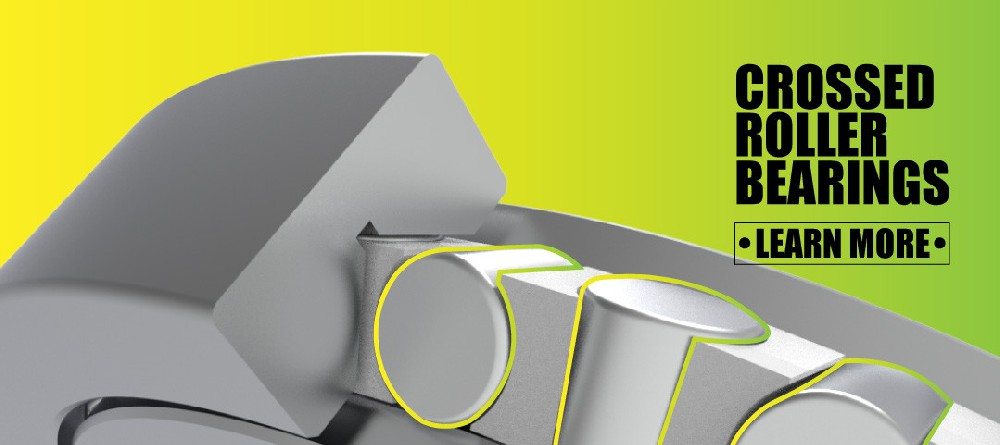
Crossed roller bearings are frequently selected for high rigidity, moment-load capacity, low runout, and precision rotary motion. They are commonly used in robot joints, rotary tables, medical equipment, measuring instruments, and semiconductor-related equipment.
Four-point contact ball bearings are often selected where bidirectional axial force, high rotational speed, and axial compactness are critical.
For a robot waist joint or a hollow rotary table with substantial overturning moment, a precision crossed roller bearing may be the more appropriate solution. For a gearbox shaft requiring compact bidirectional thrust positioning alongside a dedicated radial bearing, a four-point contact bearing may offer the more efficient arrangement.
Critical Selection Factors
A reliable bearing selection requires more than checking dynamic load rating C and static load rating C0. Engineers should analyze the full operating environment and the entire load spectrum.
1. Define the real duty cycle
Do not select from peak load alone. Document:
– Continuous operating load.
– Start-stop frequency.
– Reversing direction frequency.
– Shock and vibration events.
– Speed range.
– Acceleration and deceleration.
– Expected operating hours.
– Temperature range.
– Contamination exposure.
– Lubrication method.
A robot joint operating 16 hours per day with frequent direction reversals requires a different bearing assessment from a low-speed indexing table, even if both have the same nominal load.
2. Calculate equivalent bearing load
The basic rating life calculation for ball bearings is commonly expressed as:
L10=(C/P)3
Where:
– L10 is the basic rating life in millions of revolutions.
– C is the basic dynamic load rating.
– P is the dynamic equivalent bearing load.
This equation is useful, but it is not a complete life prediction. Actual bearing life is also influenced by lubrication film quality, contamination, mounting accuracy, internal clearance, material cleanliness, corrosion, electrical current damage, vibration, and temperature.
For this reason, a bearing that appears adequate in a simplified load calculation can still experience early failure if the housing is distorted, lubricant is contaminated, or the shaft fit is incorrect.
3. Check static safety
Static load rating matters especially in equipment that experiences:
– Sudden impact.
– High starting torque.
– Emergency stops.
– Transport vibration.
– Heavy clamping forces.
– Stationary loads.
– Robot-arm emergency braking.
– High moment loads caused by eccentric payloads.
A bearing can survive a dynamic duty cycle but still suffer permanent raceway indentation if it experiences excessive static contact stress. This can later appear as noise, torque fluctuation, vibration, or reduced positioning precision.
4. Select precision and clearance
Precision equipment requires more than a standard dimensional fit.
For industrial robots, radar positioning systems, precision rotary tables, CNC mechanisms, medical devices, and measuring equipment, evaluate:
– Radial runout.
– Axial runout.
– Ring perpendicularity.
– Bore and outside-diameter tolerances.
– Internal clearance.
– Axial clearance after mounting.
– Housing rigidity.
– Shaft rigidity.
– Thermal expansion.
For applications that require stable positioning, a controlled-clearance or preloaded arrangement may be necessary. Excessive clearance can reduce stiffness and repeatability. Excessive preload can create heat, increase friction, shorten lubricant life, and reduce service life.
5. Choose lubrication for the operating condition
Lubrication is a design variable, not a maintenance afterthought.
Grease may be suitable for sealed or moderate-speed applications with simplified maintenance requirements. Oil lubrication may be preferable when the application has high speed, elevated temperature, high heat generation, or a circulating lubrication system.
When specifying lubricant, consider:
– Base-oil viscosity at operating temperature.
– Grease thickener compatibility.
– Speed factor.
– Load level.
– Water exposure.
– Corrosive environment.
– Relubrication accessibility.
– Compatibility with seals, cages, and adjacent materials.
Too much grease can also create heat. The objective is not to fill every free space, but to establish a stable lubricating film while avoiding churning losses.
Installation Practices That Protect Bearing Life
Many bearing failures begin during installation, not during normal operation. Precision bearings require precision mounting surfaces, clean assembly procedures, and correctly applied mounting force.
Before installation
Inspect the shaft and housing for:
– Burrs, dents, corrosion, and machining damage.
– Out-of-roundness.
– Taper.
– Shoulder squareness.
– Surface roughness.
– Inadequate fillet clearance.
– Contamination from chips, dust, or abrasive particles.
Even a small burr can prevent complete ring seating. This can create ring distortion and uneven internal loading.
During installation
Follow these practical rules:
1. Keep the bearing in its original packaging until immediately before installation.
2. Clean the shaft, housing, tools, and work area thoroughly.
3. Apply mounting force only to the ring being fitted.
4. Never transmit installation force through the balls.
5. Use controlled heating for interference fits when required.
6. Confirm the bearing is seated firmly against the shaft or housing shoulder.
7. Verify axial clearance or preload after assembly.
8. Rotate the assembly by hand before high-speed commissioning.
9. Monitor temperature, noise, and vibration during the first operating period.
For example, when fitting a bearing tightly onto a shaft, force should be applied to the inner ring. Applying force through the outer ring and rolling elements can damage the raceways before the equipment even enters service.
Applications for High-Precision Bearing Solutions
Four-point angular contact ball bearings are suitable for many precision motion systems when their load characteristics match the bearing design.
Common applications include:
– Industrial robots and collaborative robots.
– Service robots and humanoid robots.
– AGV and autonomous mobile equipment.
– Radar vehicles and communication radar systems.
– CNC machine tools and machining centers.
– Rotary tables and hollow rotary platforms.
– Gearboxes and planetary reducers.
– Harmonic reducers.
– Direct-drive torque motor systems.
– Precision measuring instruments.
– Medical equipment.
– Printing and dyeing equipment.
– High-speed rotating assemblies.
– Compact aerospace and specialized machinery.
Henan Yuwei Industrial Technology Co., Ltd. focuses on precision bearing development and manufacturing for demanding motion systems. Its product range includes precision crossed cylindrical roller bearings, high-rigidity crossed roller bearings, thin-section crossed roller bearings, double-row crossed roller bearings, high-precision angular contact ball bearings, high-speed angular contact ball bearings, and long-life angular contact ball bearings.
For customers developing robots, reducers, radar platforms, CNC equipment, or high-precision rotary mechanisms, bearing selection should be based on the whole assembly. The correct bearing is the one that fits the load path, structural stiffness, installation method, target life, accuracy requirement, and cost target together.

Choose the Right Bearing Partner
A four-point angular contact ball bearing can reduce axial space, manage reversing thrust loads, and support reliable precision motion—but only when it is correctly matched to the application.
Henan Yuwei Industrial Technology Co., Ltd. works with customers on precision bearing solutions for robotics, radar systems, CNC machines, rotating platforms, reducers, medical equipment, and specialized automation. Share your drawing, bearing model, operating loads, speed, accuracy target, and application conditions to receive a practical bearing recommendation and technical evaluation.
Yuwei Bearings: Supporting safer rotation for the world.
Frequently Asked Questions
What is a four-point angular contact ball bearing?
A four-point angular contact ball bearing is a single-row bearing designed to support axial loads in both directions. Its specialized raceway geometry allows the balls to form four potential contact points between the inner and outer rings.
Can a four-point contact bearing carry radial loads?
Yes, but its radial-load capability is limited relative to its axial-load function. It is best suited for purely axial or predominantly axial loads. In many machines, a separate cylindrical roller bearing or other radial bearing carries the primary radial load.
Why is a four-point bearing used with a cylindrical roller bearing?
This arrangement separates the bearing functions. The cylindrical roller bearing handles radial load, while the four-point contact bearing handles bidirectional axial location. This can create a compact and efficient locating-bearing system.
What is the difference between a four-point bearing and a double-row angular contact bearing?
A four-point bearing is a single-row design that saves axial space and primarily supports bidirectional axial loads. A double-row angular contact bearing generally provides stronger combined radial and axial support but usually occupies more axial space.
What does the QJ designation mean?
QJ is a common designation used for four-point contact ball bearing series. Exact dimensions, cages, clearances, materials, load ratings, and limiting speeds vary by manufacturer and bearing size.
Can four-point contact bearings be used in robotic equipment?
Yes. They can be used in robotic and automated equipment where compact axial design and bidirectional thrust support are required. For joints with high overturning moments or high rigidity requirements, a crossed roller bearing may be more appropriate.
How can I extend the service life of a four-point contact bearing?
Use the correct load arrangement, maintain proper lubrication, prevent contamination, ensure accurate mounting, select suitable fits and clearance, avoid excessive preload, and monitor temperature, vibration, and noise during operation.
What information should I provide when requesting a bearing quotation?
Provide the bearing model or dimensions, radial load, axial load, speed, accuracy class, clearance or preload requirement, operating temperature, lubrication method, working environment, expected service life, annual quantity, and any special material, sealing, or cage requirements.
References
1. [SKF — Four-Point Contact Ball Bearings]
2. [SKF — QJ 208 MA Four-Point Contact Ball Bearing Product Information]
3. [Schaeffler — Four-Point Contact Bearings]
4. [Schaeffler — Design of Bearing Arrangements]
5. [ISO 281:2007 — Rolling Bearings: Dynamic Load Ratings and Rating Life]
6. [SKF Evolution — Four-Point Contact Ball Bearings: Two in One]
7. [CCTY Bearing — QJ Four-Point Contact Ball Bearing Technical Data]
Hot Tags: Four Point Contact Ball Bearings, Four Point Angular Contact Ball Bearing, Angular Contact Ball Bearings, Precision Angular Contact Ball Bearings, High Precision Ball Bearings, Industrial Bearing Manufacturer, Robot Joint Bearings, Gearbox Bearings, CNC Machine Tool Bearings, Custom Bearing Solutions