Content Menu
● What Is a Deep Groove Ball Bearing?
>> Design and Working Principle
>> Load and Speed Characteristics
● What Is an Angular Contact Ball Bearing?
>> Understanding the Contact Angle
>> Precision Grades That Matter
● A Practical Framework for Selecting the Right Bearing
● Why Contact Angle and Precision Class Now Matter More Than Ever
● Industry Perspective: Bearing Selection in Robotic Joint Design
● Maintenance Practices That Extend Bearing Life
● Work With a Precision Bearing Partner That Understands Your Application
Choosing between a deep groove ball bearing and an angular contact ball bearing is rarely a coin-flip decision. It determines how much load a shaft can carry, how fast a spindle can spin, and how long a robotic joint stays accurate before it needs servicing. This guide breaks down the real engineering differences between these two bearing families, backed by industry data, and offers a practical framework for selecting the right one for demanding applications like robotics, machine tools, and precision instrumentation.

What Is a Deep Groove Ball Bearing?
A deep groove ball bearing is the most widely produced rolling-element bearing in the world, and for good reason: its raceway geometry is simple, symmetrical, and forgiving.
Design and Working Principle
The bearing’s inner and outer rings each have a continuous, uninterrupted groove that is deeper than the ball radius. This “deep groove” allows the balls to sit with minimal contact stress against the raceway. Because the groove has no shoulder interruption, the bearing can accept:
– Radial loads as its primary function
– Moderate axial loads in either direction simultaneously
– Combined loads without requiring a mating bearing
Load and Speed Characteristics
Deep groove ball bearings run at relatively low friction because the ball-to-raceway contact stays close to the bearing’s center plane. This translates into:
– Lower operating temperatures at moderate speeds
– Quiet, smooth rotation
– Long service life with standard grease lubrication
Where They Are Used
You will find deep groove ball bearings in electric motors, gearboxes, household appliances, conveyor rollers, and general industrial machinery — essentially anywhere a cost-efficient, low-maintenance bearing needs to handle predictable radial loads.
What Is an Angular Contact Ball Bearing?
An angular contact ball bearing is engineered differently from the ground up. Instead of a symmetrical groove, one shoulder of the raceway is deliberately cut lower than the other, creating a contact angle between the ball and the raceway.
Understanding the Contact Angle
The contact angle — typically 15°, 25°, or 40° — is the single most important design variable in this bearing family. A larger contact angle increases axial (thrust) load capacity but slightly reduces the achievable rotational speed; a smaller angle favors higher speed at the expense of axial capacity. Angular contact designs can achieve 30% to 50% higher limiting speeds than cylindrical roller bearings of comparable size, with some spindle-grade units rated for 10,000 to 30,000 RPM depending on lubrication and cage material.
Precision Grades That Matter
Because angular contact bearings are frequently specified for high-precision equipment, they are manufactured to tighter tolerance classes than standard deep groove bearings. Under the ISO 492 system, tolerance classes run from Normal (P0) up through P6, P5, P4, and P2, with each step tightening dimensional and runout tolerances.
| Tolerance Class | ISO 492 Designation | Typical Use Case |
|---|---|---|
| Normal | P0 | General industrial machinery |
| Class 6 | P6 | Standard automation, pumps |
| Class 5 | P5 | Machine tool spindles, servo motors |
| Class 4 | P4 | High-speed spindles, robotic joints |
| Class 2 | P2 | Ultra-precision instrumentation |
Where They Are Used
Angular contact ball bearings dominate applications where precision and axial rigidity matter more than raw cost efficiency: machine tool spindles, robotic arm joints, rotary tables, ball screw supports, medical imaging equipment, and communication radar drives.
Side-by-Side Comparison
| Feature | Deep Groove Ball Bearing | Angular Contact Ball Bearing |
|---|---|---|
| Contact angle | 0° (symmetrical groove) | 15°, 25°, or 40° |
| Axial load capacity | Moderate, bidirectional | High, typically one direction (unless paired) |
| Radial load capacity | High | Moderate to high |
| Speed capability | Very high for the size | High, especially with hybrid ceramic balls |
| Precision options | Normal to P5 | Normal to P2 |
| Preloading required | No | Often yes, for rigidity |
| Typical mounting | Single bearing | Often paired (back-to-back or face-to-face) |
| Best suited for | General rotation, moderate combined loads | High-precision, high-speed, high-axial-load shafts |
A Practical Framework for Selecting the Right Bearing
Rather than relying on catalog defaults, engineers should walk through a structured decision process before finalizing a bearing choice.
1. Map the actual load vectors. Measure or calculate radial, axial, and moment loads separately. Underestimating axial load is the single most common cause of premature bearing failure in rotating equipment.
2. Define the required rotational speed. If the application exceeds 8,000–10,000 RPM at the bearing bore size in question, angular contact designs with ceramic hybrid balls generally outperform deep groove alternatives.
3. Set your accuracy target. Applications demanding positioning repeatability under 5 microns typically require P4 or P2 precision grades, which almost always means an angular contact or cross roller solution.
4. Decide on preload strategy. Angular contact bearings mounted in duplex pairs (DB, DF, or DT configurations) need a defined preload to remove internal clearance and achieve rated stiffness — this is not optional for precision applications.
5. Confirm environmental exposure. Dust, coolant, or washdown environments call for sealed variants regardless of bearing family, but sealing adds friction that must be factored into speed calculations.
Why Contact Angle and Precision Class Now Matter More Than Ever
Bearing selection has moved from a back-office engineering decision to a strategic supply-chain concern, largely because of the rapid expansion of precision robotics.
Industry analysis places the global humanoid robot bearings market at USD 30.21 million in 2025, projected to reach USD 929 million by 2034 — a compound annual growth rate of 50.5%. The broader humanoid robot market itself is forecast to grow from roughly USD 6.24 billion in 2026 to USD 165.13 billion by 2034. Every one of those units contains multiple joint bearings that must combine low friction, zero backlash, and compact envelopes — specifications that push designers toward angular contact and cross roller technology rather than standard deep groove bearings.
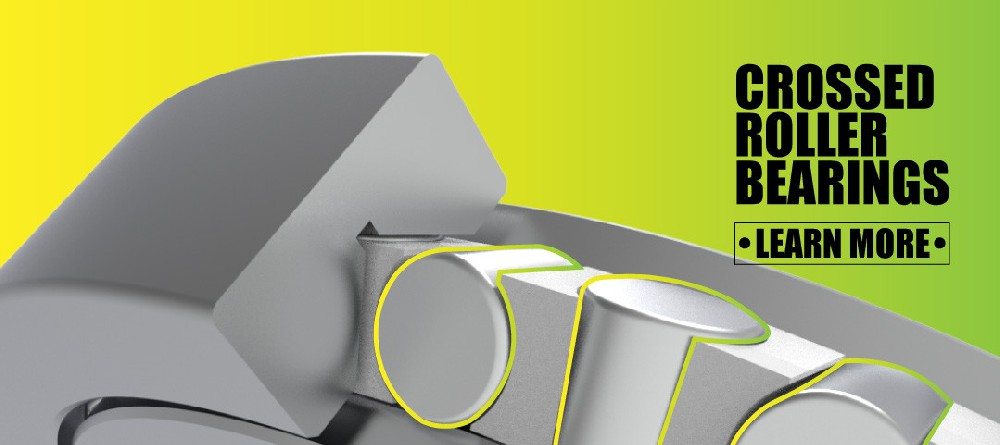
A separate engineering comparison found that crossed roller bearings can be three to four times stiffer than angular contact ball bearings of equivalent size, which is why many robotic joint and rotary table designs now specify crossed roller units for the highest-load axes while reserving angular contact pairs for higher-speed, lower-moment-load joints such as wrists and end effectors. Understanding this trade-off — stiffness versus speed versus footprint — is now a core competency for anyone specifying bearings for automation equipment.

Industry Perspective: Bearing Selection in Robotic Joint Design
In practice, engineering teams working on quadruped robots, collaborative robot arms, and AGV drive modules routinely face the same trade-off: a joint needs to resist tilting moment loads from an extended arm while still rotating smoothly at moderate speed. A single deep groove ball bearing rarely satisfies both requirements once payload and reach increase.
The common resolution is a hybrid architecture: a crossed roller or duplex angular contact bearing at the primary load-bearing joint (shoulder, hip, or base rotation), paired with lighter angular contact or thin-section bearings at distal joints such as wrists and grippers where speed matters more than moment rigidity. This layered approach — matching bearing type to the specific load profile of each axis rather than standardizing on one bearing family — is consistent with guidance from robotic joint engineering resources, which emphasize that backlash and drift are best controlled through preloaded angular contact or crossed roller designs rather than through deep groove bearings alone.
For manufacturers supplying robotics, radar systems, and precision rotary tables, this means production lines increasingly need custom contact angles, tighter P4/P2 tolerances, and matched-pair preloading rather than off-the-shelf catalog parts. Firms with in-house testing capability and university research partnerships are better positioned to validate these custom configurations under real operating loads before they reach a customer’s production floor.
Maintenance Practices That Extend Bearing Life
Regardless of bearing family, service life depends heavily on installation and upkeep discipline:
– Inspect regularly for unusual noise, vibration, or temperature rise — early signs of lubrication breakdown or contamination.
– Match lubricant to speed and load. High-speed angular contact bearings typically need low-viscosity synthetic grease or oil-air lubrication; deep groove bearings tolerate standard lithium greases.
– Respect rated load limits. Running a bearing near its dynamic load rating continuously shortens fatigue life disproportionately.
– Protect against contamination. Sealed or shielded variants are worth the added friction cost in dusty or humid environments.
– Verify preload periodically on duplex angular contact assemblies, since preload can shift after thermal cycling or heavy shock loads.

Work With a Precision Bearing Partner That Understands Your Application
Selecting between a deep groove ball bearing and an angular contact ball bearing is only the first step — matching precision grade, contact angle, and preload to your specific machine is where performance is actually won or lost.
Henan Yuwei Industrial Technology Co., Ltd. specializes in precision cross roller bearings and high-precision angular contact ball bearings, including high-rigidity, thin-wall, and double-row cross roller series, alongside high-speed and long-life angular contact ball bearing lines. Our engineering team has completed joint research and testing projects with universities and research institutes, participated in national key science and technology programs, and supplies bearings into quadruped robots, service and industrial robots, collaborative and SCARA robots, medical and exoskeleton robots, humanoid robots, AGVs, communication radar, precision measuring instruments, CNC machine tools, rotary tables, hollow rotary platforms, DD motors, and harmonic and planetary reducers. Our products serve customers across more than 20 Chinese provinces and export to the United States, Germany, Italy, Spain, Norway, Russia, South Korea, Taiwan, India, and South America.
If your project involves a high-precision or high-speed rotating axis, reach out to our engineering team for a load analysis and bearing recommendation tailored to your specific application.
Frequently Asked Questions
Q1: Can an angular contact ball bearing replace a deep groove ball bearing in every application?
Not always. Angular contact bearings excel where axial load and precision dominate, but for simple radial-load applications with moderate axial demand, a deep groove ball bearing is usually more cost-effective and just as durable.
Q2: Why do angular contact ball bearings need to be mounted in pairs?
A single-row angular contact bearing only supports axial load in one direction. Pairing two bearings back-to-back, face-to-face, or in tandem allows the assembly to resist axial loads from both directions while adding stiffness through preload.
Q3: What precision class should I choose for a robotic joint?
For high-precision robotic joints, P4 or P5 tolerance classes are common; ultra-precision applications such as surgical robotics or measurement instruments may require P2. Standard industrial automation often performs well with P6 or Normal class bearings.
Q4: Does contact angle affect rotational speed?
Yes. A smaller contact angle, such as 15°, favors higher rotational speed, while a larger angle, such as 40°, favors greater axial load capacity but slightly limits maximum speed.
Q5: Are crossed roller bearings better than angular contact ball bearings for robots?
It depends on the axis. Crossed roller bearings offer significantly higher stiffness and are preferred for primary load-bearing joints, while angular contact bearings are often better suited to higher-speed, lower-moment-load joints such as wrists.
Q6: How does lubrication choice differ between the two bearing types?
High-speed angular contact bearings typically need low-viscosity synthetic grease or oil-air lubrication systems to manage heat, while deep groove ball bearings generally perform well with standard lithium-based greases under moderate speed and load.
References
– SKF, “Tolerances,” Rolling Bearing Selection Guide — [skf.com]
– Angular Contact Ball Bearings, “Advantages of Angular Contact Ball Bearing for Spindle Use” — [angularcontactballbearings.com]
– Bearings Direct, “Solving Load and Precision Issues in Robotic Joints” — [bearingsdirect.com]
– Intel Market Research, “Humanoid Robot Bearings Market 2026 to 2034” — [intelmarketresearch.com]
– Fortune Business Insights, “Humanoid Robot Market Size, Share & Growth Report” — [fortunebusinessinsights.com]
Hot Tags: Angular Contact Ball Bearing, Deep Groove Ball Bearing, Crossed Roller Bearing, Precision Bearing Manufacturer, High Precision Bearing, Robotic Joint Bearing, CNC Spindle Bearing, Bearing Tolerance Class, Humanoid Robot Bearing, Industrial Bearing Supplier