Content Menu
● What Makes Crossed Roller Bearings Different
● Crossed Roller Bearings Compared to Five Other Bearing Types
>> Crossed Roller Bearings vs Ball Bearings
>> Crossed Roller Bearings vs Cylindrical Roller Bearings
>> Crossed Roller Bearings vs Tapered Roller Bearings
>> Crossed Roller Bearings vs Slewing Bearings
>> Crossed Roller Bearings vs Needle Roller Bearings
● 2026 Market Outlook: Robotics Is Rewriting Demand
● Crossed Roller Bearings vs Angular Contact Ball Bearings: An Engineer’s View
● How to Select the Right Crossed Roller Bearing: A 5-Step Framework
● Practical Takeaway for Buyers
Choosing the right rolling-element bearing is one of the most consequential decisions in precision machine design. Get it wrong, and the result is backlash, heat, and premature wear. Get it right, and a single crossed roller bearing can replace two or three conventional bearings while tightening rotational accuracy to the micron level.
This guide compares crossed roller bearings against five other common roller and ball bearing types, then goes further with current market data, a practical selection framework, and a direct engineer-level comparison against angular contact ball bearings, a comparison most buying guides skip entirely.

What Makes Crossed Roller Bearings Different
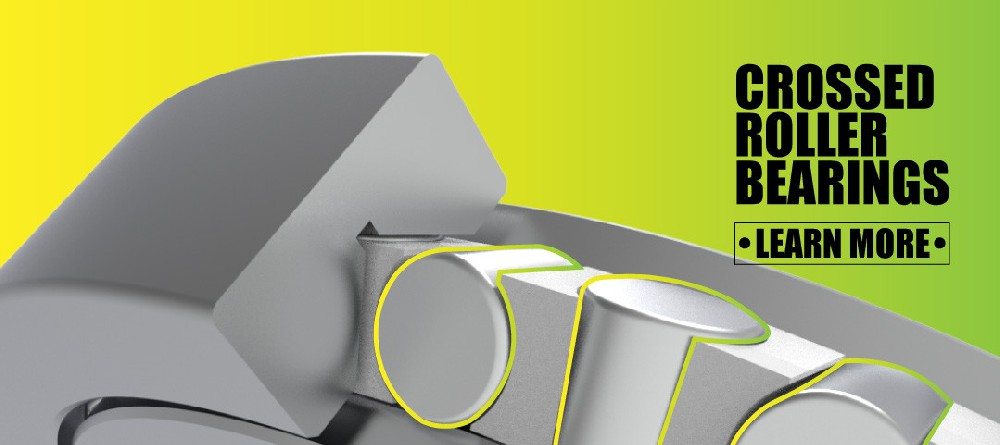
A crossed roller bearing arranges cylindrical rollers in a V-shaped groove, with each roller alternating at 90 degrees to its neighbor. One roller carries load in one direction; the adjacent roller carries load in the opposite direction. The result is a single, compact ring that manages radial, axial, and moment loads simultaneously.
Three properties define this bearing category:
– High rigidity. Line contact between roller and raceway, combined with the ability to run negative clearance, gives crossed roller bearings three to four times the rigidity of a comparable ball bearing.
– Compact, multi-directional load handling. One crossed roller ring does the job of two angular contact ball bearings mounted back to back, saving axial space and mounting complexity.
– Sustained accuracy. Deflection under load stays minimal, so positioning accuracy holds up even after millions of duty cycles. This is why these bearings dominate robot joints, rotary tables, and indexing systems.
Crossed Roller Bearings Compared to Five Other Bearing Types
| Bearing Type | Load Direction Strength | Precision Level | Space Efficiency | Best-Fit Applications |
|---|---|---|---|---|
| Crossed roller bearing | Radial + axial + moment (combined) | Very high (P5–P2) | Excellent, single-ring design | Robot joints, rotary tables, CNC turntables |
| Ball bearing | Light-to-moderate radial or axial | Moderate | Good | Motors, conveyors, light machinery |
| Cylindrical roller bearing | High radial only | Moderate | Moderate | Gearboxes, pumps, electric motors |
| Tapered roller bearing | Combined radial + axial | Moderate | Good | Automotive hubs, heavy machinery |
| Slewing bearing | Very high radial + axial + moment (large scale) | Lower than crossed roller | Bulky | Cranes, wind turbines, excavators |
| Needle roller bearing | High radial, tight space | Moderate | Excellent for radial-only | Transmissions, small appliances |
Crossed Roller Bearings vs Ball Bearings
Ball bearings make point contact with the raceway; crossed roller bearings make line contact. That single difference explains almost everything else. Point contact means the ball deforms more under load, so ball bearings suit lighter, cost-sensitive applications like conveyors and household motors. Crossed roller bearings absorb heavier combined loads while holding tighter tolerances, which is why they routinely replace paired ball bearings in precision joints.
Crossed Roller Bearings vs Cylindrical Roller Bearings
Cylindrical roller bearings excel at pure radial loads in motors, pumps, and gearboxes, but cannot manage axial or moment loads on their own. A crossed roller bearing handles all three load types in one ring, reducing part count and eliminating tolerance stack-up across multiple components.
Crossed Roller Bearings vs Tapered Roller Bearings
Tapered roller bearings distribute combined radial and axial loads efficiently and remain the workhorse of automotive hubs and heavy gearboxes. Where they fall short is rotational precision: crossed roller bearings deliver noticeably tighter runout and lower cycle-to-cycle variance, which matters in machine tools and robotics but is largely irrelevant in a truck wheel hub.
Crossed Roller Bearings vs Slewing Bearings
Slewing bearings are the large-diameter cousins built for cranes, excavators, and wind turbines, where sheer load capacity outweighs micron-level accuracy. Crossed roller bearings occupy the precision end of the same load-handling concept, packaged smaller and tighter for robotics and rotary stages rather than heavy construction equipment.
Crossed Roller Bearings vs Needle Roller Bearings
Needle roller bearings pack high radial capacity into very little radial space, ideal for transmissions and compact gear sets. They are not engineered for combined axial or moment loads, so they cannot substitute where a crossed roller bearing’s multi-directional capability is required.
2026 Market Outlook: Robotics Is Rewriting Demand
The bearing conversation has shifted sharply in recent years. The global cross roller bearings market is projected to grow from roughly US$1.5 billion in 2024 to US$1.9 billion by 2031, driven primarily by robotics, aerospace, and automated manufacturing rather than traditional industrial equipment.
The bigger story is humanoid robotics. The humanoid robot bearings segment was valued at approximately US$30 million in 2025 and is forecast to reach US$929 million by 2034, a compound annual growth rate above 50%. Growth is being driven by manufacturers scaling pilot fleets, advances that reduce crossed-roller unit costs, and Asian production clusters, particularly in China, that supply high-precision capacity at competitive prices.
For bearing buyers, this shift has practical consequences. Robot joints, especially shoulders, elbows, and wrists, need a bearing that eliminates backlash while surviving millions of short, high-acceleration strokes. That requirement is pushing designers toward crossed roller bearings even in cost-sensitive robot programs, because the total system cost of extra bearings, brackets, and preload hardware often exceeds the price premium of a single crossed roller ring.

Crossed Roller Bearings vs Angular Contact Ball Bearings: An Engineer’s View
Most comparison articles stop at five bearing types, but angular contact ball bearings deserve a direct comparison because they compete head-to-head with crossed roller bearings in robot joints and rotary axes.
Where crossed roller bearings win: rigidity, resistance to tipping moments, and part-count reduction. A single crossed roller ring replaces a matched pair of angular contact ball bearings, cutting axial length and simplifying housing design. Because rollers spread load across a line rather than a point, deflection under combined loads stays lower, preserving positioning accuracy through repeated cycles.
Where angular contact ball bearings win: rotational speed and lubrication life. Point contact generates less rolling friction and heat than line contact, so angular contact ball bearings tolerate higher speeds and longer intervals between relubrication. They also cost less to manufacture and are easier to source in standard catalog sizes.
The practical rule engineers apply: if the axis needs maximum stiffness at low-to-moderate speed with zero backlash, specify a crossed roller bearing. If the axis prioritizes speed, cost, and simpler lubrication over ultimate rigidity, an angular contact ball bearing, often in a preloaded duplex pair, remains the sound choice.
How to Select the Right Crossed Roller Bearing: A 5-Step Framework
Specifying a crossed roller bearing correctly the first time avoids costly redesigns. Follow this sequence:
1. Define the load profile. List the maximum radial, axial, and moment loads the joint or table will see, including transient shock loads during acceleration.
2. Choose the series and roller arrangement. Full-complement designs (no separators) maximize load capacity at lower speeds; separator or cage designs run cooler at higher speeds with a modest capacity trade-off.
3. Set the accuracy class. Precision machine tools and robot joints generally require P5 or higher; semiconductor and metrology equipment often demand P4 or P2.
4. Select preload and clearance. Negative clearance (preload) removes backlash and boosts rigidity but raises starting torque and heat; choose the lightest preload that still meets the stiffness target.
5. Confirm mounting and lubrication. Bolt-on flanged series simplify assembly and reduce alignment error; match grease type to expected operating temperature and duty cycle, since roller bearings run warmer than ball bearings under equivalent load.
Skipping the accuracy-class and preload steps is the most common specification error among first-time robotics and machine-tool buyers, and it is the fastest way to end up with unexplained vibration or premature wear within months of production.

Practical Takeaway for Buyers
Crossed roller bearings are not a universal upgrade. For light, low-precision applications, a standard ball or cylindrical roller bearing remains the more economical choice. But wherever a design demands combined radial, axial, and moment load support in a compact footprint, with accuracy that survives millions of cycles, crossed roller bearings are the specification engineers reach for first, and increasingly the default choice in robotic joints, rotary tables, and precision indexing systems.
If your project involves a robot joint, rotary stage, or precision turntable and you are unsure whether a crossed roller bearing, angular contact ball bearing, or a custom hybrid solution fits best, consult a bearing engineer before finalizing the drawing. A short design review at the specification stage can prevent a costly redesign later. Contact our engineering team today for a free technical consultation and quotation tailored to your application, robotics, CNC machinery, medical devices, radar systems, or precision rotary platforms.
Frequently Asked Questions
1. What load types can a single crossed roller bearing support?
A crossed roller bearing supports radial, axial, and moment (tilting) loads simultaneously in one compact ring, which is why it can replace a pair of angular contact ball bearings in many designs.
2. Are crossed roller bearings more expensive than ball bearings?
Yes, unit cost is typically higher due to more complex machining of the crossed raceway groove. However, total system cost is often lower once the extra bearings, brackets, and alignment work that a ball-bearing solution requires are factored in. Buyers should also weigh total cost of ownership: a crossed roller bearing’s higher unit price is frequently offset by fewer components, simpler housings, and lower long-term maintenance across the machine’s service life.
3. What accuracy class should be specified for a robot joint?
Most robot joints and precision rotary tables perform well with P5 accuracy class. Semiconductor handling and high-end metrology equipment usually require P4 or P2 for tighter runout control.
4. Do crossed roller bearings run hotter than ball bearings?
Generally yes. Line contact generates more rolling friction than the point contact in ball bearings, so lubricant selection and relubrication intervals matter more with crossed roller bearings, especially in continuous-duty applications.
5. Can crossed roller bearings be used in humanoid robots?
Yes, and demand from this segment is growing quickly. Crossed roller bearings are widely used in humanoid robot shoulders, elbows, and wrists because they eliminate backlash while handling the combined loads these joints experience during dynamic motion.
6. How should one decide between a crossed roller bearing and a slewing bearing?
Choose a slewing bearing for large-diameter, heavy-load rotation such as cranes or turntables where extreme precision is not the priority. Choose a crossed roller bearing when the application needs compact size combined with high rotational accuracy, such as robotics or CNC rotary axes.
References
– LKP Bearing, “Comparison Of Crossed Roller Bearings With Other 5 Types Of Roller Bearings” — [lkpbearing.com]
– Persistence Market Research, “Cross Roller Bearings Market Size & Share Analysis, 2031” — [persistencemarketresearch.com]
– Machine Design, “Why Crossed Roller Bearings Dominate Precision Robotics and Automation” (interview with SKF engineer Doug Martin) — [machinedesign.com]
– Intel Market Research, “Humanoid Robot Bearings Market 2026 to 2034” — [intelmarketresearch.com]
– Bearings Direct, “Solving Load and Precision Issues in Robotic Joints” — [bearingsdirect.com]
– PRS Bearings, “Crossed Roller Bearing vs. Angular Contact Ball Bearing: Which Is Better for Rigidity?” — [prsbearings.com]
Hot Tags: Crossed Roller Bearings, Angular Contact Ball Bearings, Precision Bearings Manufacturer, Robot Joint Bearings, Humanoid Robot Bearings, CNC Rotary Table Bearings, Industrial Robot Bearings, Slewing Bearings, High Precision Rotary Bearings, Cross Roller Bearing Supplier