Content Menu
● Why Precision Bearings Matter in Modern Equipment
● Crossed Roller Bearings for High Rigidity and Compact Design
>> Where Crossed Roller Bearings Create Value
>> Main Crossed Roller Bearing Types
● Angular Contact Ball Bearings for Speed and Precision
>> When to Choose Angular Contact Ball Bearings
>> Crossed Roller vs. Angular Contact Ball Bearings
● A Practical Bearing Selection Process
>> Step 1: Define the Real Load Case
>> Step 2: Specify Accuracy and Rigidity Targets
>> Step 3: Check Mounting Interfaces
>> Step 4: Match Lubrication to the Environment
>> Step 5: Verify Life Beyond the Catalog Rating
● Engineering Insight: The Mounting Structure Is Part of the Bearing System
● How to Reduce Bearing Failures Before They Happen
● Partner With Henan Yuwei for Precision Bearing Solutions
>> What is the main advantage of a crossed roller bearing?
>> Can crossed roller bearings be used in robot joints?
>> When should I choose angular contact ball bearings instead?
>> What information is needed for a custom bearing quotation?
>> Why is mounting accuracy important for precision bearings?
>> How can I improve the service life of a precision bearing?
Precision machines do not fail because one component is merely “slightly off.” They fail when stiffness, runout, preload, mounting accuracy, lubrication, and real operating loads are treated as separate issues rather than one motion-system problem.
For robotics, radar platforms, medical equipment, rotary tables, direct-drive motors, reducers, and precision measuring instruments, the bearing is more than a standard mechanical part. It determines how reliably a system carries axial, radial, and overturning-moment loads while preserving positioning accuracy and smooth rotation.
Henan Yuwei Industrial Technology Co., Ltd. develops and manufactures precision crossed roller bearings and high-precision angular contact ball bearings for demanding motion applications. Our product range includes high-rigidity crossed roller bearings, thin-section crossed roller bearings, double-row crossed roller bearings, precision angular contact ball bearings, high-speed angular contact ball bearings, and long-life angular contact ball bearing series.
This guide explains how to choose the right precision bearing architecture, what engineers should verify before ordering, and how manufacturers can reduce avoidable performance risks during design, installation, and operation.

Why Precision Bearings Matter in Modern Equipment
A conventional bearing may support rotation. A precision bearing must support rotation while controlling deflection, runout, vibration, friction, and repeatability.
That distinction is especially important in equipment where even minor angular displacement affects the finished result. A robot joint may lose repeatability. A radar antenna may lose pointing precision. A machine-tool rotary axis may produce poor surface quality. A medical scanner may generate unstable motion.
Precision bearing selection should therefore begin with the actual duty cycle, not only a catalog diameter or nominal load rating.
Key conditions include:
– Axial load generated along the shaft or rotation axis
– Radial load acting perpendicular to the axis
– Overturning moment caused by an offset load or long arm
– Rotational speed and acceleration/deceleration profile
– Required positioning accuracy and rotational smoothness
– Mounting-space constraints
– Temperature, contamination, corrosion, and lubrication conditions
– Expected service life and maintenance access
A bearing that is oversized for load but poorly matched to rigidity, installation conditions, or speed can still become the weak point of the assembly.
Crossed Roller Bearings for High Rigidity and Compact Design
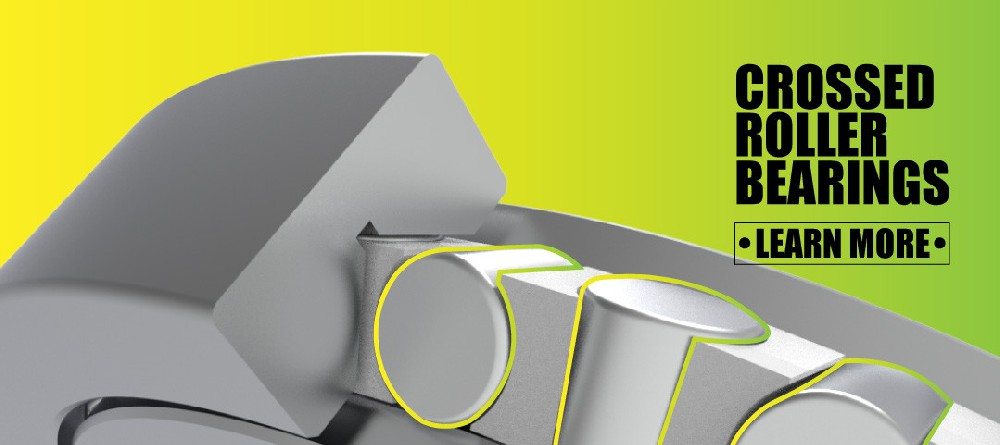
A crossed roller bearing uses cylindrical rollers arranged alternately at 90 degrees. This geometry allows one bearing to carry radial loads, axial loads in both directions, and overturning moments at the same time.
For designers, this often eliminates the need for multiple bearing sets and can make the entire rotation mechanism shorter, simpler, and more rigid.
Where Crossed Roller Bearings Create Value
Crossed roller bearings are particularly suited to equipment that needs compact construction and stable, high-accuracy rotation, including:
– Four-legged robots and humanoid robots
– Service, industrial, collaborative, SCARA, and medical robots
– Exoskeleton robots and special-purpose robots
– Automated guided vehicles
– Precision rotary tables and hollow rotary platforms
– Direct-drive motor systems
– Harmonic reducers and planetary reducers
– Radar and communication equipment
– Precision measuring instruments
– CNC machine tools
– Medical diagnostic and treatment equipment
– Printing, dyeing, and textile machinery
In these applications, the most important performance advantage is not simply load capacity. It is the ability to maintain high rotational rigidity with limited installation space.

Main Crossed Roller Bearing Types
| Bearing type | Typical advantage | Suitable applications |
|---|---|---|
| Precision crossed cylindrical roller bearing | High rotational accuracy and multi-directional load capacity | Machine tools, measuring devices, precision platforms |
| High-rigidity crossed roller bearing | Strong resistance to deformation under moment load | Robot joints, reducers, industrial turntables |
| Thin-section crossed roller bearing | Compact radial section and space-saving construction | Lightweight robots, compact instruments, medical systems |
| Double-row crossed roller bearing | Higher capacity and improved structural stability | Heavy-duty rotary equipment, large robotic axes, radar platforms |
The correct type depends on the relationship between load direction, available space, required rigidity, and rotational accuracy. Selecting only by outside diameter or basic load rating can lead to an unsuitable design.
Angular Contact Ball Bearings for Speed and Precision
Angular contact ball bearings are designed to carry combined loads. Because the contact angle transfers force between the raceways and balls, these bearings can support radial load together with axial load.
They are widely used where high rotational speed, low friction, controlled preload, and precise shaft guidance are required.
Henan Yuwei provides high-precision, high-speed, and long-life angular contact ball bearing options for applications where stable performance is essential.
When to Choose Angular Contact Ball Bearings
Angular contact ball bearings are often the stronger choice when the system requires:
– Higher rotational speed
– Low friction and smooth running
– Controlled preload for improved stiffness
– Precise spindle or motor-shaft support
– Compact bearing arrangements
– Reliable axial guidance in one or both directions
Typical applications include high-speed motors, CNC spindles, precision actuators, machine-tool assemblies, transmission systems, and compact rotary modules.
Crossed Roller vs. Angular Contact Ball Bearings
| Selection factor | Crossed roller bearing | Angular contact ball bearing |
|---|---|---|
| Combined radial, axial, and moment loads | Excellent within one bearing unit | Usually requires paired or multi-bearing arrangements |
| Rigidity under overturning moment | Very high | Depends heavily on bearing arrangement and preload |
| High-speed capability | Application-dependent | Often preferred for high-speed shaft systems |
| Installation space | Compact axial structure | Can be compact, but paired arrangements may need more space |
| Typical use | Robot joints, rotary tables, reducers, precision platforms | Spindles, motors, gearboxes, high-speed rotating shafts |
| Alignment sensitivity | Requires careful mounting precision | Also sensitive, especially with preload arrangements |
In practical design work, there is no universally “better” bearing type. The right answer depends on the motion architecture.
For example, a robotic arm joint with a large offset payload usually benefits from a high-rigidity crossed roller bearing. A high-speed electric spindle often requires precision angular contact ball bearings configured to manage preload, heat, and speed.

A Practical Bearing Selection Process
A reliable bearing inquiry should provide more than a model number. Engineers get better results when they supply operating data early, allowing the manufacturer to recommend a bearing based on the full application condition.
Step 1: Define the Real Load Case
Identify the maximum and normal operating values for:
– Radial load
– Axial load
– Overturning moment
– Rotational speed
– Acceleration and deceleration
– Duty cycle
– Shock or impact load
Do not use only static payload weight. A robot arm, for example, creates changing moment loads as its position, acceleration, and end-effector orientation change.
Step 2: Specify Accuracy and Rigidity Targets
Clarify what “precision” means for the machine:
– Allowable radial runout
– Allowable axial runout
– Required rotational torque
– Angular displacement limit under load
– Positioning repeatability
– Vibration and noise limits
This turns a broad request into an engineering requirement that can be evaluated and verified.
Step 3: Check Mounting Interfaces
Bearing performance is strongly influenced by the stiffness and flatness of the housing and shaft interfaces. The bearing rings must receive uniform support around their circumference; otherwise, local deformation can reduce accuracy and load distribution.
Before installation, check:
1. Mounting-surface flatness
2. Bore and shaft geometry
3. Surface cleanliness
4. Bolt-hole alignment
5. Housing rigidity
6. Fastening-bolt grade and tightening method
For large rotary bearing arrangements, bolt preload is a critical design and assembly parameter rather than an afterthought. SKF technical guidance notes that slewing-bearing bolt preload is linked to the thread friction condition and may be specified close to the bolt yield limit in certain designs.
Step 4: Match Lubrication to the Environment
Lubrication affects friction, heat, wear, and fatigue life. The grease or oil choice should match speed, temperature, load, sealing design, and contamination risk.
A clean laboratory instrument, a high-speed spindle, and an outdoor radar platform should not automatically use the same lubrication solution.
For long-life performance, consider:
– Lubricant type and viscosity
– Relubrication interval
– Seal arrangement
– Dust and moisture exposure
– Corrosion protection
– Operating temperature range
– Compatibility between lubricant and sealing materials
Step 5: Verify Life Beyond the Catalog Rating
Basic bearing-life calculation is useful, but it is not a complete reliability guarantee. ISO 281 provides methods for calculating dynamic load ratings and rating life, including the effect of lubrication conditions, lubricant contamination, and fatigue load on modified rating life.
However, real service life can also be reduced by:
– Inadequate mounting support
– Incorrect preload
– Bolt loosening
– Misalignment
– Foreign particles
– Corrosion
– Electrical erosion
– Unexpected shock loading
A successful bearing selection combines life calculation with a realistic review of the machine structure and operating environment.
Engineering Insight: The Mounting Structure Is Part of the Bearing System
One of the most common purchasing mistakes is treating the bearing as an isolated component.
In reality, the bearing, housing, shaft, fasteners, lubrication system, seals, and applied load form one functional unit. A high-precision crossed roller bearing installed on an insufficiently rigid or poorly machined mounting surface cannot deliver its intended accuracy.
For this reason, engineering support should include discussion of:
– Bearing dimensions and mounting holes
– Ring thickness and structural stiffness
– Raceway orientation
– Installation sequence
– Bolt tightening pattern and torque
– Preload requirements
– Lubrication method
– Inspection and maintenance plan
Schaeffler notes that crossed roller bearings can be directly screw-mounted to adjacent structures in applicable designs, which makes interface design and fastening quality especially important.
At Henan Yuwei, we work with universities and research institutions on technical cooperation, research projects, and specialized bearing development. This experience supports custom solutions for demanding equipment, including robot systems, radar vehicles, high-precision instruments, and industrial rotary mechanisms.
How to Reduce Bearing Failures Before They Happen
Most early bearing failures begin long before a visible problem appears. They are often introduced during selection, machining, installation, or maintenance.
Use this checklist before releasing a design or purchase order:
– Confirm all radial, axial, and moment loads, including dynamic peaks.
– Check whether a single bearing must carry multiple load directions.
– Define accuracy targets in measurable terms.
– Verify housing and shaft stiffness, not only bearing load capacity.
– Select preload according to the application rather than using a generic value.
– Match grease or oil to speed, temperature, load, and environmental exposure.
– Specify mounting-bolt grade, tightening pattern, and torque procedure.
– Confirm protection against dust, water, corrosion, and accidental impact.
– Request drawings, tolerance requirements, and technical documentation before production.
– Plan routine inspection for noise, vibration, temperature rise, backlash, and lubricant condition.
Partner With Henan Yuwei for Precision Bearing Solutions
Henan Yuwei Industrial Technology Co., Ltd. serves customers across China and international markets, including the United States, Germany, Italy, Spain, Norway, Russia, South Korea, Taiwan, India, and South America.
We understand that a bearing quotation is only useful when it supports the real machine design. Whether you are developing a robot joint, rotary table, hollow rotary platform, radar system, reducer, medical device, or high-speed motor assembly, our team can help assess your operating conditions and identify a suitable precision bearing solution.
Send us your bearing drawing, model number, installation dimensions, load data, rotational speed, and annual quantity requirement. We will provide a technical evaluation and a targeted quotation for your application.
Frequently Asked Questions
What is the main advantage of a crossed roller bearing?
A crossed roller bearing can carry radial load, axial loads in both directions, and overturning moment in one compact unit. It is often selected where high rigidity and rotational accuracy are required.
Can crossed roller bearings be used in robot joints?
Yes. They are widely used in industrial robots, collaborative robots, humanoid robots, service robots, medical robots, and other articulated systems because they handle combined loads and resist moment-induced deflection.
When should I choose angular contact ball bearings instead?
Choose angular contact ball bearings when high rotational speed, low friction, controlled preload, and accurate shaft support are central requirements. They are common in spindles, motors, machine tools, and precision transmission systems.
What information is needed for a custom bearing quotation?
Provide the bearing drawing or target dimensions, radial and axial loads, overturning moment, speed, accuracy requirement, installation structure, operating environment, lubrication method, and estimated purchase quantity.
Why is mounting accuracy important for precision bearings?
Poor mounting flatness, insufficient housing rigidity, contamination, or uneven bolt tightening can distort bearing rings and create uneven load distribution. This can reduce accuracy, increase torque, and shorten service life.
How can I improve the service life of a precision bearing?
Use correct load calculations, ensure rigid and clean mounting surfaces, apply the specified preload and fastening process, use suitable lubrication, maintain seals, and inspect the system regularly for abnormal noise, heat, vibration, or backlash.
References
1. [Original article: Exploring Slewing Bearings: China’s Leading Manufacturer]
2. [ISO 281: Rolling bearings — Dynamic load ratings and rating life]
3. [SKF Slewing Bearings technical publication]
4. [Schaeffler: Crossed roller bearings for high-precision applications]
5. [Schaeffler: Design of bearing arrangements]
6. [Schaeffler Crossed Roller Bearing product information]
Hot Tags: Precision Crossed Roller Bearings, Crossed Roller Bearing Manufacturer, High Precision Angular Contact Ball Bearings, Robot Joint Bearings, Industrial Robot Bearings, Thin Section Crossed Roller Bearings, High Rigidity Crossed Roller Bearings, Rotary Table Bearings, Harmonic Drive Bearings, Custom Precision Bearings