Content Menu
● What Determines Rotary Accuracy?
● Cross Roller Ring Structure and Accuracy
>> Why Cross Roller Rings Improve Rotary Accuracy
>> Cross Roller Ring Limitations
● Angular Contact Ball Bearing Structure
>> Why Angular Contact Ball Bearings Excel at Speed
● Cross Roller Ring vs Angular Contact Ball Bearing
● Which Bearing Provides Better Rotary Accuracy?
● The Hidden Factor: System Stiffness
● Application Example: Robot Joint vs High-Speed Spindle
● Practical Selection Checklist
● Work with a Precision Bearing Partner
● FAQ
>> 1. Is a cross roller bearing more accurate than an angular contact ball bearing?
>> 2. Can a cross roller ring replace two angular contact ball bearings?
>> 3. Why are angular contact ball bearings commonly used in spindles?
>> 4. What is the best bearing for a robot joint?
>> 5. Does preload improve rotary accuracy?
>> 6. What causes poor rotary accuracy after installation?
>> 7. Are hybrid angular contact ball bearings suitable for high speed?
When engineers compare a cross roller ring vs angular contact ball bearing, the right answer depends on what “rotary accuracy” means in the real machine. For a slow-to-medium-speed axis that must resist overturning moment, maintain compact geometry, and rotate precisely under changing loads, a precision cross roller ring will usually offer the stronger all-in-one solution. For a high-speed spindle where heat control, low friction, and speed capability dominate, a high-precision angular contact ball bearing arrangement is often the better choice.
At Henan Yuwei Industrial Technology Co., Ltd., we evaluate bearing selection from the application outward—not simply from a catalogue comparison. A robot joint, hollow rotary platform, radar turntable, SCARA arm, medical imaging device, harmonic reducer, or machine-tool spindle experiences different combinations of radial load, axial load, moment load, speed, preload, mounting error, and temperature rise. The bearing must be selected as part of the complete rotary system.

What Determines Rotary Accuracy?
Rotary accuracy is not one single value. It is the combined ability of a bearing-supported axis to maintain its intended position and motion while rotating.
In practical engineering, rotary accuracy commonly includes:
– Radial runout: movement of the rotating axis away from its ideal centerline
– Axial runout: movement along the axis of rotation
– Tilting error: angular deflection caused by moment load
– Rotational torque stability: consistency of torque during rotation
– Position repeatability: ability to return to the same angular position
– Thermal stability: ability to maintain accuracy as speed and temperature change
– Structural stiffness: resistance to elastic deformation under load
A bearing with excellent dimensional accuracy can still deliver poor rotary accuracy if the housing is weak, the mounting surfaces are not flat, preload is incorrect, or contamination enters the raceway. The complete assembly matters.
For example, a robotic wrist may rotate slowly but face large eccentric payloads. In that situation, moment rigidity can have a bigger influence on end-effector accuracy than maximum rotational speed. A high-speed grinding spindle has the opposite priority: low heat generation and stable operation at high speed often matter more than integrated moment-load capacity.
Cross Roller Ring Structure and Accuracy
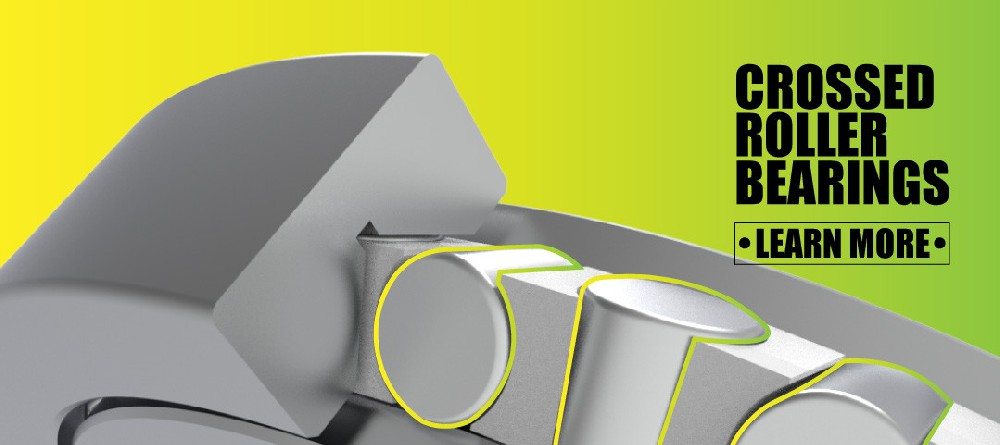
A cross roller ring uses cylindrical rollers arranged alternately at 90 degrees in V-shaped raceways. One roller carries load in one direction, while the adjacent roller is oriented perpendicular to it.
This structure enables a single bearing to support:
– Radial loads
– Axial loads in both directions
– Overturning moments
– Combined loads from multiple directions
Because cylindrical rollers provide line contact with the raceways, a cross roller ring can achieve high stiffness in a compact envelope. The alternating roller arrangement also allows one bearing unit to replace more complex multi-bearing structures in many rotary axes.
THK notes that its cross roller ring design can accept radial, axial, and moment loads in all directions within one bearing. It also states that the cross-roller configuration can provide rigidity three to four times greater than conventional thin angular ball bearing arrangements in comparable applications.

Why Cross Roller Rings Improve Rotary Accuracy
A precision cross roller ring is particularly effective when the rotating component faces a significant tilting moment. Typical examples include robot joints, rotary index tables, radar antennas, medical equipment, precision measuring instruments, and hollow rotary platforms.
Key reasons include:
– High moment rigidity: The bearing can resist tilting caused by an offset load.
– Single-bearing load support: One unit handles radial, axial, and moment loads together.
– Compact installation: Designers can reduce the axial length of the rotary structure.
– Stable preload response: Adjustable preload can reduce internal clearance and improve positioning behavior.
– Large roller contact area: Cylindrical rollers distribute load over a longer contact zone than balls.
Spacer-retainer designs help keep rollers properly aligned, reducing roller skewing and unstable torque. This is especially valuable in controlled motion systems, where torque fluctuation can affect servo response and positioning consistency.
Cross Roller Ring Limitations
Cross roller rings are not automatically the best solution for every high-precision axis. Their performance depends heavily on correct mounting.
Watch for these factors:
– Housing and flange rigidity
– Raceway mounting surface flatness
– Bolt tightening sequence and torque consistency
– Preload selection
– Lubrication method
– Operating speed
– Load distribution
– Environmental contamination
A cross roller bearing can be highly accurate in a laboratory inspection report but lose system-level accuracy if mounted on a thin, distorted support structure. In our experience with precision rotary applications, the surrounding structure should be treated as part of the bearing system—not as a secondary mechanical detail.
Angular Contact Ball Bearing Structure
An angular contact ball bearing uses balls that contact the inner and outer raceways at a defined contact angle. This geometry allows the bearing to carry combined radial and axial loads.
A single-row angular contact ball bearing typically supports axial load primarily in one direction. Therefore, two or more bearings are commonly combined in back-to-back, face-to-face, or tandem arrangements.
High-precision angular contact ball bearings are widely used in:
– High-speed machine-tool spindles
– Grinding spindles
– Milling heads
– Motorized spindles
– Precision pumps
– High-speed electric motors
– Medical rotating equipment
– High-speed test systems
SKF’s super-precision angular contact ball bearing range is designed for high speed, high stiffness, compact sections, and low heat generation. Its listed configurations include 15°, 18°, and 25° contact angles to balance speed, axial capacity, and rigidity requirements.
Why Angular Contact Ball Bearings Excel at Speed
The rolling contact of balls produces lower friction than cylindrical roller contacts in many high-speed conditions. This gives angular contact ball bearings a clear advantage when rotational speed is the first design priority.
High-precision angular contact ball bearings can offer:
– High-speed capability
– Lower frictional heat
– Fast acceleration and deceleration
– Excellent spindle suitability
– Flexible preload options
– Multiple arrangement choices
– Compatibility with hybrid ceramic balls
Hybrid angular contact ball bearings use silicon nitride balls instead of steel balls. Ceramic balls are lighter, reducing centrifugal force and heat at high speed. This can improve speed capability, stiffness, and service life when lubrication and preload are correctly controlled.
SKF states that its relevant super-precision series are manufactured as standard to P4A tolerance class, described as better than ABEC 7, with higher PA9A precision available on request.
Cross Roller Ring vs Angular Contact Ball Bearing
The following comparison focuses on rotary-axis performance rather than isolated catalogue specifications.
| Performance factor | Cross roller ring | Angular contact ball bearing |
|---|---|---|
| Rotary accuracy under moment load | Usually excellent due to integrated moment support | Can be excellent, but depends strongly on paired or multi-bearing arrangement |
| Radial and axial load handling | One bearing can handle loads in all directions | Usually requires matched pairs or sets for bidirectional axial loads |
| Tilting stiffness | Very high in compact rotary structures | High in back-to-back arrangements, but depends on bearing spacing |
| High-speed capability | Better suited to low-to-medium-speed precision rotation | Usually the stronger option for high-speed spindles |
| Friction and heat | Can be higher, especially with preload and high speed | Generally lower for high-speed operation |
| Installation space | Compact axial design; often replaces several bearings | May require multiple bearings, spacers, locknuts, and housing features |
| Mounting sensitivity | Highly sensitive to housing flatness and bolt tightening | Sensitive to preload, fits, matching, and axial adjustment |
| Typical applications | Robots, reducers, rotary tables, radar, measuring systems | Spindles, motors, pumps, grinding and milling systems |
| Cost structure | Can lower system-part count but has demanding mounting requirements | Individual bearings may cost less, but system design can be more complex |
The decision is therefore not simply “roller versus ball.” It is a decision between two different rotary-system architectures.
Which Bearing Provides Better Rotary Accuracy?
For many precision rotary axes, the cross roller ring provides better rotary accuracy under combined loading, especially when moment load is significant.
A robot joint is a clear example. The bearing may carry the weight of the arm, gearbox loads, acceleration forces, cable routing effects, and an offset end-effector payload. These loads create radial, axial, and tilting forces simultaneously. A high-rigidity cross roller ring can support those loads in one compact bearing position while limiting angular deflection.
However, for a high-speed spindle, a precision angular contact ball bearing set usually provides better practical rotary accuracy over time. The reason is thermal behavior. Even a mechanically stiff bearing system can lose accuracy if high speed creates excess heat, changes preload, expands shaft components, or reduces lubricant film stability.
Simple Selection Rule
Choose a cross roller ring when your rotary axis requires:
– High tilting stiffness
– Strong moment-load resistance
– Compact structure
– Low-to-medium rotational speed
– Stable precision under complex loads
– Hollow-center or integrated rotary-platform design
Choose angular contact ball bearings when your application requires:
– High or ultra-high speed
– Low heat generation
– High-speed spindle performance
– Rapid acceleration and deceleration
– Flexible paired-bearing arrangements
– Hybrid ceramic ball options
The Hidden Factor: System Stiffness
The most common selection mistake is comparing bearing stiffness while ignoring the surrounding parts.
Rotary accuracy is influenced by a stiffness chain:
Ksystem=f(Kbearing,Kshaft,Khousing,Kflange,Kbolts,Kpreload)
A high-rigidity cross roller bearing installed in a flexible housing cannot fully deliver its rated stiffness. Likewise, a precision angular contact bearing set cannot maintain intended preload if the shaft shoulder, spacer, or locknut arrangement deforms during operation.
For cross roller ring assemblies, inspect:
1. Mounting surface flatness and parallelism
2. Housing wall thickness and flange rigidity
3. Bolt-hole layout and tightening sequence
4. Bearing seat cleanliness
5. Preload or clearance specification
6. Lubricant compatibility and replenishment plan
For angular contact ball bearing assemblies, inspect:
1. Bearing arrangement: DB, DF, DT, or matched set
2. Preload grade
3. Shaft and housing fits
4. Spacer accuracy
5. Thermal expansion path
6. Maximum operating speed and lubrication method
Application Example: Robot Joint vs High-Speed Spindle
Consider two applications requiring precision rotation.
Robot Elbow Joint
A robot elbow rotates relatively slowly but experiences frequent acceleration, deceleration, and changing overturning moment from the arm and payload. The ideal bearing should resist tilting and maintain joint accuracy without requiring a long axial bearing stack.
A high-rigidity cross roller ring is usually the preferred solution because it supports radial, axial, and moment loads in one compact unit. It can simplify the joint structure and improve stiffness at the reducer output.
High-Speed Milling Spindle
A milling spindle may operate at very high speed with limited radial space. Here, low friction, controlled preload, thermal stability, and lubrication are critical. A matched set of super-precision angular contact ball bearings is normally more suitable.
SKF identifies back-to-back arrangements as providing high rigidity and the ability to accommodate tilting moments, while matched bearing sets help achieve controlled preload and load distribution.

Practical Selection Checklist
Before selecting either bearing type, define the operating conditions clearly.
– What are the maximum radial, axial, and moment loads?
– Is the load constant, alternating, or impact-based?
– What is the required rotational speed?
– What runout and positioning tolerance does the final machine require?
– Is the axis horizontal, vertical, or inclined?
– Is the load center offset from the bearing center?
– What installation space is available?
– Is a hollow shaft or cable passage required?
– What lubrication method will be used?
– How will the housing control temperature?
– What mounting accuracy can the machine builder consistently achieve?
– Does the application need a preloaded bearing?
A correct answer to these questions often makes the bearing selection obvious.
Work with a Precision Bearing Partner
Henan Yuwei Industrial Technology Co., Ltd. develops and manufactures precision cross roller bearings and high-precision angular contact ball bearings for demanding rotary applications. Our product range includes precision crossed cylindrical roller bearings, high-rigidity cross roller bearings, thin-section cross roller bearings, double-row cross roller bearings, high-speed angular contact ball bearings, and long-life angular contact ball bearings.
For robot joints, humanoid robots, AGVs, medical systems, radar equipment, precision measuring instruments, CNC machine tools, rotary tables, DD motors, harmonic reducers, and planetary reducers, the correct bearing is not only a purchased component. It is a foundation for machine accuracy, durability, and user confidence.
Contact Yuwei Bearing with your drawing, load data, speed requirement, installation space, and target accuracy. Our engineering team can help you compare cross roller ring and angular contact ball bearing solutions for your specific rotary system.
FAQ
1. Is a cross roller bearing more accurate than an angular contact ball bearing?
A cross roller bearing is often more accurate under combined radial, axial, and moment loads because one bearing supports all of these loads with high rigidity. For high-speed spindle rotation, a precision angular contact ball bearing arrangement may provide better long-term accuracy because it generates less heat.
2. Can a cross roller ring replace two angular contact ball bearings?
In many rotary applications, yes. A cross roller ring can support loads in all directions and resist moment loads within one bearing unit. However, replacement should be confirmed through load, speed, stiffness, mounting, and life calculations.
3. Why are angular contact ball bearings commonly used in spindles?
They combine high rotational speed, low friction, controlled preload, and good rigidity. Matched pairs or sets can support axial loads in both directions and manage tilting moments effectively.
4. What is the best bearing for a robot joint?
A high-rigidity precision cross roller bearing is often the preferred choice for robot joints because it handles radial, axial, and moment loads in a compact structure. Final selection depends on payload, reducer arrangement, joint size, and required accuracy.
5. Does preload improve rotary accuracy?
Yes. Proper preload removes or reduces internal clearance, increases stiffness, and can improve positioning stability. Excessive preload, however, increases friction, heat, torque, and the risk of premature wear.
6. What causes poor rotary accuracy after installation?
Common causes include uneven mounting surfaces, distorted housings, incorrect preload, contamination, insufficient lubrication, poor shaft and housing fits, loose mounting bolts, and thermal expansion.
7. Are hybrid angular contact ball bearings suitable for high speed?
Yes. Hybrid designs with ceramic balls can reduce centrifugal force and heat, helping improve speed capability and stiffness. They are especially relevant for demanding high-speed spindle applications.
References
1. [THK Cross-Roller Ring: Structure, Features, Load Capacity, and Rigidity]
2. [THK RU and RUV Cross-Roller Ring Product Information]
3. [THK Cross-Roller Ring Catalogue and Rotational Accuracy Data]
4. [SKF Super-Precision Angular Contact Ball Bearings: High-Speed B Design]
5. [MIT Precision Machine Design: Rolling Rotary Bearings]
6. [SKF Super-Precision Angular Contact Thrust Ball Bearings for Screw Drives]
Hot Tags: Cross Roller Ring, Angular Contact Ball Bearing, Precision Cross Roller Bearing, High Rigidity Cross Roller Bearing, High Precision Angular Contact Ball Bearing, Rotary Accuracy Bearing, Robot Joint Bearing, Industrial Robot Bearing, CNC Machine Tool Bearing, Harmonic Reducer Bearing