Content Menu
● Cross Roller Bearing vs Angular Contact Bearing: Quick Comparison
● How Cross Roller Bearings Support Medical Precision Motion
>> Why Moment Rigidity Matters in Medical Devices
>> Best Medical Applications for Cross Roller Bearings
● How Angular Contact Bearings Perform in Medical Equipment
>> Strengths of Angular Contact Bearings
● Cross Roller Bearing vs Angular Contact Bearing: Load and Stiffness
● Speed, Friction, and Thermal Control
>> Questions to Ask Before Selecting for Speed
● Precision Is More Than Bearing Accuracy Grade
>> An Expert Method: Start With the Error Budget
● Installation Quality Can Determine Bearing Performance
>> Installation Checklist for Medical Motion Assemblies
● Lubrication and Environmental Compatibility
● A Decision Framework for Medical Equipment Designers
>> Select a Cross Roller Bearing When:
>> Select Angular Contact Bearings When:
>> Consider a Hybrid System When:
● Work With a Bearing Partner Early
● FAQ
>> 1. Is a cross roller bearing better than an angular contact bearing for a surgical robot?
>> 2. Can angular contact bearings handle axial loads in both directions?
>> 3. Why is preload important in angular contact bearings?
>> 4. Are cross roller bearings suitable for high-speed medical equipment?
>> 5. Which bearing is more compact for a high-moment rotary axis?
>> 6. What information should be sent to a bearing manufacturer for selection?
>> 7. Can bearing installation affect medical device precision?
Medical equipment motion systems demand more than smooth rotation. They must deliver repeatable positioning, low vibration, controlled stiffness, compact installation, and dependable service life under real operating conditions. When engineers compare a cross roller bearing vs angular contact bearing for medical equipment, the right answer depends on the load path, rotational speed, space envelope, accuracy target, mounting design, lubrication strategy, and regulatory validation plan.
For applications such as surgical robots, CT and imaging gantries, diagnostic scanners, laboratory automation, rehabilitation devices, medical positioning tables, and precision optical equipment, cross roller bearings and angular contact ball bearings solve different motion problems. A cross roller bearing is often selected when one compact bearing must carry radial load, axial load, and overturning moment with high rigidity. An angular contact bearing is often preferred where high rotational speed, low friction, controlled preload, and paired-spindle performance are the priority.
Henan Yuwei Industrial Technology Co., Ltd. develops and manufactures precision cross roller bearings and high-precision angular contact ball bearings for demanding motion applications, including robotics, precision machinery, rotary platforms, radar systems, reducers, and medical equipment. From an application-engineering perspective, the most reliable selection process is not “which bearing is better?” It is: which bearing architecture best controls the motion risks in this specific medical device?

Cross Roller Bearing vs Angular Contact Bearing: Quick Comparison
The table below gives medical equipment designers a practical first screening tool.
| Selection Factor | Cross Roller Bearing | Angular Contact Bearing |
|---|---|---|
| Rolling-element design | Cylindrical rollers arranged alternately at 90 degrees | Balls contact raceways at a defined contact angle |
| Typical load capability | Radial, axial, overturning moment, and combined loads in one bearing | Primarily radial and axial loads; often installed in pairs or sets |
| Rigidity | Very high, especially against tilting and moment loads | High when correctly preloaded, but usually lower moment rigidity than a cross roller bearing |
| Installation space | Compact solution for integrated radial, axial, and moment support | May require two or more bearings, spacers, or a matched set |
| Rotational speed | Suitable for precision rotation, usually not the first choice for extremely high speed | Often the better option for high-speed spindles and motor-driven systems |
| Friction and heat | Roller contact can create more frictional sensitivity at high speed | Point contact can support lower friction and better high-speed behavior |
| Positioning behavior | Excellent for low-speed, oscillating, indexing, and precision rotary positioning | Excellent for high-speed rotation and precisely controlled preload systems |
| Common medical uses | Robot joints, imaging rotation modules, positioning stages, compact turntables | Dental spindles, centrifuges, pumps, medical motors, high-speed instrument shafts |
| Main design caution | Mounting surface accuracy and bolt tightening directly affect performance | Preload, contact angle, matching arrangement, and thermal growth must be controlled |
The comparison shows why bearing selection should begin with the machine’s actual motion duty. A bearing selected solely by bore diameter or catalog load rating may work initially but later create problems with vibration, positional drift, unexpected heat, or short operating life.

How Cross Roller Bearings Support Medical Precision Motion
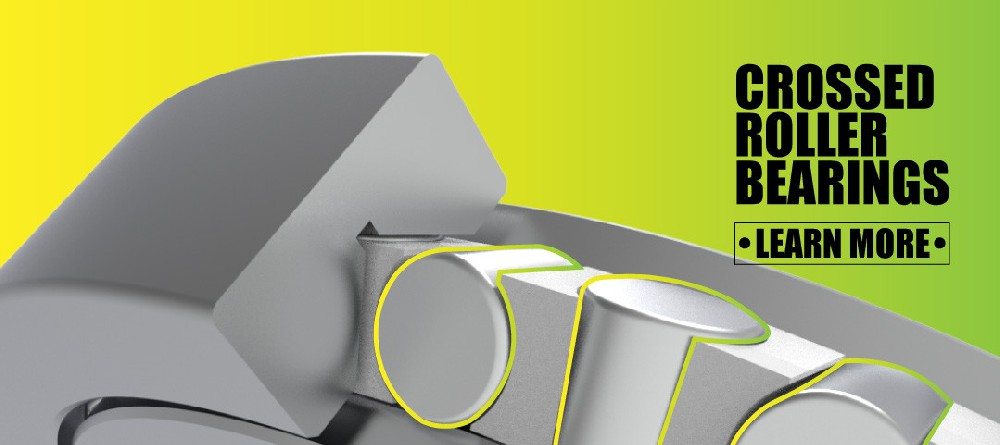
A precision cross roller bearing uses cylindrical rollers positioned alternately at right angles between inner and outer raceways. This arrangement allows the bearing to accept loads from multiple directions within one compact assembly.
For medical motion systems, the main advantage is structural simplicity with high stiffness. Rather than using separate radial and thrust bearings, a cross roller bearing can manage radial load, axial load in both directions, and overturning moment at the same time.
Why Moment Rigidity Matters in Medical Devices
Overturning moment is especially important when a load acts away from the bearing centerline. In a surgical robot joint, for example, the robot arm, instrument, cable bundle, and end effector create leverage. The bearing must resist not only the equipment weight but also the tilting force generated during movement and acceleration.
A high-rigidity cross roller bearing can help maintain:
– Stable tool orientation in robotic-assisted procedures
– Accurate imaging component alignment
– Repeatable movement of patient-positioning modules
– Reduced angular deflection under changing load
– Reliable rotary-platform performance in compact equipment
– Lower structural vibration during slow, controlled movement
This is why cross roller bearings are frequently considered for medical robots, imaging devices, precision measurement systems, automated diagnostic equipment, and compact rotary joints.
Best Medical Applications for Cross Roller Bearings
Cross roller bearings are generally a strong option when the application has one or more of the following characteristics:
– Low-to-medium rotational speed
– High radial, axial, or combined load
– Significant overturning moment
– Strict positioning-repeatability requirements
– Limited installation space
– Oscillating or indexing motion
– A need for simplified bearing architecture
– High stiffness requirements at the output joint or rotary table
A robotic shoulder, elbow, wrist, or waist axis is a typical example. The bearing must support variable loads from different robot poses. It must also maintain alignment while the robot accelerates, decelerates, and stops. In this situation, a cross roller bearing can provide a compact and mechanically rigid solution.
How Angular Contact Bearings Perform in Medical Equipment
An angular contact ball bearing uses balls that contact the inner and outer raceways at an angle. This contact angle enables the bearing to support both radial load and axial load in one direction. For bidirectional axial loading, designers often use two bearings in a matched arrangement.
Common arrangements include:
– Back-to-back arrangement: Delivers high moment stiffness and a wide support span.
– Face-to-face arrangement: Can accommodate certain alignment conditions.
– Tandem arrangement: Increases axial load capacity in one direction.
– Duplex or matched pairs: Supports controlled preload and predictable accuracy.
In a medical precision motion system, angular contact bearings are particularly valuable when speed, smoothness, and low heat generation matter more than carrying large overturning moment in a single compact bearing.

Strengths of Angular Contact Bearings
Properly selected angular contact bearings can provide:
– High-speed rotational capability
– Low friction compared with many roller-bearing arrangements
– Good running smoothness
– Accurate shaft support
– Controlled axial stiffness through preload
– Low noise when manufacturing quality and lubrication are well matched
– Flexible arrangement options for spindles and motor shafts
Medical equipment such as dental handpiece spindles, laboratory centrifuges, high-speed diagnostic motors, pump drives, precision optical scanning systems, and compact instrument spindles may benefit from angular contact bearing arrangements.
The key engineering lesson is that angular contact bearings are rarely selected as isolated components. Their performance depends heavily on the bearing pair, preload method, housing geometry, shaft fit, lubrication, and thermal behavior.
Cross Roller Bearing vs Angular Contact Bearing: Load and Stiffness
The most important difference between the two designs is how they respond to combined load and tilt.
A cross roller bearing distributes load through multiple cylindrical rollers. Its geometry allows one bearing to support radial load, axial force in both directions, and moment load. This makes it highly attractive for direct-drive rotary axes and joints where structural rigidity affects positioning performance.
Angular contact bearings support combined radial and axial loads, but their moment capacity typically depends on the spacing and arrangement of multiple bearings. A back-to-back pair can provide excellent support, but it usually requires more axial installation length than a single cross roller bearing.
Practical Selection Rule
Choose a cross roller bearing when the axis must resist tilting, support a cantilevered load, or combine several load directions in a compact rotary structure.
Choose angular contact bearings when the shaft rotates at high speed and the application allows a properly designed paired-bearing arrangement with controlled preload.
For example, consider two medical devices:
– A compact surgical robot wrist must hold a tool with stable orientation while changing position. The wrist experiences radial load, axial load, and substantial moment load. A cross roller bearing is often the more natural starting point.
– A high-speed dental spindle must rotate smoothly at very high speed with minimal heat and vibration. A matched angular contact bearing set is often the more suitable starting point.
Speed, Friction, and Thermal Control
High speed changes the bearing-selection conversation. As speed rises, lubrication shear, cage behavior, preload, centrifugal effects, friction, and heat generation become increasingly important.
Angular contact ball bearings are widely used in high-speed precision applications because ball contacts generally produce lower rolling friction than line-contact roller designs. Their preload can also be optimized for stiffness without unnecessarily increasing heat, provided the speed range and thermal expansion are correctly modeled.
Cross roller bearings can deliver excellent rotational accuracy and compact stiffness, but they require careful speed evaluation. At higher speeds, the roller contact condition, lubrication film, preload or clearance, cage design, and heat dissipation must all be considered.
Questions to Ask Before Selecting for Speed
1. What is the maximum continuous rotational speed?
2. What is the maximum intermittent speed?
3. Is the motion continuous, oscillating, indexed, or reversing?
4. What is the acceleration and deceleration profile?
5. What ambient temperature and internal heat sources exist?
6. Is the system sealed against fluid, dust, disinfectant vapor, or washdown exposure?
7. What lubrication life is required between service intervals?
8. Is there a permissible temperature-rise limit near sensitive electronics, optics, or patient-contact zones?
A bearing that meets load requirements but produces excess heat can still be the wrong choice. In medical equipment, thermal growth can affect encoder alignment, optical calibration, imaging accuracy, and instrument handling.
Precision Is More Than Bearing Accuracy Grade
Design teams sometimes specify a high-precision bearing and assume the final mechanism will automatically achieve high positioning accuracy. In practice, the bearing is only one part of the system.
Final motion precision depends on:
– Bearing radial runout and axial runout
– Rotational torque consistency
– Bearing stiffness under real load
– Housing roundness and flatness
– Shaft geometry and fit tolerance
– Mounting-bolt torque sequence
– Gear, belt, reducer, or direct-drive motor error
– Encoder resolution and installation accuracy
– Structural deflection of the surrounding frame
– Lubricant type and temperature stability
For high-precision medical motion, engineers should define the allowable error at the point of use. A robot end effector, imaging detector, laser head, or instrument tip may be far from the bearing center. Even small angular deflection at the bearing can become a larger positional error at the working point.
An Expert Method: Start With the Error Budget
Before choosing between a cross roller bearing and an angular contact bearing, create an error budget.
1. Define the allowable final position and angular error.
2. Identify the distance between the bearing axis and the critical working point.
3. Estimate the maximum radial, axial, and moment loads.
4. Establish the permissible deflection under those loads.
5. Assign error allowances to the bearing, housing, shaft, drive system, encoder, and assembly process.
6. Test the assembled system, not only the individual bearing.
This approach prevents a frequent mistake: selecting a premium bearing while overlooking a flexible housing or poorly controlled mounting surface.
Installation Quality Can Determine Bearing Performance
In precision medical equipment, mounting conditions can affect bearing performance as much as the bearing specification itself.
A cross roller bearing requires especially careful attention to mounting-face flatness, concentricity, support rigidity, bolt tightening sequence, and clamping force. Uneven support can distort the raceway and cause uneven torque, reduced accuracy, noise, or localized overload.
Angular contact bearings require careful control of preload, shoulder geometry, spacer dimensions, fit selection, and thermal expansion. Excess preload may increase stiffness but also raises torque and temperature. Insufficient preload may allow vibration, axial movement, or poor repeatability.
Installation Checklist for Medical Motion Assemblies
– Confirm housing and shaft tolerances before assembly.
– Check support-face flatness and runout.
– Keep assembly areas clean and free from abrasive contamination.
– Use controlled tightening torque and a cross-pattern sequence where applicable.
– Avoid striking rings through rolling elements during installation.
– Verify starting torque after assembly.
– Measure radial and axial runout at the functional output.
– Conduct thermal and vibration checks at operating speed.
– Record inspection results for traceability and process improvement.
For production medical devices, it is also wise to validate the bearing assembly after repeated motion cycles, temperature exposure, transport vibration, and expected cleaning or environmental conditions.
Lubrication and Environmental Compatibility
Lubrication is a performance variable, not a maintenance afterthought. The correct lubricant must protect rolling contact surfaces while remaining compatible with speed, temperature, sealing, cleaning requirements, and the intended service interval.
Medical equipment may operate in environments that include dust control, disinfectant exposure, moderate humidity, temperature cycling, or strict noise limits. The bearing system may need specialized seals, carefully selected grease, low-outgassing materials, or controlled cleanliness procedures depending on the device category.
When reviewing lubrication requirements, evaluate:
– Grease base oil viscosity
– Thickener type
– Temperature range
– Oxidation resistance
– Corrosion protection
– Water resistance
– Noise characteristics
– Compatibility with seals and adjacent plastics
– Relubrication accessibility
– Expected operating life under the real duty cycle
For high-speed angular contact bearings, grease quantity and distribution can strongly influence temperature and torque. For cross roller bearings, lubrication should support stable motion while avoiding contamination and excessive friction under reversing or oscillating movement.
A Decision Framework for Medical Equipment Designers
Use this simplified decision path during early-stage concept development.
Select a Cross Roller Bearing When:
– The mechanism carries combined radial, axial, and moment loads.
– The load is cantilevered away from the rotation center.
– High tilting stiffness is critical.
– The device has a compact axial envelope.
– The motion is slow, intermittent, oscillating, or precision-indexed.
– A single bearing should replace a multi-bearing arrangement.
– The equipment includes a robotic joint, rotary stage, compact turntable, or direct-drive axis.
Select Angular Contact Bearings When:
– Rotational speed is a central design requirement.
– Low friction and thermal control are essential.
– The shaft can accommodate a paired or matched bearing arrangement.
– Controlled preload can be specified and maintained.
– The primary need is spindle-like support rather than compact moment capacity.
– The application includes a high-speed motor, pump, centrifuge, dental instrument, or optical scanning shaft.
Consider a Hybrid System When:
Some advanced medical devices use both bearing types in different locations. For example, a robotic imaging platform may use cross roller bearings at a high-moment rotational joint while using high-precision angular contact bearings inside a high-speed motor or instrument spindle.
This is not a compromise. It is often the most efficient way to match each motion axis with the bearing design that best fits its operating conditions.
Work With a Bearing Partner Early
The best bearing decision is made before the mechanical envelope, motor size, reducer ratio, and housing structure become fixed. Early technical collaboration makes it easier to balance rigidity, speed, preload, mounting accuracy, service life, cost, and manufacturability.
Henan Yuwei Industrial Technology Co., Ltd. provides precision cross roller bearing and angular contact ball bearing solutions for applications requiring high rigidity, high precision, high speed, or long service life. The company supports custom bearing requirements for robotics, automation, precision instruments, rotary platforms, reducers, and specialized equipment.
To evaluate the right bearing for your medical precision motion system, prepare a technical request containing the bore and outer diameter limits, bearing height, load spectrum, operating speed, rotation angle, duty cycle, required accuracy, installation design, lubrication environment, and target service life. A complete load-and-motion profile leads to a more reliable recommendation than a size-only inquiry.
Contact Yuwei Bearing with your drawings, load data, and operating conditions to discuss a cross roller bearing or angular contact bearing solution tailored to your medical equipment project.
FAQ
1. Is a cross roller bearing better than an angular contact bearing for a surgical robot?
A cross roller bearing is often a strong choice for surgical robot joints because it can carry radial load, axial load, and overturning moment in one compact component. However, the final decision should be based on the joint speed, arm length, tool load, required rigidity, mounting structure, and motion profile.
2. Can angular contact bearings handle axial loads in both directions?
A single angular contact bearing is designed to support axial load mainly in one direction. To support axial load in both directions, engineers normally use a matched pair or a multi-bearing arrangement, such as back-to-back or face-to-face mounting.
3. Why is preload important in angular contact bearings?
Preload removes internal clearance and increases stiffness, which can improve shaft positioning and vibration behavior. Excessive preload, however, can increase friction, heat, and wear. Preload must be selected according to speed, load, accuracy, and thermal conditions.
4. Are cross roller bearings suitable for high-speed medical equipment?
They can be suitable for certain high-precision rotating systems, but speed must be assessed carefully. High-speed use requires attention to lubrication, heat dissipation, cage design, mounting accuracy, load distribution, and allowable torque. For extremely high-speed spindle applications, angular contact bearings are often more appropriate.
5. Which bearing is more compact for a high-moment rotary axis?
A cross roller bearing is usually more compact because it can support radial, axial, and moment loads within one bearing. An angular contact bearing solution may require two bearings and a defined spacing to achieve comparable moment support.
6. What information should be sent to a bearing manufacturer for selection?
Provide the application drawing, available installation dimensions, radial load, axial load, overturning moment, operating speed, acceleration, motion range, duty cycle, target accuracy, environment, lubrication preference, service-life target, and expected production quantity.
7. Can bearing installation affect medical device precision?
Yes. Housing flatness, shaft and bore fit, bolt torque, preload, cleanliness, lubrication, and assembly alignment can materially affect torque, runout, vibration, temperature, and service life. A precision bearing should always be paired with a precision mounting process.
References
1. [Henan Yuwei Industrial Technology Co., Ltd. — Super Precision Bearing Manufacturer]
2. [Yuwei Bearing — Precision Cross Roller and Angular Contact Ball Bearing Solutions]
3. [Crossed Roller Bearings and Angular Contact Ball Bearings for Precision Motion Systems]
4. [SKF — Angular Contact Ball Bearings]
5. [Schaeffler — Angular Contact Ball Bearings]
6. [THK — Cross-Roller Ring Technical Information]
7. [NSK — Crossed Roller Bearings]
Hot Tags: Cross Roller Bearing, Angular Contact Bearing, Precision Bearing Manufacturer, Medical Equipment Bearings, Medical Robot Bearings, High Precision Bearings, Crossed Roller Bearings, Angular Contact Ball Bearings, Robotic Joint Bearings, Precision Motion Systems