Content Menu
● Why Bearing Type Selection Matters
● Ball Bearings: Efficient and Versatile
>> Main Advantages of Ball Bearings
>> Main Limitations of Ball Bearings
● Angular Contact Ball Bearings: High Speed With Controlled Precision
>> Advantages of Angular Contact Ball Bearings
>> Disadvantages of Angular Contact Ball Bearings
● Roller Bearings: Strong Load Support, With Trade-Offs
>> Advantages of Roller Bearings
>> Disadvantages of Roller Bearings
● Cross Roller Bearings: Compact Rigidity for Complex Loads
>> Why Cross Roller Bearings Are Used in Precision Equipment
>> Advantages of Cross Roller Bearings
>> Limitations of Cross Roller Bearings
● Plain Bearings: Simple Solutions for Specific Conditions
>> Advantages of Plain Bearings
>> Disadvantages of Plain Bearings
● Magnetic and Air Bearings: Specialized Precision Options
>> Advantages
>> Limitations
● Bearing Selection Matrix by Application Need
● A Practical Bearing Selection Process
>> 1. Define the Motion and Load Condition
>> 2. Confirm Accuracy and Stiffness Targets
>> 3. Evaluate Installation Space
>> 4. Select Lubrication and Sealing Strategy
>> 5. Verify Mounting and Preload Requirements
>> 6. Validate Through Testing
● Common Bearing Selection Mistakes
● Precision Bearing Support for Advanced Equipment
>> What is the main advantage of a cross roller bearing?
>> Are angular contact ball bearings suitable for high-speed applications?
>> How do I choose between a cross roller bearing and an angular contact ball bearing?
>> Can a bearing carry both axial and radial loads?
>> Why do precision bearings fail prematurely?
>> What information should I provide when requesting a bearing quotation?
Selecting the right bearing type is not simply a catalogue decision. In robotics, machine tools, radar systems, rotary tables and precision medical equipment, the bearing directly influences stiffness, positioning accuracy, speed, torque, service life and total operating cost.
At Henan Yuwei Industrial Technology Co., Ltd., our engineering work with precision cross roller bearings and angular contact ball bearings starts with the complete operating condition—not only the bearing dimensions. A bearing that performs well in a low-speed conveyor may be unsuitable for a high-rigidity robot joint, a hollow rotary platform, a DD motor or a high-speed spindle.
This guide explains the advantages and disadvantages of major bearing types, then provides a practical selection approach for demanding precision-motion applications.

Why Bearing Type Selection Matters
A bearing supports and guides relative motion between machine parts while reducing friction. However, different bearing designs distribute load, manage speed, resist moment loads and accommodate installation errors in very different ways.
Before selecting a bearing, engineers should evaluate:
– Load direction: radial, axial or combined load
– Load magnitude: continuous load, peak load and shock load
– Moment load: overturning moment caused by an offset load
– Required stiffness: resistance to elastic deflection under load
– Rotational speed: including acceleration, deceleration and duty cycle
– Positioning accuracy: runout, axial/radial clearance and repeatability
– Installation space: bore diameter, outer diameter and section height
– Environmental conditions: dust, moisture, temperature, vibration and corrosion
– Lubrication method: grease, oil, oil-air or maintenance-free operation
– Expected working life: including maintenance access and replacement cost
A selection based only on load rating or bearing size can create costly problems later, such as unstable motion, excessive heat, vibration, premature wear or poor robot positioning accuracy.
Ball Bearings: Efficient and Versatile
Ball bearings use rolling balls between inner and outer rings. Because balls contact the raceway at relatively small points, they usually provide low friction and smooth running characteristics.
Main Advantages of Ball Bearings
– Low friction torque, especially at moderate and high speeds
– Good rotational smoothness for compact equipment
– Wide availability across many dimensions and configurations
– Cost-effective design for general industrial applications
– Can support radial, axial or combined loads, depending on the design
– Suitable for motors, pumps, fans, gearboxes and many light-to-medium-duty assemblies
Main Limitations of Ball Bearings
– Lower contact area means lower rigidity than many roller-bearing solutions
– May deform or develop raceway damage under high shock loads
– Limited capacity for large overturning moments in single-bearing arrangements
– High speed can increase heat, vibration and noise if preload or lubrication is poorly controlled
– Misalignment can lead to uneven load distribution and shortened service life
Deep-groove ball bearings are often a practical choice for standard radial loads. However, they are generally not the first choice where a machine requires high axial rigidity, tightly controlled preload or large combined loads.

Angular Contact Ball Bearings: High Speed With Controlled Precision
Angular contact ball bearings are designed so that the line of contact between ball and raceway is angled relative to the bearing axis. This enables the bearing to carry combined radial and axial loads.
They are widely used in high-speed machine-tool spindles, servo motors, ball screw supports, precision pumps, robotic actuators and high-speed rotating equipment.
Advantages of Angular Contact Ball Bearings
– Support combined radial and axial loads
– Suitable for high-speed operation
– Available with different contact angles for different axial-load and speed requirements
– Can be arranged in back-to-back, face-to-face or tandem configurations
– Preload can improve axial stiffness, rotational accuracy and repeatability
– Compact designs are available for space-constrained assemblies
For example, a matched back-to-back pair can provide higher moment stiffness than a single bearing. This is useful when a shaft is exposed to axial loading from both directions or when a motor-driven mechanism experiences reversing movement.
Disadvantages of Angular Contact Ball Bearings
– Incorrect preload can cause excess heat, torque and early failure
– Installation accuracy is critical, especially in high-speed applications
– Single-row designs typically support axial load primarily in one direction
– Performance is sensitive to lubrication condition, contamination and mounting force
– They may require matched pairing when the application needs bidirectional axial support
For high-speed equipment, bearing selection should consider not only maximum RPM but also bore diameter, lubrication type, cage design, preload level and heat dissipation. A bearing that is theoretically rated for a target speed may still run too hot if the complete shaft system is not properly designed.
Roller Bearings: Strong Load Support, With Trade-Offs
Roller bearings replace balls with cylindrical, tapered, spherical or needle rollers. The larger line contact between rollers and raceways generally gives roller bearings higher load capacity and stiffness than ball bearings of similar size.
Advantages of Roller Bearings
– High radial load capacity
– Strong resistance to deformation under heavy load
– Good choice for heavy machinery, gearboxes, rolling mills and industrial transmission systems
– Certain designs can support substantial axial loads
– Cylindrical roller arrangements can offer excellent radial stiffness
– Tapered roller bearings can carry combined radial and axial loads
Disadvantages of Roller Bearings
– Often create higher friction than ball bearings, especially at high speeds
– Require more careful attention to lubrication and heat generation
– Some types have limited tolerance for misalignment
– Can occupy more axial or radial space than compact ball-bearing solutions
– Installation, adjustment and preload settings may be more demanding
Roller bearings are highly effective where heavy loads are the primary concern. Yet a conventional roller-bearing arrangement may not provide the compact structure or integrated moment capacity required for a robotic joint or precision rotary table.
Cross Roller Bearings: Compact Rigidity for Complex Loads
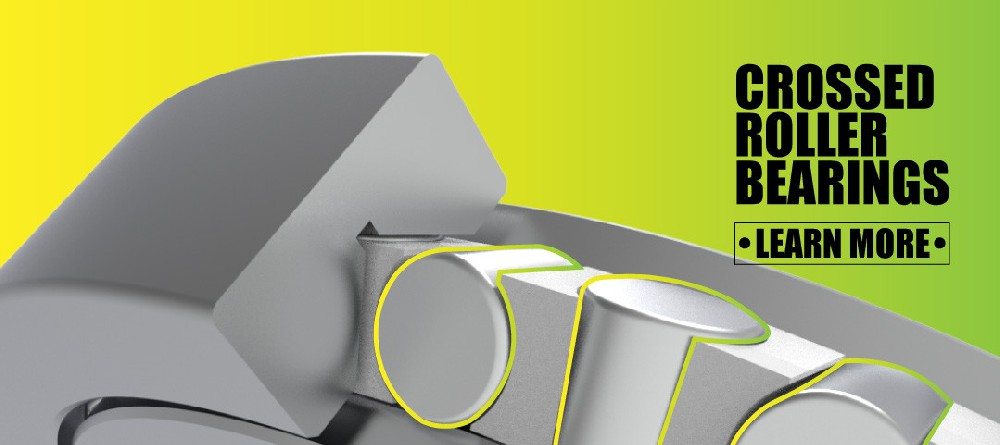
Cross roller bearings use cylindrical rollers arranged alternately at right angles between inner and outer rings. This geometry allows one bearing to support radial load, axial load from both directions and overturning moment.
For precision rotating systems, this is one of the most important differences between cross roller bearings and conventional bearing arrangements.
Why Cross Roller Bearings Are Used in Precision Equipment
A properly selected cross roller bearing can replace a multi-bearing arrangement in applications where installation space is limited but rigidity requirements are high.
Typical applications include:
– Industrial robots and collaborative robots
– Humanoid, quadruped and service robots
– SCARA robot rotary joints
– Harmonic reducers and planetary reducers
– Machine-tool rotary tables
– Hollow rotary platforms
– DD motors and torque motors
– Radar and communications equipment
– Medical imaging and surgical equipment
– Precision measuring instruments
– Semiconductor and automation equipment
Advantages of Cross Roller Bearings
– Carry radial, axial and moment loads simultaneously
– Offer high rigidity in a compact envelope
– Help simplify machine structure by reducing the number of separate bearings
– Suitable for low-speed, oscillating and intermittent rotary motion
– Can provide excellent rotational accuracy when manufactured and installed correctly
– Thin-section versions help reduce weight and installation space
– Useful for hollow-shaft systems and compact rotary platforms
Limitations of Cross Roller Bearings
– Usually not the best solution for extremely high-speed rotation
– Installation surfaces must have sufficient flatness, rigidity and geometric accuracy
– Mounting screw torque and tightening sequence can affect running accuracy
– Lubrication selection is important, particularly for high load or frequent oscillation
– Contamination can damage raceways and rollers, reducing precision and service life
– A low-priced bearing may create higher total costs if its dimensional consistency is poor
For a robot joint, the bearing is often required to resist radial load from the arm, axial force from movement direction changes and moment load caused by the distance between the payload and rotational center. This is exactly where a high-rigidity cross roller bearing can offer a significant structural advantage.
Plain Bearings: Simple Solutions for Specific Conditions
Plain bearings, also called sleeve bearings or bushings, operate through sliding contact rather than rolling elements. They may be metallic, polymer-based, composite or self-lubricating.
Advantages of Plain Bearings
– Simple structure and economical cost
– Can operate in dirty, wet or corrosive conditions with appropriate materials
– Good vibration damping characteristics
– Available in self-lubricating materials
– Suitable for oscillating motion and low-speed applications
– Can be useful where noise reduction is important
Disadvantages of Plain Bearings
– Higher friction than rolling bearings in many operating conditions
– Wear rate can increase significantly under poor lubrication or high load
– Less suitable for high-precision rotational positioning
– More heat may be generated during continuous high-speed operation
– May seize or gall if material pairing and lubrication are poorly selected
Plain bearings remain useful in agricultural equipment, construction machinery, low-speed pivot points and certain maintenance-free mechanisms. They are generally less suitable for applications that require precise rotational accuracy and very low starting torque.
Magnetic and Air Bearings: Specialized Precision Options
Magnetic bearings and air bearings are advanced solutions for highly specialized equipment.
Magnetic bearings use electromagnetic forces to support a rotating shaft without mechanical contact. Air bearings use a thin pressurized air film to separate surfaces.
Advantages
– Very low friction
– Minimal mechanical wear during normal operation
– Potential for extremely high speed
– High precision for selected applications
– Suitable for ultra-clean or highly controlled environments
Limitations
– High equipment cost
– Complex control, air-supply or power-system requirements
– Lower tolerance for unstable environments or poor maintenance
– More challenging integration than conventional rolling bearings
– Often unnecessary for mainstream industrial machinery
These technologies are valuable in specialized metrology systems, semiconductor equipment, high-speed turbomachinery and advanced scientific instruments. For most industrial robots, reducers and machine tools, precision rolling bearings remain the more practical and economical choice.
Bearing Selection Matrix by Application Need
| Application requirement | Usually suitable bearing solution | Key reason |
|---|---|---|
| High-speed spindle | High-precision angular contact ball bearing | Low friction and controlled preload |
| Robot joint with high moment load | Precision cross roller bearing | High rigidity with radial, axial and moment capacity |
| Heavy radial load | Cylindrical roller bearing | High radial load capability |
| Combined radial and axial load | Angular contact or tapered roller bearing | Supports combined loading |
| Compact hollow rotary platform | Thin-wall cross roller bearing | Compact structure and high moment stiffness |
| Low-speed oscillating pivot | Plain bearing or bushing | Simple, durable and cost-efficient |
| Clean-room precision stage | Air bearing | Very low friction and high precision |
| Active vibration control system | Magnetic bearing | Contact-free support and controllability |
This table is a starting point, not a final specification. The best bearing design depends on the complete system—including housing stiffness, shaft fit, preload, lubrication and assembly quality.
A Practical Bearing Selection Process
A reliable bearing choice should follow a structured engineering process.
1. Define the Motion and Load Condition
Identify whether the mechanism rotates continuously, oscillates, indexes or reverses direction frequently. Measure radial force, axial force, moment load, speed, acceleration and duty cycle.
Do not ignore peak loads. A robotic arm may operate at modest average load but experience high transient forces during rapid start-stop movement or emergency braking.
2. Confirm Accuracy and Stiffness Targets
Define the acceptable radial runout, axial runout, tilt error, backlash and positioning repeatability.
For example, a radar antenna platform and a precision rotary table may both rotate slowly, but their required stiffness and positioning accuracy can be dramatically different.
3. Evaluate Installation Space
Record the maximum bore diameter, outer diameter, axial height and hollow-shaft requirement. A compact cross roller bearing may reduce overall assembly dimensions compared with a conventional multi-bearing arrangement.
4. Select Lubrication and Sealing Strategy
Lubrication is not an afterthought. Inadequate lubrication, contamination, overload and improper installation are widely recognized contributors to premature bearing damage. Water contamination can also seriously affect lubricant performance and bearing life.
Consider:
– Grease or oil lubrication
– Operating temperature range
– Relubrication accessibility
– Seal design
– Dust, moisture and chemical exposure
– Cleanliness during assembly
5. Verify Mounting and Preload Requirements
Use accurate shaft and housing seats. Follow recommended fitting tolerances, tightening torque and tightening sequence. For precision cross roller bearings, uneven mounting-surface flatness or improper screw tightening can negatively affect rotational smoothness and accuracy.
6. Validate Through Testing
For demanding equipment, conduct prototype validation under realistic loading, speed, temperature and motion conditions. Record temperature rise, starting torque, vibration, noise, runout and lubricant condition.
This approach is particularly important for customized bearings used in robotics, radar vehicles, medical equipment and high-precision automation systems.
Common Bearing Selection Mistakes
Even a premium bearing can fail early if the surrounding system is not properly controlled.
– Selecting by outside dimensions only
– Ignoring moment load in a cantilevered mechanism
– Using excessive preload to “solve” stiffness problems
– Choosing a high-speed bearing without checking thermal conditions
– Neglecting housing rigidity and mounting-surface flatness
– Using unsuitable grease or mixing incompatible lubricants
– Installing bearings in contaminated assembly conditions
– Applying force through rolling elements during mounting
– Failing to define a realistic duty cycle and peak load profile
In practice, bearing performance depends on the complete assembly. The bearing, shaft, housing, seals, lubricant, preload and installation process work as one system.
Precision Bearing Support for Advanced Equipment
Henan Yuwei Industrial Technology Co., Ltd. develops and manufactures precision cross cylindrical roller bearings, high-rigidity cross roller bearings, thin-wall cross roller bearings, double-row cross roller bearings, high-precision angular contact ball bearings, high-speed angular contact ball bearings and long-life angular contact ball bearing series.
Our products are designed for advanced applications including robotics, AGV systems, precision machinery, industrial rotary tables, numerical-control machine tools, radar equipment, medical devices, DD motors, harmonic reducers and planetary reducers.
Through long-term technical cooperation with universities and research institutions, our team supports the development of specialized bearing solutions for challenging applications. Whether your project requires a compact robot-joint bearing, a high-rigidity rotary-table bearing or a high-speed angular contact bearing arrangement, we can help evaluate the load condition, installation space and precision target.
Contact Henan Yuwei Industrial Technology Co., Ltd. today to discuss your bearing model, drawings, operating conditions and quantity requirements. Our engineering team can recommend a suitable precision bearing solution for your equipment.
Frequently Asked Questions
What is the main advantage of a cross roller bearing?
A cross roller bearing can support radial loads, axial loads from both directions and overturning moments within one compact bearing structure. This makes it especially suitable for robot joints, rotary tables, reducers and precision indexing systems.
Are angular contact ball bearings suitable for high-speed applications?
Yes. High-precision angular contact ball bearings are commonly used for high-speed applications because they offer low friction and support combined loads. Proper preload, lubrication, cage selection and heat control are essential.
How do I choose between a cross roller bearing and an angular contact ball bearing?
Choose a cross roller bearing when the application requires high rigidity, compact installation and strong resistance to overturning moment. Choose an angular contact ball bearing when high rotational speed, controlled preload and combined radial-axial loading are the primary requirements.
Can a bearing carry both axial and radial loads?
Yes. Angular contact ball bearings, tapered roller bearings and cross roller bearings can all support combined loading. The actual load capacity depends on bearing design, contact angle, arrangement, preload and operating conditions.
Why do precision bearings fail prematurely?
Common causes include improper lubrication, contamination, overload, poor installation, incorrect preload, misalignment and insufficient housing rigidity. These factors can damage raceways, rolling elements and lubricant films.
What information should I provide when requesting a bearing quotation?
Provide the bearing model or drawing, quantity, application, shaft and housing dimensions, radial/axial/moment loads, speed, precision requirements, lubrication method, operating environment and expected service life. The more complete the information, the more accurate the bearing recommendation can be.
References
1. SKF. “[Bearing Installation and Maintenance Guide].” Guidance on bearing selection factors, alignment and relubrication considerations.
2. Timken. “[Bearing Killers: Technical White Paper].” Information on premature bearing damage related to lubrication, contamination, overload and improper handling.
3. Timken. “[Bearing Damage Analysis].” Technical overview of common bearing-damage modes and contributing operating conditions.
4. NSK. “[Rolling Bearings for Industrial Machinery].” General reference for rolling-bearing selection and application design.
5. Timken. “[Bearing Performance in Debris-Contaminated Lubrication Conditions].” Research discussing the impact of debris contamination on bearing performance and service life.
Hot Tags: Cross Roller Bearings, Angular Contact Ball Bearings, Precision Bearings, Industrial Robot Bearings, High Precision Bearings, Robot Joint Bearings, Rotary Table Bearings, Thin Section Bearings, High Speed Angular Contact Bearings, Bearing Manufacturer