Content Menu
● Understanding robot arm joint requirements
● What is an angular contact ball bearing?
● What is a cross roller bearing?
● Core comparison: ball vs cross roller in robot arm joints
>> Load capacity and stiffness
>> Rotational speed and friction
● Application scenarios in robot arm joints
● Expert design checklist: choosing between the two
● Why Henan Yuwei’s bearing portfolio fits high-precision robot arm joints
● Practical selection guide for robot arm designers
● Optimize your robot arm joints with tailored bearing solutions
● FAQ
Angular contact ball bearings deliver higher speed and cost-efficiency, while cross roller bearings provide superior rigidity and accuracy for demanding robot arm joints. The right choice depends on your joint’s load profile, precision targets, available space and budget, not on a single performance metric.

Understanding robot arm joint requirements
Designing joints for modern industrial, collaborative and humanoid robots means balancing four critical factors: multi-directional loads, positional accuracy, rigidity and lifecycle cost. In articulated arms, each axis must:
– Support radial loads from arm segments and tooling
– Handle axial thrust and tilting moments from acceleration, deceleration and payload changes
– Maintain repeatable positioning over millions of cycles
– Fit into compact housings with integrated motors, gearboxes and encoders
In my work with robotics manufacturers, I see a clear pattern: designers typically choose angular contact ball bearings for high-speed, cost-sensitive joints, and cross roller bearings for high-stiffness, high-precision axes where even micron-level deflection is unacceptable.
What is an angular contact ball bearing?
Angular contact ball bearings use balls as rolling elements and are designed so the load passes through the raceways at a specific contact angle. This geometry allows one bearing to support radial load and axial load in one direction at the same time.
Key characteristics:
– Rolling element: steel balls (point contact with raceways)
– Load direction: radial + one-direction axial; paired bearings handle bidirectional axial loads
– Contact angle: typically 15°–40°, optimized for different mixes of radial and axial loads
– Common arrangements: single row, back-to-back (DB), face-to-face (DF), tandem (DT)
Because of the ball’s point contact, these bearings run with low friction, making them well-suited for high-speed joints such as robot wrists, elbows and rotary axes where smooth, efficient rotation is essential.
What is a cross roller bearing?
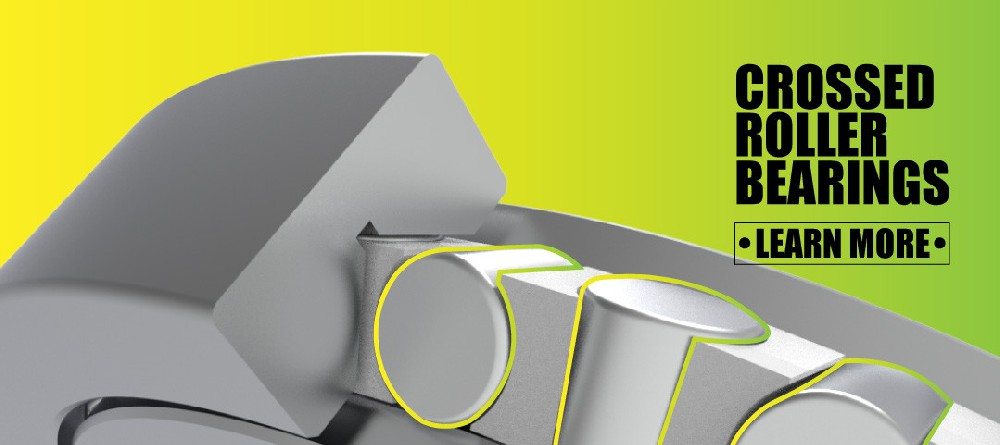
Cross roller bearings use cylindrical rollers arranged at 90° to each other in a single raceway. Each roller alternates orientation, forming an orthogonal pattern that can support radial, axial and moment loads simultaneously.
Key characteristics:
– Rolling element: cylindrical rollers (line contact with raceways)
– Arrangement: rollers alternately crossed at 90°
– Load capacity: radial, axial and tilting moment loads in all directions within one bearing
– Rigidity: typically 3–4× higher than ball bearings for the same envelope size
Because the rollers have line contact, the load spreads over a larger area, resulting in higher stiffness, lower elastic deformation and better resistance to tipping moments, which is crucial in robot shoulder and base joints, precision rotary tables and high-end measurement systems.
Core comparison: ball vs cross roller in robot arm joints
Load capacity and stiffness
– Angular contact ball bearings
– Good radial capacity, strong axial capacity in one direction
– Require pairing (DB/DF) to handle bidirectional axial loads or higher moments
– Stiffness is moderate to high, depending on preload, but limited by point contact
– Cross roller bearings
– Support radial, axial and moment loads at once in one compact bearing
– Deliver extremely high rigidity, minimal elastic deformation and excellent resistance to tilting moments
– Often described as equivalent to two angular contact bearings in terms of load function, but with higher stiffness and better accuracy
In high-precision robot arm joints—especially shoulder, base and key positioning axes—even small angular deflections translate into millimeter-level errors at the end-effector. Here, the higher stiffness and moment capacity of cross roller bearings provide a measurable performance advantage.
Rotational speed and friction
– Angular contact ball bearings
– Lower friction, lower starting torque and excellent high-speed capability
– Ideal for joints with continuous rotation, high duty cycles and fast acceleration, such as pick-and-place wrists and high-speed SCARA axes
– Cross roller bearings
– Higher starting torque and tighter rotational feel due to line contact and preload
– More suitable for low-to-medium speed applications where precision and rigidity outweigh speed
If your robot joint must run at very high speeds or prioritize energy efficiency, angular contact ball bearings are typically the preferred option.
Accuracy and repeatability
– Angular contact ball bearings
– Offer good rotational accuracy for general industrial robots and automation systems
– Under high moment loads or long lever arms, they exhibit more elastic deformation than roller-based designs
– Cross roller bearings
– Designed for sub-micron repeatability and strict positional accuracy targets, often within ±0.01 mm over extended cycles
– Premium models achieve rotational accuracy in the range of 2–5 arcseconds for demanding applications such as semiconductor handling and medical robotics
For robot arms used in precision assembly, surgical robots, optical alignment or semiconductor tooling, the accuracy profile of cross roller bearings is a strong fit.
Space and integration
– Angular contact ball bearings
– Often require paired installation, which increases axial length or overall package size
– Widely available with standardized dimensions, simplifying sourcing and integration
– Cross roller bearings
– Compact and lightweight for the level of load and stiffness they provide
– Can be bolted directly to housings and rotors, offering flexible mounting in limited space environments such as robot wrists and hollow rotary platforms
Where design teams need high stiffness in tight envelopes—for example, in hollow-shaft robot joints carrying cables, hoses or waveguides through the center—cross roller bearings are often chosen.
Cost and lifecycle
– Angular contact ball bearings
– Generally more economical, especially for standard sizes and high-volume production
– Well-suited to cost-sensitive robot series and mid-range automation solutions
– Cross roller bearings
– Typically higher in upfront cost due to more demanding manufacturing tolerances and assembly complexity
– Offer better long-term stability in accuracy under repeated loading, which can reduce recalibration and maintenance costs in premium systems
For applications where total cost of ownership and precision over many years matter more than initial price, cross roller bearings often justify the investment.
Application scenarios in robot arm joints
From a practical design perspective, engineers rarely choose bearings in isolation—they select them based on joint function and system-level requirements. Typical patterns include:
– Shoulder and base joints
– High payloads, strong moments, demanding stiffness
– Often benefit from cross roller bearings to minimize deflection and backlash
– Elbow and wrist joints
– Mixed speed and precision requirements, moderate loads
– Frequently use angular contact ball bearings, sometimes paired, for balanced performance
– End-of-arm tooling interfaces and small rotary axes
– Need compact size, good rigidity and precise positioning
– Depending on payload and duty cycle, may use either cross roller or angular contact designs
Henan Yuwei Industrial Technology Co., Ltd. supplies both high-precision angular contact ball bearings and multiple families of cross roller bearings—including thin-section, high-rigidity and double-row configurations—specifically tailored for robotic arm joints, hollow rotary tables, DD motors, and precision reducers in applications ranging from four-legged robots and exoskeletons to AGVs, radar systems and CNC turntables. This dual offering allows integrators to standardize on one supplier while still optimizing each axis with the most suitable bearing type.

Expert design checklist: choosing between the two
From a bearing design and selection standpoint, I recommend a structured evaluation based on the following criteria:
1. Define load cases clearly
– Maximum radial load, axial load, and tilting moment
– Dynamic load variations during acceleration and deceleration
– Safety factors required for overload scenarios
2. Quantify precision requirements
– Positional accuracy at the end-effector (e.g., ±0.02 mm vs ±0.002 mm)
– Allowable angular deflection in each joint
– Backlash and repeatability targets over lifecycle
3. Map speed and duty cycle
– Rotational speed profiles for each joint
– Continuous vs intermittent operation
– Cycle time requirements for the robot cell
4. Assess integration constraints
– Available space in radial and axial directions
– Housing stiffness and mounting options
– Need for hollow-shaft configuration or direct motor coupling
5. Evaluate lifecycle and cost trade-offs
– Expected operating hours per year
– Acceptable maintenance intervals and recalibration frequency
– Balance between upfront investment and long-term performance
When stiffness and precision at the tool center point dominate—such as in laser processing, medical intervention, micro-assembly or metrology robots—cross roller bearings usually come out ahead. When speed, cost and flexible configurations are the primary drivers, angular contact ball bearings are typically preferable.
 x
Why Henan Yuwei’s bearing portfolio fits high-precision robot arm joints
Henan Yuwei Industrial Technology Co., Ltd. focuses on precision cross roller bearings and high-precision angular contact ball bearings developed in collaboration with universities and research institutes. The company has completed multiple research and test projects to create bearings for:
– Specialized robots (four-legged, service, industrial, collaborative, SCARA, medical, exoskeleton and humanoid types)
– Special vehicles and radar platforms
– High-precision measurement instruments, DD motors, harmonic and planetary reducers
This R&D foundation allows Henan Yuwei to:
– Offer thin-wall cross roller bearings for compact robotic wrists and hollow rotary platforms
– Supply high-rigidity cross roller bearings for base and shoulder joints that demand minimal deflection
– Deliver high-speed, long-life angular contact ball bearings for axes where speed and durability are critical
Combined with long-term partnerships and wide global deployment across North America, Europe and Asia, these bearings provide reliable, high-value solutions for robot manufacturers who need both types of bearings in a single, coordinated portfolio.
Practical selection guide for robot arm designers
To make this comparison actionable, here is a condensed decision guideline for high-precision robot arm joints:
– Choose cross roller bearings when:
– Joint stiffness and positional accuracy are critical
– Multi-direction loads (radial, axial, moment) must be handled by one bearing
– Space is limited but high load capacity and rigidity are required
– The application involves precision motion such as surgery, semiconductor processing or metrology
– Choose angular contact ball bearings when:
– High rotational speeds and smooth, low-friction motion are essential
– Budget constraints favor more economical bearing options
– Precision requirements are high but not at sub-micron levels
– Joint designs can accommodate paired bearings to manage axial loads and moments
For robot arm projects that span multiple platforms—from industrial manipulators to mobile service robots—many engineering teams adopt a hybrid strategy, using cross roller bearings in the most critical joints and angular contact ball bearings elsewhere. Henan Yuwei’s range of cross roller and angular contact bearings is well-suited to support this mixed architecture, enabling consistent quality and simplified sourcing.
Optimize your robot arm joints with tailored bearing solutions
If you are designing or upgrading high-precision robot arm joints, you do not have to choose blindly between angular contact ball bearings and cross roller bearings. By sharing your load profiles, precision targets and space constraints, Henan Yuwei’s engineering team can help you:
– Select the optimal bearing type and configuration for each axis
– Balance stiffness, speed and cost across the entire arm
– Integrate specialized bearing designs into robot joints, hollow rotary platforms and precision reducers
Henan Yuwei Industrial Technology Co., Ltd. welcomes inquiries from robot manufacturers, system integrators and research institutions. With deep experience in robotics bearings, radar systems and precision machinery, we are ready to provide customized bearing solutions that keep your world turning safely and precisely.
FAQ
1. Can one cross roller bearing replace a pair of angular contact ball bearings in a robot joint?
Yes, a single cross roller bearing can often perform the load functions of two angular contact ball bearings, supporting radial, axial and moment loads within one compact assembly. The main benefits are higher stiffness and reduced backlash, at the cost of higher initial investment.
2. Are cross roller bearings always better than angular contact ball bearings for precision robots?
Not always. Cross roller bearings excel when stiffness and moment capacity are dominant requirements, but angular contact ball bearings are better suited to high-speed, cost-sensitive joints where moderate precision is sufficient.
3. Do angular contact ball bearings work in collaborative and service robots?
Yes. In many collaborative and service robots, angular contact ball bearings are widely used in elbows and wrists because they provide a good balance of load capacity, speed and cost while still delivering reliable positioning accuracy.
4. How does preload affect joint performance in these bearings?
Preload increases stiffness and reduces backlash but also raises friction and heat. Both angular contact ball bearings and cross roller bearings are available with different clearance and preload options, allowing designers to tune the joint’s dynamic response and accuracy.
5. What industries benefit most from cross roller bearings in robot arm joints?
Industries such as semiconductor manufacturing, medical robotics, precision assembly, optical equipment, CNC machine tools and metrology benefit strongly from cross roller bearings, thanks to their superior stiffness, sub-micron repeatability and resistance to tilting moments.
References
1. Eureka – “Cross-Roller Bearings for Robot Arms: Achieving Positional Accuracy” – https://eureka.patsnap.com/report-cross-roller-bearings-for-robot-arms-achieving-positional-accuracy
2. JTEKT Koyo – “What Are the Differences Between Bearings?” – https://koyo.jtekt.co.jp/en/bearing-column/bearing_trivia_1st_series/bearing_trivia_1st_series_04.html
3. CCTY Group – “How Bearings Drive Precision in Industrial Robotic Arms” – https://cctygroup.com/how-bearings-drive-precision-in-industrial-robotic-arms/
4. PRS Bearings – “Crossed Roller Bearing vs. Angular Contact Ball Bearing” – https://www.prsbearings.com/a/news/difference-between-crossed-roller-bearings-and-angular-contact-ball-bearings.html
5. PIB Sales – “Complete Solutions for Articulated Arms in Robots” – https://pibsales.com/bearings/complete-solutions-for-articulated-arms-in-robots/
6. HGT Bearing – “Crossed Roller Bearings: The Optimal Solution for Robotic” – https://hgtbearing.com/Crossed-Roller-Bearings-for-Robotic
7. Bearings Direct – “Solving Load and Precision Issues in Robotic Joints” – https://bearingsdirect.com/blog/solving-load-and-precision-issues-in-robotic-joints
8. CCTY Group – “Crossed Roller Bearings I CCTY Precision Design” – https://cctygroup.com/products-for-motion-control/roller-bearings/crossed-roller-bearings/
9. RigBRS Bearing – “Compare from Six Aspects – Crossed Roller vs Ball Bearing” – http://www.rigbrsbearing.com/crossed-roller-vs-ball-bearing/
10. HIWIN – “Crossed Roller Bearings” – https://www.hiwin.com/wp-content/uploads/crossed_roller_bearings-e-1.pdf
11. LKPB Bearing – “Comparison of Crossed Roller Bearings with Other Types of Roller Bearings” – https://lkpbearing.com/comparison-of-crossed-roller-bearings-with-other-5-types-of-roller-bearings/
12. STOBER – “Robotic Arm Joint Design Challenges and Performance Factors” – https://www.stober.com/blog/robotic-arm-joint-design-challenges-and-performance-factors/
Hot Tags: High Precision Robot Bearings, Angular Contact Ball Bearing, Cross Roller Bearing, Robot Arm Joint Design, Industrial Robot Bearing Solutions, Collaborative Robot Bearings, Robotic Rotary Table Bearings, Hollow Shaft Robot Joint Bearings, DD Motor Bearing Integration, Harmonic Reducer Bearing Supplier